
Jeonju Hanok Maeul and the tiled hanok roofs of Jeonju
Published on 09/01/2026 at 19:47 | Editorial responsibility: Rafael Müller, Editor-in-Chief AD HOC NEWS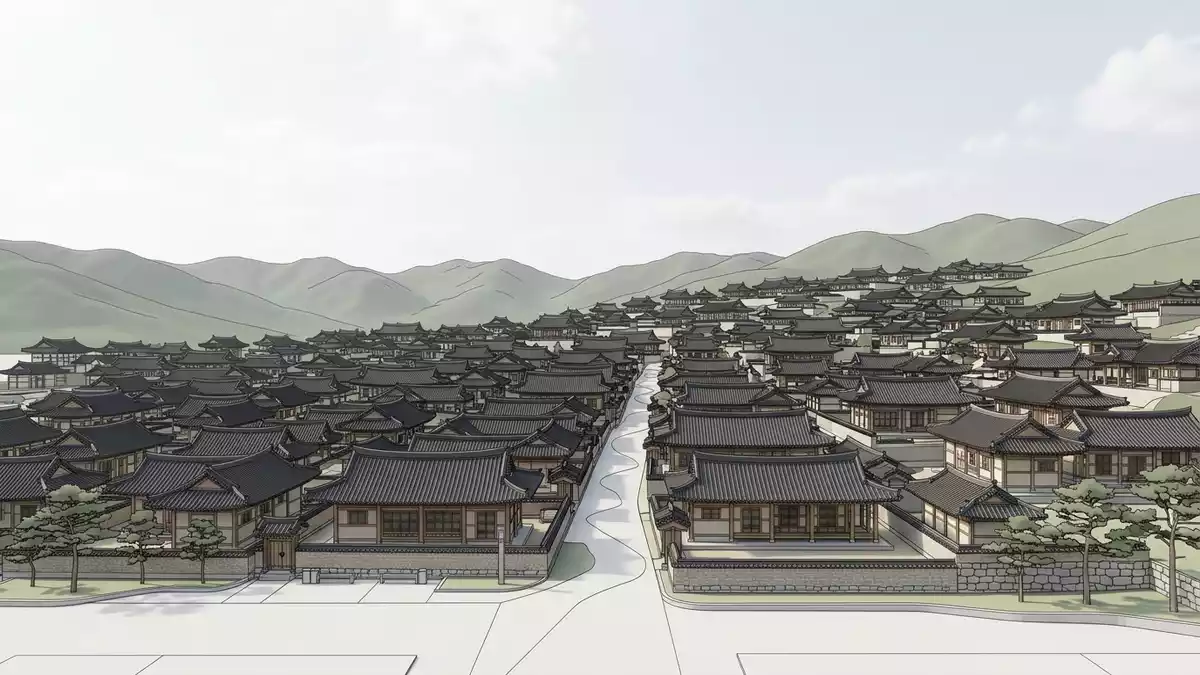
Jeonju Hanok Maeul in Jeonju is a compact neighbourhood where traditional Korean houses cluster into a dense urban village framed by tiled roofs and wooden courtyards. Set in Wansan-gu in North Jeolla Province, the village began to form in the 1910s as Koreans settled Pungnam-dong and Gyo-dong with hanok housing that preserved familiar layouts in an increasingly modern city.development process of Korea's modern housing culture
Hanok roofs and courtyards in an urban cluster
Jeonju Hanok Maeul is one of South Korea’s largest concentrations of hanok, with more than 700 traditional wooden houses grouped together on streets that slope gently towards the Namcheon stream.village contains over 800 Korean traditional houses From above, the tiled roofs form a continuous pattern of dark lines and ridges, broken only by alleys and small inner courtyards that punctuate the grid of buildings.rows of tiled rooftops create a continuous silhouette
Most hanok in the village follow recognisable patterns of Korean domestic architecture, with timber frames, gently pitched roofs and rooms arranged around enclosed yards rather than facing the street. The low height of the houses keeps the skyline relatively level, so the main vertical accents are trees, small pavilions and occasional gate structures rather than towers or apartment blocks. Narrow lanes weave between the houses, turning this part of Jeonju into a self-contained district where the fabric is dominated by wood, earth-toned walls and roof tiles rather than concrete and glass.more than 800 hanoks in Jeonju Hanok Village
From colonial-era settlement to preserved hanok district
The origins of Jeonju Hanok Maeul lie in the early decades of Japanese colonial rule over Korea, when Koreans relocated to Pungnam-dong and Gyo-dong and began building hanok neighbourhoods at the edge of the former fortress area.hanok village originates from the 1910s In the 1930s, the hanok district around Gyeonggijeon Hall became an important centre for education, with schools clustered among the houses and courtyards.district around Gyeonggijeon Hall
Later in the twentieth century, Jeonju Hanok Maeul was designated as a preservation district and scenic zone, protecting the low-rise hanok fabric from high-rise redevelopment.Gyo-dong and Pungnam-dong area designated as the Hanok Preservation District Ordinances introduced from 2002 supported renovation of hanok houses and set the framework for a Special Traditional Culture Zone, ensuring that the traditional structures remained integral to the city’s identity.Jeonju Hanok Preservation Support Ordinance These measures helped Jeonju Hanok Maeul retain its early twentieth-century character while integrating cultural facilities and visitor services into an existing residential landscape.
Gyeonggijeon, cultural facilities and everyday life
Within Jeonju Hanok Maeul, a number of cultural and historical sites sit among the houses, including Gyeonggijeon, Omokdae and Jeonju Hyanggyo, together forming a cluster of shrines, pavilions and Confucian educational buildings.home of about 20 cultural facilities including Gyeonggijeon, Omokdae, and Hyanggyo Many hanok now host small museums, workshops, guesthouses and tea rooms, but their timber structures still follow the layouts that characterised urban hanok in the first half of the twentieth century.more than 800 hanok traditional wooden homes
Jeonju Hanok Maeul functions as a mixed district where residents live alongside cultural institutions and businesses, and where traditional architecture forms the everyday backdrop rather than a separate heritage park. Views open towards surrounding hills and the wider city, but within the village the dominant impression is of interconnected roofs, low eaves and stone foundations, with alleys leading past family compounds, shrines and local schools that reflect Jeonju’s long-standing role as an administrative and cultural centre.more than 700 Hanok houses
Visiting Jeonju Hanok Maeul: what travellers from Western Europe should know
- Jeonju Hanok Maeul lies in central Jeonju within Wansan-gu, overlapping the neighbourhoods of Pungnam-dong and Gyo-dong, and is reached by local buses or taxis from Jeonju’s rail and bus stations.
- The village is laid out on gently sloping ground, with narrow alleys and some uneven stone paving; moving between different parts of the district involves walking along streets that rise and fall towards the Namcheon stream.
- Jeonju Hanok Maeul stands in South Korea, where the official language is Korean and the currency is the won.
- Entry requirements depend on your nationality; UK travellers can check the FCDO travel advice at gov.uk/foreign-travel-advice, Irish travellers the Department of Foreign Affairs at ireland.ie.
Searching for Jeonju Hanok Maeul on social platforms
These links open searches for Jeonju Hanok Maeul on each platform.
Frequently asked questions about Jeonju Hanok Maeul
Where is Jeonju Hanok Maeul located?
Jeonju Hanok Maeul is located in Wansan-gu in the city of Jeonju, in South Korea’s North Jeolla Province, overlapping the Pungnam-dong and Gyo-dong neighbourhoods.
What can visitors expect when walking through the village?
Visitors encounter streets lined with traditional hanok houses, tiled roofs, wooden gates and courtyards, with cultural facilities such as Gyeonggijeon and Omokdae integrated among the residential blocks.
What makes Jeonju Hanok Maeul distinctive compared with other parts of Jeonju?
The district preserves a wide expanse of early twentieth-century hanok housing at the centre of a modern city, creating an urban area where low timber houses and cultural sites dominate the urban fabric.


