
Kapellbrucke turns a Luzern crossing into a painted history
Published on 09/24/2026 at 00:32 | Editorial responsibility: Rafael Müller, Editor-in-Chief AD HOC NEWS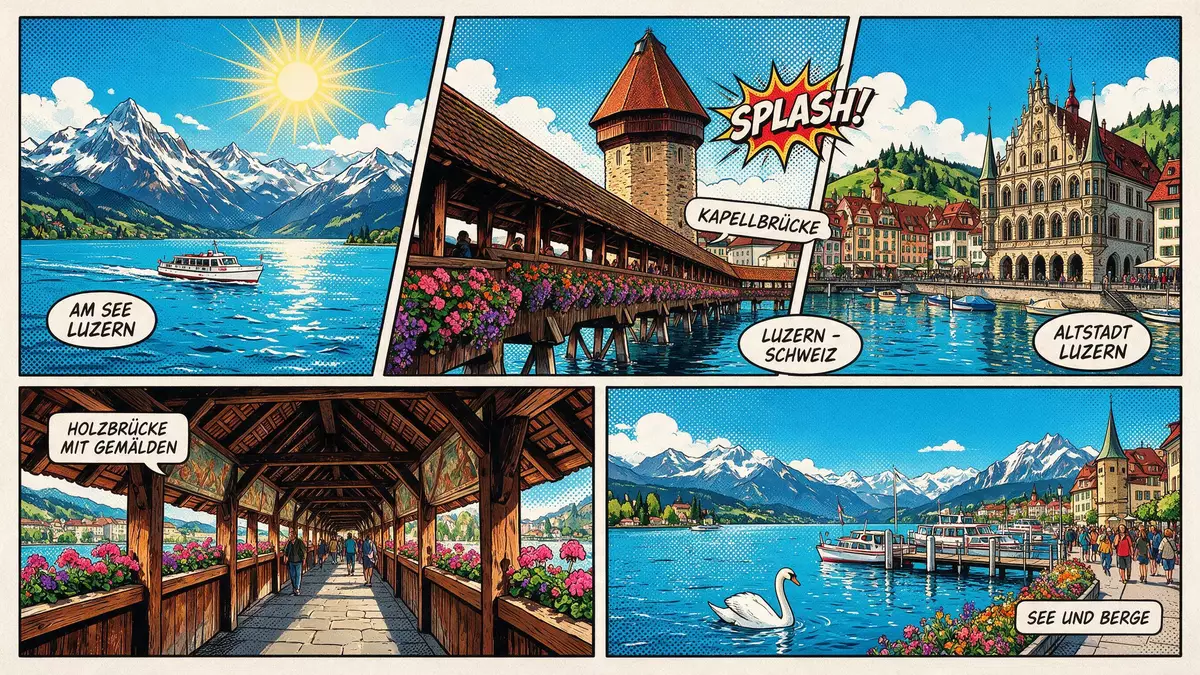
Kapellbrucke crosses the Reuss in Luzern beneath a timber roof lined with painted triangular panels. The bridge combines a fourteenth-century crossing, a surviving water tower and a seventeenth-century picture cycle.
Kapellbrucke and the Reuss crossing
The bridge stands beside Luzern’s old town and runs diagonally across the river towards the area around Bahnhofplatz. Its covered timber walkway is supported by a roof whose gabled frames contain scenes connected with local and Swiss history.
Kapellbrucke is traditionally dated to 1333, although historical accounts also place its construction in the middle of the fourteenth century. It formed part of Luzern’s medieval fortifications and connected the two sides of the Reuss. The name refers to St Peter’s Chapel near the bridge.
The crossing is associated with the Reuss waterfront, the old town, the Jesuit Church and the lake-facing end of the city. The bridge’s wooden structure and its dark roof create a long interior passage above the river. A fourteenth-century crossing remains at the centre of its identity.
Paintings beneath a seventeenth-century roof
The panels beneath the roof belong to a picture cycle created in the early seventeenth century. Hans Heinrich Wägmann, a painter from Luzern, made the images, while the cycle presents religious legends, civic history and episodes associated with Switzerland.
The painted scenes include the city’s patron saints, Leodegar and Mauritius, together with biblical subjects, historical episodes and symbolic figures. Their position within the roof structure turns the passage into a sequence of framed images rather than an undecorated wooden walkway.
Renward Cysat, a town chronicler and scholar, developed the concept for the decoration. The surviving and reconstructed panels do not form a single uninterrupted set of original works, because the fire of 1993 destroyed or damaged much of the cycle.
The bridge contains 30 completely restored panels from the historic series. Other sections contain replacements and reconstructed elements, preserving the visual arrangement beneath the roof. The restored painted panels remain part of the bridge’s public interior.
Fire, reconstruction and the surviving water tower
A fire spread through Kapellbrucke during the night of 18 August 1993. Much of the wooden structure and many paintings were lost, while the Wasserturm and the stone elements at the bridge ends survived.
The bridge was reconstructed in its historic form and reopened in 1994. Its present appearance therefore combines medieval proportions, seventeenth-century decoration, twentieth-century loss and post-fire rebuilding.
The Wasserturm rises beside the bridge near the riverbank. The stone tower has served several functions during its history, including defensive, civic and custodial uses. Its compact masonry form contrasts with the timber roof and open sides of Kapellbrucke.
The 1993 fire remains inseparable from the bridge’s visual history, because visitors encounter both historic material and reconstructed work in the same passage. A 1993 bridge fire changed the surviving picture cycle without removing its place within Luzern’s landscape.
Visiting Kapellbrucke: what travellers from Western Europe should know
- Kapellbrucke crosses the Reuss in central Luzern, beside the old town and close to Luzern railway station. The bridge is reached on foot from the station and the riverside streets.
- The crossing is a pedestrian bridge with a covered timber walkway. Its route passes above the river, with stairs and uneven historic surfaces at access points.
- The roof frames contain painted panels, while the Wasserturm stands beside the bridge as a separate masonry landmark.
- The official language is German and the currency is the Swiss franc.
Searching for Kapellbrucke on social platforms
These links open searches for Kapellbrucke on each platform.
Frequently asked questions about Kapellbrucke
Where is Kapellbrucke?
Kapellbrucke crosses the Reuss in central Luzern, beside the old town and near the riverfront. Luzern railway station is close to the southern approach.
What can visitors see on the bridge?
The covered timber passage contains painted panels beneath its roof. The route also provides views towards the Reuss, the old town and the Wasserturm.
What makes Kapellbrucke distinctive?
Its medieval bridge form, timber roof, seventeenth-century paintings and neighbouring water tower form a single historic landmark. The reconstructed bridge also preserves the memory of the 1993 fire.


