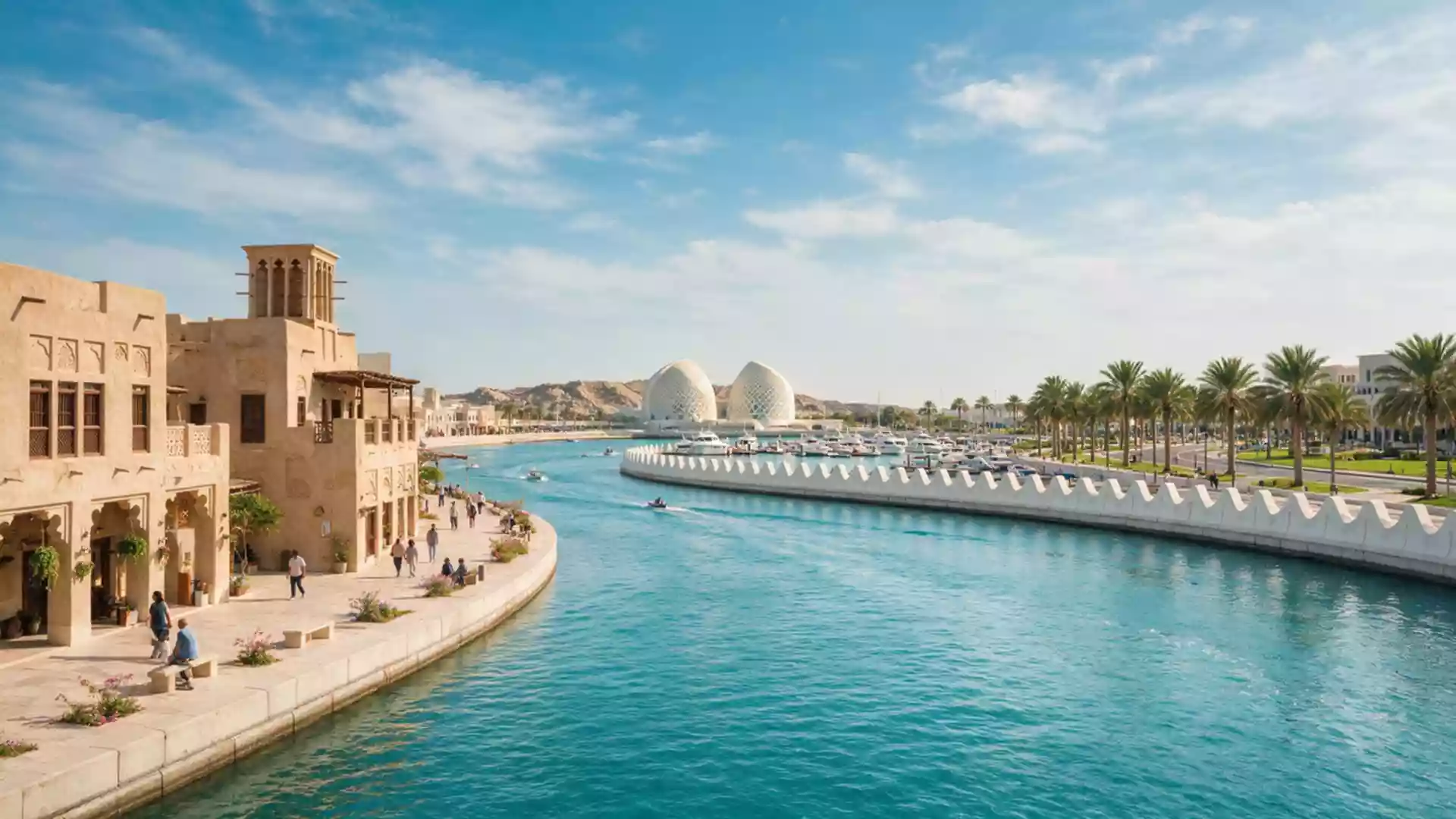
Katara as a shoreline city of theatres, mosques and hills
Published on 09/02/2026 at 11:19 | Editorial responsibility: Rafael Müller, Editor-in-Chief AD HOC NEWS
Katara in Doha is a planned cultural quarter where a waterfront promenade, purpose-built hills and a dense grid of alleys bring theatres, mosques and galleries together on reclaimed land along the Arabian Gulf. Established in 2010 between the West Bay business district and The Pearl, it was conceived as a place where cultural venues, public art and everyday leisure sit side by side in one coastal landscape.Katara in Doha
An amphitheatre facing sea and skyline
The most striking single structure in Katara is the open-air amphitheatre set close to the shoreline, a horseshoe of pale stone that steps up from a flat performance space towards views of sea and city.The Katara Amphitheatre Its stepped seating echoes classical Greek theatres, while the detailing of arches and surfaces draws on Islamic architectural traditions, giving the structure a hybrid character that suits its role in a contemporary Gulf city.
The amphitheatre covers an area of around 3,275 square metres and can accommodate about 5,000 spectators, a scale that makes it large enough for open-air concerts yet still intimate compared with stadium venues.around 3,275 square metres From the upper tiers the eye runs across the curve of the seating to the Arabian Gulf on one side and the built fabric of Katara on the other, with the towers of West Bay visible beyond, so performances take place against a layered backdrop of water, stone and skyline.
Mosques, galleries and a maze of alleys
Behind the waterfront, Katara is organised as a network of narrow lanes, small plazas and courtyards, built in a manner that recalls historic Gulf trading quarters and souqs.Katara Cultural Village is a maze The building fronts have a consistent palette of sandy tones, projecting volumes and shaded walkways, so that walking through the alleys gives a sense of moving through a single, coherent district rather than a collection of unrelated projects.
Among the most recognisable religious buildings in this grid is the Katara Masjid, also known as the Blue Mosque, designed by the Turkish architect Zeynep Fadillioglu with a team linked to the Dolmabahce Palace in Istanbul.Katara Masjid Its tilework and detailing draw inspiration from Ottoman precedents, and it stands alongside a smaller mosque sometimes called the Golden Masjid, whose cladding catches the strong Gulf light in a different way.
Hills, beach and cultural institutions
Katara’s layout is framed by the sea on one side and a pair of landscaped hills on the other, known collectively as the Katara Hills, which rise above the alleys and offer elevated views over the quarter, the Pearl development and the wider coastline.bordered by a vast beach Paths climb these slopes, and the contrast between the greened hilltops and the low-rise sandy buildings below gives the district a strong topographic identity unusual in an otherwise flat urban shoreline.
On the seaward edge, a long public beach runs parallel to the main promenade, with sections given over to beach sports and water-based activities alongside stretches that remain relatively open.a 1.5 km purpose-built beach Sprinkled through the alleys and along the waterfront are cultural institutions such as the Katara Art Center, an opera house used by the Qatar Philharmonic Orchestra, a planetarium and several galleries, which anchor the district’s role as a place where performance, exhibition and everyday urban life intersect.an opera house, a planetarium and galleries
Visiting Katara: what travellers from Western Europe should know
- Katara lies on Doha’s eastern shoreline between West Bay and The Pearl, and is linked to the wider city by the Doha Metro’s Red Line at Katara Station and by major coastal roads.
- The ground within Katara includes gentle slopes up the Katara Hills and a network of cobbled alleys, so moving between the waterfront, the hills and the cultural venues can involve extended walking on uneven surfaces and gradual climbs.
- The official language is Arabic and the currency is the Qatari riyal. Entry requirements depend on your nationality; UK travellers can check the FCDO travel advice at gov.uk/foreign-travel-advice, Irish travellers the Department of Foreign Affairs at ireland.ie.
Searching for Katara on social platforms
These links open searches for Katara on each platform.
Frequently asked questions about Katara
Where is Katara located within Doha?
Katara stands on Doha’s eastern coast between the high-rise district of West Bay and The Pearl development, on reclaimed land that projects into the Arabian Gulf.
What can visitors expect during a visit?
Visitors move between an open-air amphitheatre, mosques, galleries, a beach, landscaped hills and a grid of alleys lined with cultural venues, shops and cafés.
What makes Katara distinctive among Doha’s districts?
The combination of a purpose-built amphitheatre, Ottoman-inspired mosques, a long public beach and sculpted hills within one compact coastal quarter gives Katara a distinctive character.