
Kawah Ijen and the blue fire above Banyuwangi
Published on 09/23/2026 at 13:06 | Editorial responsibility: Rafael Müller, Editor-in-Chief AD HOC NEWS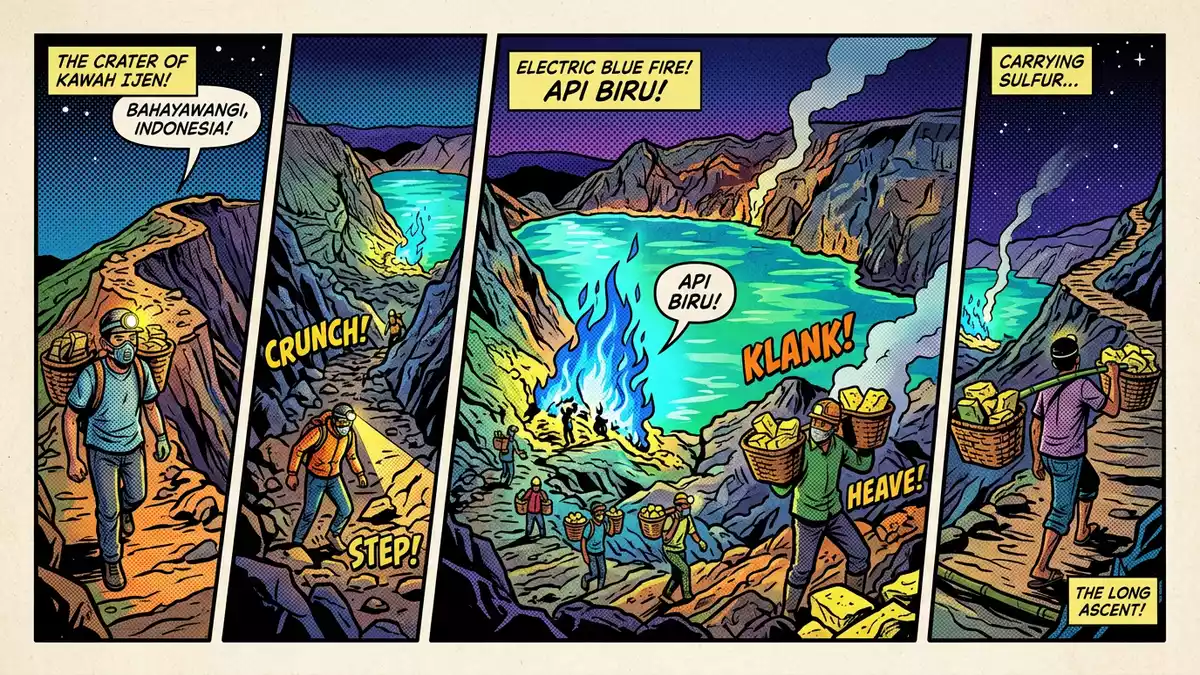
Kawah Ijen is a volcanic crater in East Java, Indonesia, where a turquoise crater lake occupies the centre of a dark mountain landscape. After nightfall, sulphur-rich gases can burn with blue flames around the volcanic vents, while the crater rim rises above the lake as part of the Ijen volcano complex.
Kawah Ijen’s turquoise lake inside an active volcano
Kawah Ijen lies inland from Banyuwangi, near the eastern end of Java and the Bali Strait. The site belongs to a larger volcanic complex on the boundary between Banyuwangi Regency and Bondowoso Regency.
The active cone associated with the crater rises to about 2,386 metres above sea level. The wider Ijen complex reaches higher ground, with elevations approaching 2,799 metres. UNESCO Global Geopark status covers the Ijen landscape, including its volcanic formations, crater lake and surrounding biological environment.
The lake occupies a broad volcanic basin enclosed by steep crater walls. Its turquoise colour comes from minerals and volcanic chemistry in the water. The lake is extremely acidic, with measurements close to zero on the pH scale, so the water belongs to the landscape as a visible geological feature rather than a place for contact.
Why the flames at Kawah Ijen burn blue
The blue fire is not blue lava. It appears when sulphur-rich volcanic gases escape through vents, meet oxygen and ignite. The gases can reach temperatures of about 600°C, producing blue flames in the darkness. sulphur gases behind the flames explain the colour more accurately than photographs alone.
Some sulphur condenses into liquid near the vents. In darkness, burning sulphur can appear to run across the ground, creating the visual impression of glowing streams. The phenomenon belongs to the surface activity of an active stratovolcano, whose crater also holds the acidic lake.
Kawah Ijen’s last confirmed magmatic eruption occurred in 1817. That date refers to molten rock reaching the surface, while the gas vents and sulphur activity are part of the volcanic system visible around the crater.
Sulphur, miners and the Ijen landscape
Bright yellow sulphur occurs around the crater vents. Workers have extracted sulphur from the volcanic area by hand, carrying loads along the steep route between the crater and lower ground. Their work forms part of the human history attached to Kawah Ijen.
The landscape combines several materials and colours: dark volcanic rock, yellow sulphur deposits, green vegetation on the outer slopes and the mineral-rich lake below the rim. The contrast is especially clear from viewpoints above the crater basin.
The Ijen area also contains other volcanic cones and highland terrain within East Java. Kawah Ijen is therefore both a named crater and a visible part of a wider geological complex. Its protected landscape combines volcanic features with forests and habitats associated with the eastern Javanese mountains.
Visiting Kawah Ijen: what travellers from Western Europe should know
- Kawah Ijen lies inland from Banyuwangi in East Java. The approach uses roads from Banyuwangi towards the Ijen highlands, with the final route continuing on foot towards the crater rim.
- The approach is a mountain hike over uneven volcanic ground. The crater rim stands at roughly 2,386 metres, and the descent towards the volcanic area involves steep terrain.
- The blue flames belong to the hours of darkness. The crater lake and yellow sulphur deposits are visible features of the daylight landscape.
- The official language is Indonesian and the currency is the Indonesian rupiah.
- Entry requirements depend on your nationality; UK travellers can check the FCDO travel advice at gov.uk/foreign-travel-advice, Irish travellers the Department of Foreign Affairs at ireland.ie.
- Conditions on the mountain change with the seasons; the local cable-car operators and alpine clubs provide information.
Searching for Kawah Ijen on social platforms
These links open searches for Kawah Ijen on each platform.
Frequently asked questions about Kawah Ijen
Where is Kawah Ijen?
Kawah Ijen is in East Java, Indonesia, inland from Banyuwangi and near the border with Bondowoso Regency.
What can visitors expect at the crater?
The landscape includes a steep mountain approach, a turquoise acidic crater lake, volcanic vents and yellow sulphur deposits.
What makes Kawah Ijen distinctive?
Sulphur-rich gases can ignite after dark, producing blue flames beside an intensely acidic crater lake within an active volcanic complex.


