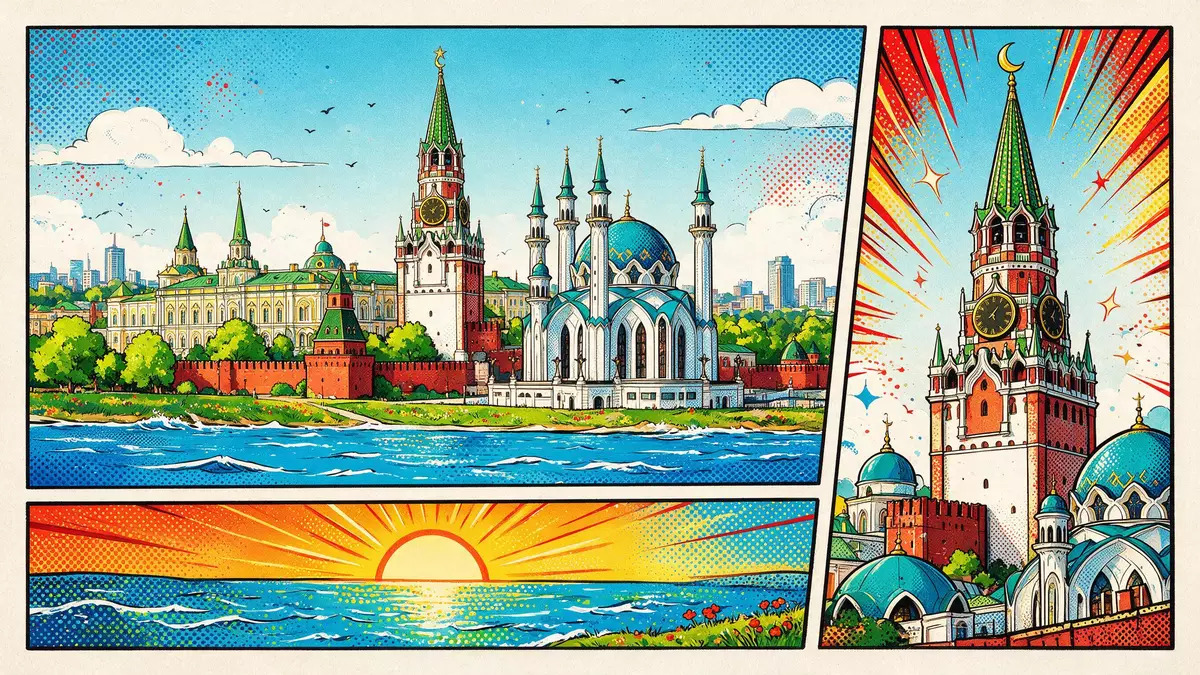
Kazanski Kreml: a riverside fortress in Kasan
Published on 08/06/2026 at 20:05 | Editorial responsibility: Rafael Müller, Editor-in-Chief AD HOC NEWS
Kazanski Kreml is the historic fortress at the core of Kasan, rising above the left bank of the Volga River with white walls, towers and sacred buildings gathered inside its perimeter. The ensemble belongs to the long tradition of Kremlin fortresses in Russia and has roots in the rule of Ivan IV in the sixteenth century, when Kasan was integrated into the growing Russian state. Within its walls, churches, government buildings and defensive structures stand side by side, making Kazanski Kreml a compact summary of several centuries of Russian architecture and power.
Stone walls, towers and a view over the Volga
The most immediate impression of Kazanski Kreml is its defensive outline, with stout masonry walls and towers tracing an irregular polygon on the ridge above the river. The fortifications follow the edge of the plateau, so that some towers stand close to the break of slope facing the Volga, while others look inland towards the city quarters that grew around the fortress. Built in stone and brick, the walls have a pale, almost whitewashed appearance in many stretches, contrasted by darker roofs and spires rising from the buildings within.
Several towers punctuate the curtain walls, each with its own proportions and roofline, and gateways pierce the fortifications at key points where streets from Kasan climb up into the enclosure. From the riverbank below, Kazanski Kreml reads as a layered silhouette: defensive walls at the base, then the outlines of churches and administrative buildings, and above them slender spires and domes. The elevated position gives long views along the Volga valley, and the relationship between the fortress and the river is one of the defining features of the site.
Orthodox churches and civic buildings inside the Kremlin
Inside Kazanski Kreml, religious and civic buildings share the same enclosed ground, reflecting the fusion of spiritual and secular authority that has long characterised Russian Kremlins. The principal Orthodox cathedral, set near the centre of the enclosure, carries the forms of post-medieval Russian church architecture, with bright façades, ornamental cornices and an array of domes clustered above the main body of the church. Its interior houses icons and liturgical furnishings associated with the Orthodox tradition, and services take place under vaults decorated in colour.
Close to the cathedral stand administrative buildings used by regional authorities, generally lower and more regular in their façades, with rows of windows and pitched roofs framing internal courtyards. Some structures reveal nineteenth-century rebuilding, with classical details such as pilasters and pediments introduced as Kasan developed as a provincial centre within the Russian Empire. The mixture of ecclesiastical and governmental architecture means that a walk through Kazanski Kreml crosses from church squares to formal frontages, all within the shelter of the same walls.
Layers of history from khanate to Russian province
Long before Kazanski Kreml took its present form, Kasan was the centre of the Khanate of Kazan, a Tatar state whose capture by Ivan IV in 1552 marked a turning-point in Russian expansion eastwards. The fortress that visitors see today reflects the Russian phase that followed, with brick churches and orthodox symbolism replacing much of the earlier Tatar presence inside the enclosure. The sixteenth century and the reign of Ivan IV thus anchor the historical identity of Kazanski Kreml, and the site is closely associated with the consolidation of Russian control along the Volga.
Over the following centuries, the Kremlin was rebuilt and adapted several times as fires, changing military needs and administrative reforms reshaped its internal structures. Elements of seventeenth and eighteenth-century masonry stand alongside nineteenth-century façades, and restoration work in the twentieth century added further layers. In its present form, Kazanski Kreml presents a palimpsest of Russian rule in the Volga region, where the basic outline of the fortress remains, but the buildings within trace a sequence from early Muscovite power to imperial and Soviet periods.
Visiting Kazanski Kreml: what travellers from Western Europe should know
- Kazanski Kreml stands on a ridge above the Volga River in Kasan and is reached overland from other Russian cities and from airports that serve the Volga region.
- Admission arrangements and opening hours are set by the site's operator and change with the season; the official website is the only binding source.
- Kasan experiences cold winters and warm summers, so consider the weather when planning a visit and allow time to explore both the walls and the interior squares.
- The site involves walking on cobbled surfaces, climbing inclines up to the fortress and moving between buildings that may have staircases and uneven floors; sturdy footwear is advisable and restrictions may apply on site.
- Russian is the main language used around Kazanski Kreml, and payments in the city typically rely on roubles; bank cards are accepted in many urban establishments, and visitors benefit from observing local Orthodox customs inside churches.
- Entry requirements depend on your nationality. UK travellers should check the FCDO travel advice at gov.uk/foreign-travel-advice; Irish travellers the Department of Foreign Affairs at ireland.ie; EU and EEA citizens their own national foreign ministry.
Searching for Kazanski Kreml on social platforms
These links open searches for Kazanski Kreml on each platform.
Frequently asked questions about Kazanski Kreml
Where is Kazanski Kreml located?
Kazanski Kreml stands above the Volga River in the city of Kasan in Russia, forming the historic core of the urban area.
What can visitors expect inside the Kremlin walls?
Visitors find Orthodox churches, administrative buildings, squares, walls and towers within the enclosed ground, all linked by lanes and courtyards.
What makes Kazanski Kreml distinctive among Russian fortresses?
The combination of a riverside setting on the Volga, sixteenth-century Russian origins under Ivan IV and the mix of religious and civic buildings gives Kazanski Kreml a particular character.