
Kiyomizu-dera and its hillside wooden stage above Kyoto
Published on 08/21/2026 at 12:04 | Editorial responsibility: Rafael Müller, Editor-in-Chief AD HOC NEWS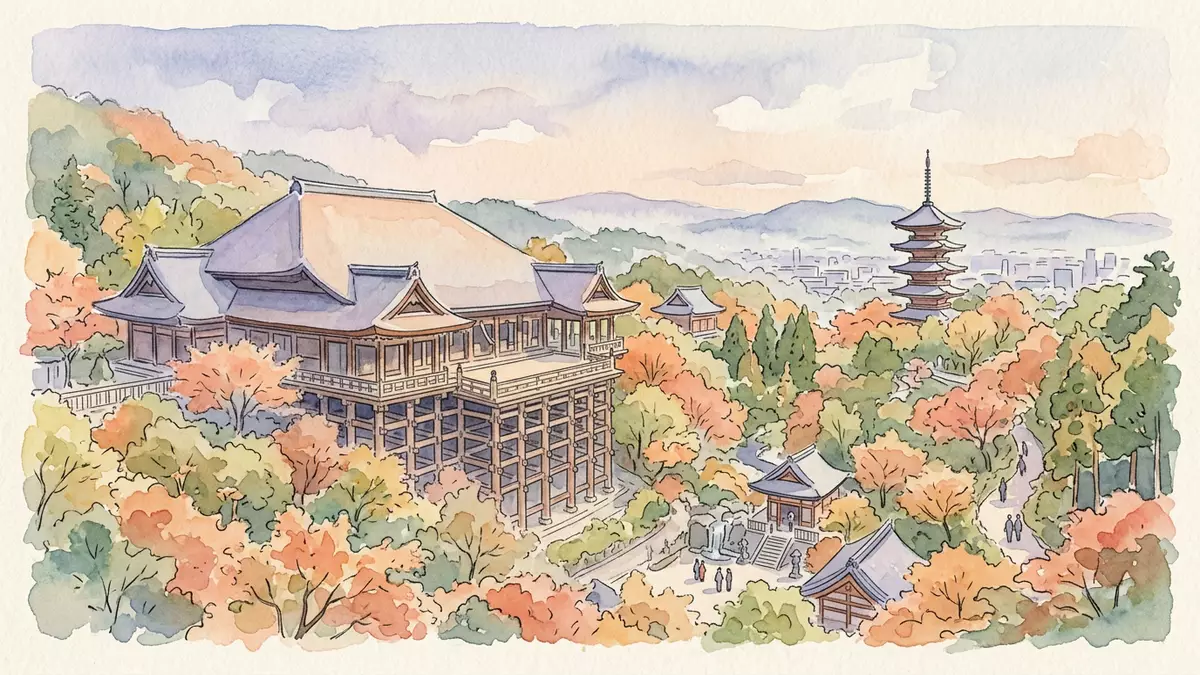
Kiyomizu-dera is a Buddhist temple complex on the eastern hills of Kyoto, known for a wide wooden veranda that projects from its main hall over a steep forested slope. Established during the Nara period in the eighth century, it was rebuilt in the early seventeenth century under the Tokugawa shogunate and later inscribed as part of the Historic Monuments of Ancient Kyoto on the UNESCO World Heritage List.
A timber stage suspended above a hillside
The defining feature of Kiyomizu-dera is the main hall, whose veranda extends over a steep drop with an uninterrupted view towards central Kyoto. The hall stands on a framework of tall timber pillars and crossbeams that rises from the slope below, a construction method that lets the building project beyond the rock face without stone foundations at the outer edge.The imposing veranda is supported by tall wooden columns The present form of this stage dates from a reconstruction in 1633, giving the terrace a clear place in the architectural history of early Edo-period Japan.The present stage was reconstructed in 1633
The veranda floor is laid in smooth cypress planks and reaches several metres beyond the line of the hall, framed by simple timber balustrades. Beneath it, a forest of zelkova pillars rises from the hillside, their upper ends linked by horizontal rails that pass through each column and lock the frame together. This latticework of posts and beams forms a rigid timber cage that carries the weight of the hall and terrace above the slope.
Founding legends and Edo-period reconstruction
The history of Kiyomizu-dera reaches back to 778, towards the end of the Nara period, when a monk named Enchin is recorded as the religious figure associated with the temple’s origin on Mount Otowa.Kiyomizu-dera tradition links its beginnings to Enchin in 778 Two years later, in 780, the military leader Sakanoue no Tamuramaro became the patron who established a temple here, giving Kiyomizu-dera a clear foundation story tied to a named shogun of early Heian Japan.Sakanoue no Tamuramaro is recorded as the patron in 780
Over the centuries the temple buildings suffered repeated destruction by fire, and the ensemble visible today largely dates from a seventeenth-century rebuilding under the third Tokugawa shogun, Tokugawa Iemitsu.The current main buildings date from 1631-1633 under Tokugawa Iemitsu The reconstruction created the main hall with its projecting stage, flanked by subsidiary halls, pagodas and entrance gates that together form a terraced complex on the eastern slopes of Kyoto’s Higashiyama district.
Pure water and temple precincts in the Higashiyama hills
Kiyomizu-dera sits on the lower slopes of Mount Otowa, and its name, which translates as “Pure Water Temple”, refers to the Otowa-no-taki waterfall that cascades within the grounds.The temple name derives from the pure water of the Otowa waterfall Below the main hall, the waterfall is guided into three separate channels that fall into a stone basin, and visitors can climb to the edge of the platform to see the streams descending from the rock face.
The temple precincts extend across the hillside, with stone-paved paths linking the main hall to a series of halls, pagodas and gates coloured in vermilion and natural timber. From the terrace, the cityscape of Kyoto stretches across the plain, while the wooded slopes around the complex frame the main buildings in cherry and maple trees that change colour with the seasons.Kiyomizu-dera stands on the eastern hills of Higashiyama overlooking Kyoto
Visiting Kiyomizu-dera: what travellers from Western Europe should know
- Kiyomizu-dera lies on the eastern side of Kyoto in the Higashiyama district, on the slopes of Mount Otowa above the streets that lead from the city’s eastern edge.
- The approach from the surrounding neighbourhoods runs along sloping, stone-paved lanes and through the temple gates, and within the precincts there are numerous stairways and terraces.
- The official language is Japanese and the currency is the Japanese yen. Entry requirements depend on your nationality; UK travellers can check the FCDO travel advice at gov.uk/foreign-travel-advice, Irish travellers the Department of Foreign Affairs at ireland.ie.
Searching for Kiyomizu-dera on social platforms
These links open searches for Kiyomizu-dera on each platform.
Frequently asked questions about Kiyomizu-dera
Where is Kiyomizu-dera located in Kyoto?
Kiyomizu-dera stands on the eastern hills of Kyoto in the Higashiyama district, on the slopes of Mount Otowa overlooking the city.
What should visitors expect when exploring Kiyomizu-dera?
Visitors move through a terraced temple complex linked by stone-paved paths, gates and stairways, with the main hall’s wooden stage projecting above a forested hillside.
What makes Kiyomizu-dera distinctive among Kyoto temples?
The combination of its seventeenth-century main hall, the projecting timber stage above the slope and the Otowa waterfall’s pure water gives Kiyomizu-dera a particular character within Kyoto’s temple landscape.


