Kopalnia Soli Wieliczka’s underground chapels and chambers
Published on 08/07/2026 at 15:07 | Editorial responsibility: Rafael Müller, Editor-in-Chief AD HOC NEWS
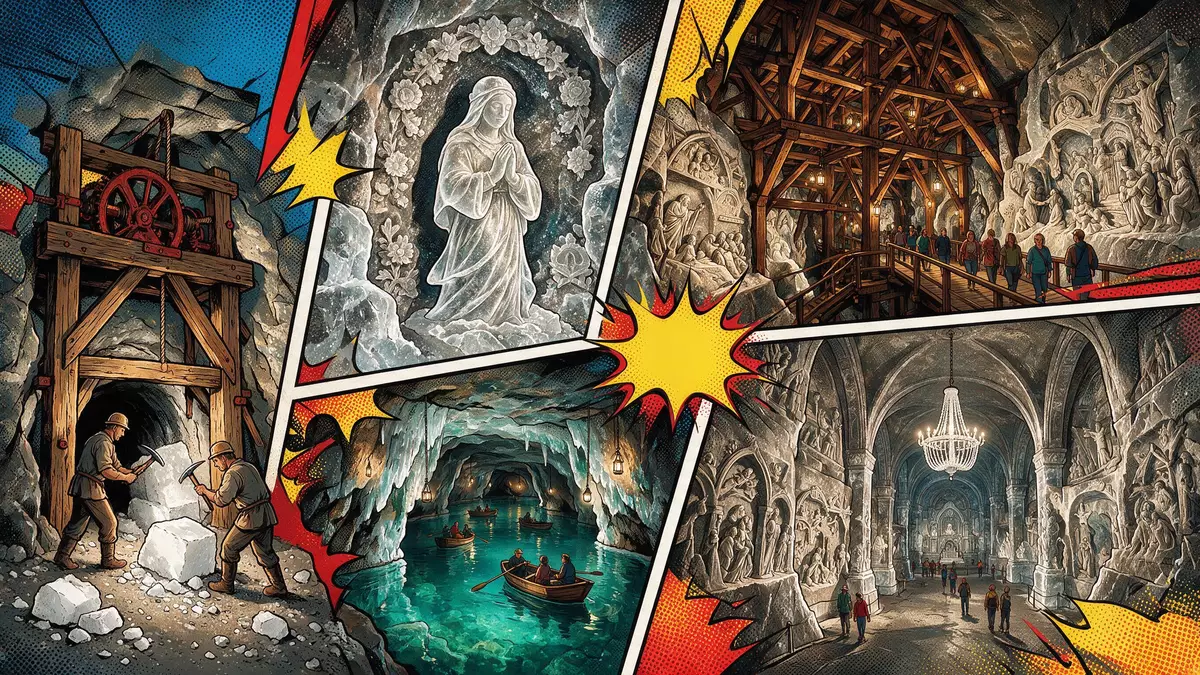
Kopalnia Soli Wieliczka in Wieliczka is an underground salt mine with chambers, passages and chapels hewn from rock salt. Its most striking feature is the scale of the space beneath the surface, shaped by centuries of mining and by the work of miners such as Janowice and Miko?aj Dani?owicz.
The underground world of salt and timber
The mine extends below Wieliczka in southern Poland and belongs to the long mining tradition of the Kingdom of Poland. Its chambers are cut into salt, with timber supports, stairways and carved religious interiors that give the place its particular character.
Among the best-known spaces is the St Kinga Chapel, a vast underground church decorated with salt sculptures, reliefs and a polished floor. The mine also includes older working areas, galleries and lakes, and the constant presence of salt shapes the experience of moving through it.
Salt mining, craft and devotion
Work began at Wieliczka in the Middle Ages, and salt extraction continued for many centuries. The mine reflects that long occupational history in a direct way: tools, supporting structures and devotional spaces all sit within the same underground network.
King Casimir III the Great granted the town of Wieliczka an important place in the royal salt economy in the 13th century. Later generations of miners added chapels and decorations, turning labour spaces into places of worship as well as work.
St Kinga Chapel and the carved chambers
The St Kinga Chapel is the most elaborately finished chamber in the mine. Salt reliefs, chandeliers and figures made by miners line the space, and the chamber’s proportions make it feel closer to an underground hall than a simple side chamber.
Elsewhere, the mine’s galleries and chambers keep a rougher appearance. Salt walls, timber bracing and long walkways create a sequence of spaces that move between working mine, sacred place and historic monument.
Visiting Kopalnia Soli Wieliczka: what travellers from Western Europe should know
- Wieliczka lies near Kraków in southern Poland and is reached by road and rail from the city.
- Admission arrangements and opening hours are set by the site's operator and change with the season; the official website is the only binding source.
- Spring and early autumn suit a visit well, when the weather outside is milder for the approach.
- Expect long underground walks, many steps and a deep descent into the mine.
- Polish is the main language on site, and payment in Poland uses the z?oty.
- Entry requirements depend on your nationality. UK travellers should check the FCDO travel advice at gov.uk/foreign-travel-advice; Irish travellers the Department of Foreign Affairs at ireland.ie; EU and EEA citizens their own national foreign ministry.
Searching for Kopalnia Soli Wieliczka on social platforms
These links open searches for Kopalnia Soli Wieliczka on each platform.
Frequently asked questions about Kopalnia Soli Wieliczka
Where is Kopalnia Soli Wieliczka?
It is in Wieliczka, near Kraków in southern Poland. The mine lies below the town and is entered from the surface.
What should visitors expect?
A visit involves underground chambers, long passages and many steps. The route passes from working spaces into decorated chapels and carved halls.
What makes it distinctive?
The combination of active mining history, salt-carved interiors and the St Kinga Chapel defines the place. Few historic mines present such a continuous sequence of working, devotional and monumental spaces.