Kumamoto-jo’s stone walls and rebuilt keep
Published on 08/09/2026 at 15:00 | Editorial responsibility: Rafael Müller, Editor-in-Chief AD HOC NEWS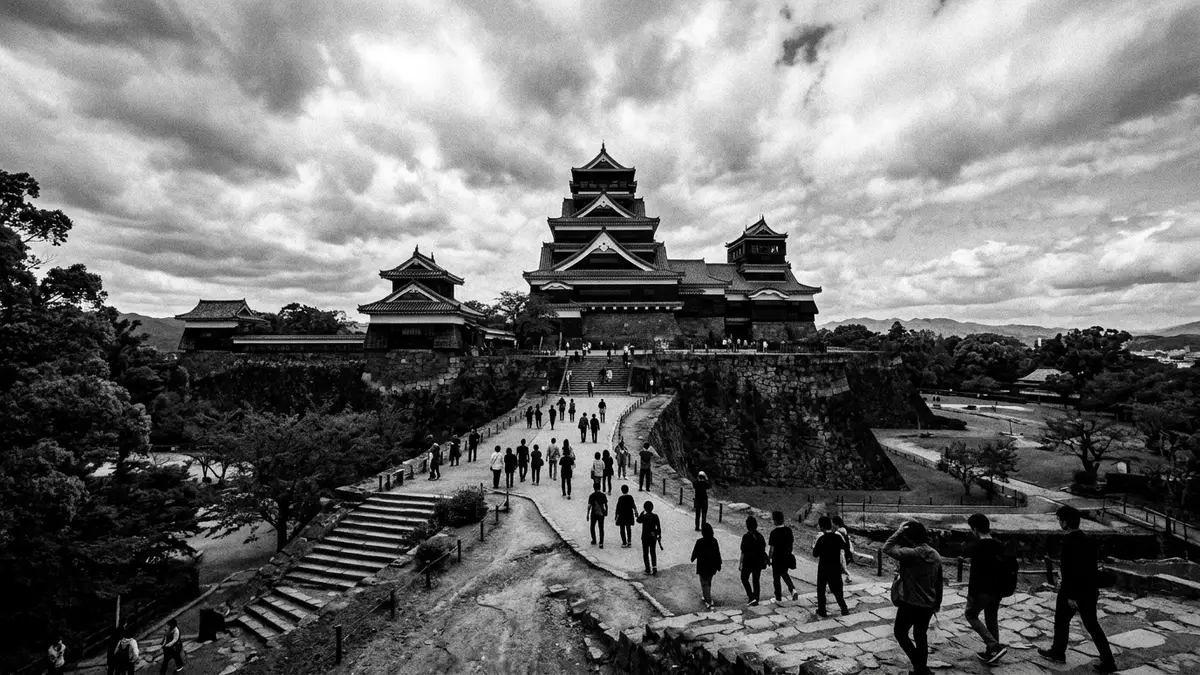
Kumamoto-jo rises over Kumamoto as a castle of stone walls, white plaster, and dark roofs. Associated with Kato Kiyomasa and the early seventeenth century, it is one of Japan’s best-known castle complexes.
Stone walls and layered defences
The most striking feature at Kumamoto-jo is the sweep of its stone ramparts. They rise in long, steep lines, then bend around terraces, gates, and baileys. The result is a castle that reads as much through its walls as through its buildings.
Inside the enclosure, the rebuilt keep stands above lower structures with the neat contrast of white walls and black roof surfaces. The visual rhythm is severe and ordered, with heavy masonry below and lighter timber forms above.
A castle with a long feudal past
Kato Kiyomasa began the castle in the early seventeenth century, during Japan’s Tokugawa era. The site became one of the major strongholds of Kyushu, and its name remains tied to samurai power and domain rule.
That past is visible in the scale of the enceinte, the gates, and the broad terraces. Even after changes across later centuries, the castle preserves the commanding outline of a feudal fortress rather than a compact urban monument.
Rebuilt structures and surviving fabric
The keep visible at Kumamoto-jo is a reconstruction, but the stonework around it includes important original fabric. The contrast between repaired masonry, restored buildings, and older surfaces gives the complex a layered appearance.
That mix is part of its appeal. Visitors do not encounter a single frozen moment, but a castle landscape shaped by destruction, repair, and continued care across generations.
Visiting Kumamoto-jo: what travellers from Western Europe should know
- Kumamoto-jo is in Kumamoto, reached from the city by local transport and by foot through the castle grounds.
- Admission arrangements and opening hours are set by the site's operator and change with the season; the official website is the only binding source.
- Spring and autumn suit outdoor walks around the walls and gates, when the approach through the grounds is most comfortable.
- The site includes slopes, steps, and uneven stone surfaces, so sturdy footwear makes sense.
- Japanese is the main language on site, and cashless payment may not be accepted everywhere.
- Entry requirements depend on your nationality. UK travellers should check the FCDO travel advice at gov.uk/foreign-travel-advice; Irish travellers the Department of Foreign Affairs at ireland.ie; EU and EEA citizens their own national foreign ministry.
Searching for Kumamoto-jo on social platforms
These links open searches for Kumamoto-jo on each platform.
Frequently asked questions about Kumamoto-jo
Where is Kumamoto-jo?
Kumamoto-jo is in Kumamoto, on Japan’s island of Kyushu. It sits within the city rather than in a separate parkland setting.
What should visitors expect?
Expect stone ramps, gates, terraces, and a mixture of rebuilt and surviving castle fabric. The grounds ask for a fair amount of walking and some attention on uneven surfaces.
What makes it distinctive?
The castle is distinguished by its strong stone walls and the broad, layered layout around them. Its association with Kato Kiyomasa and the Tokugawa period gives the site historical weight as well as architectural presence.