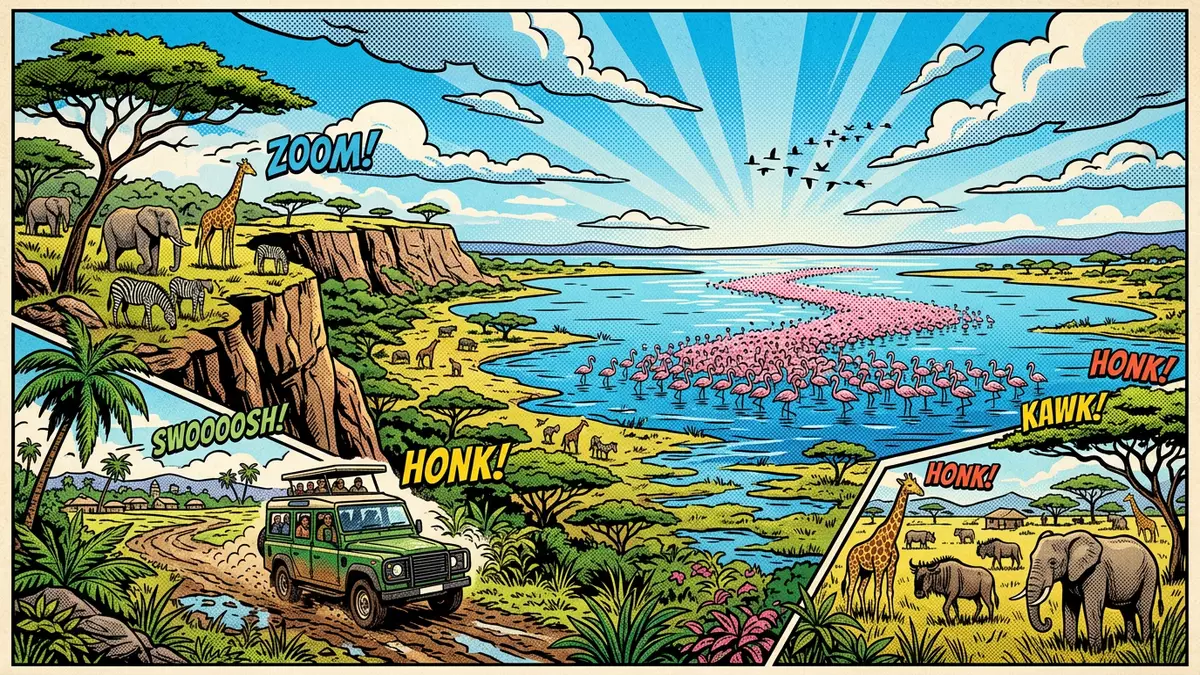
Lake Manyara National Park between lake and Rift Valley wall
Published on 08/12/2026 at 14:21 | Editorial responsibility: Rafael Müller, Editor-in-Chief AD HOC NEWS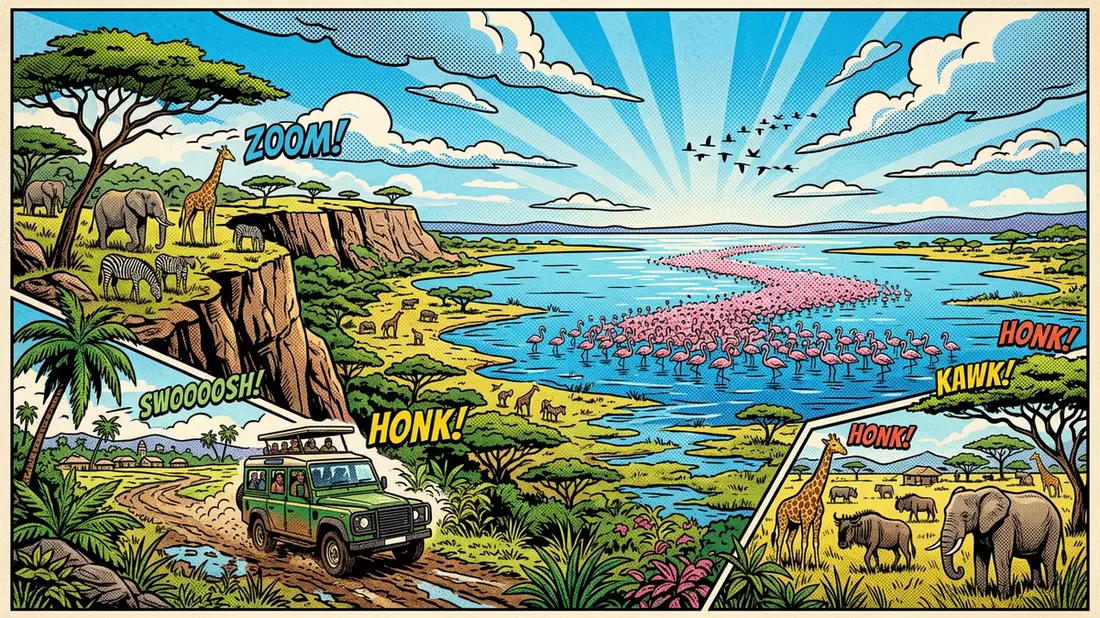
Lake Manyara National Park lies on the floor of northern Tanzania’s Great Rift Valley, where the steep escarpment drops to meet the shimmering waters of Lake Manyara and the market town of Mto wa Mbu. Within a relatively compact area it brings together soda lake, woodland, grassy floodplain and the dramatic Rift Valley wall, an arrangement that gives the park its character as a layered landscape rather than a single vista. Designated as a national park in 1960, and forming part of the Lake Manyara Biosphere Reserve recognised by UNESCO in 1981, it is one of the classic safari areas of the country’s northern circuit.
Lake, escarpment and the narrow Rift Valley strip
Lake Manyara National Park occupies a strip of land between the western wall of the Great Rift Valley and the eastern shore of Lake Manyara, with the park boundary extending over both dry land and lake surface.The park covers about 325 square kilometres, including around 230 square kilometres of shallow lake when water levels are high.Lake Manyara itself is a soda, or alkaline, lake, sitting at roughly 960 m (3,150 ft) above sea level in a depression of the Rift Valley floor.
The western edge of the park is dominated by the Rift Valley escarpment, which rises several hundred metres above the lake and forms a near-continuous wall of rock and forest.Descriptions of the escarpment speak of height differences of up to about 600 m between valley floor and plateau. From Mto wa Mbu the transition is immediate: a short drive leads from the town’s streets to riverine forest and then out towards the open lakeshore, with the escarpment always in view to one side and the lake stretching away to the other.
Habitats packed into a compact park
Although Lake Manyara National Park is smaller than Tanzania’s better known reserves such as Serengeti, it contains a notable variety of habitats within its borders.Groundwater forests fed by underground springs fringe parts of the lakeshore, with evergreen trees forming dense stands close to the inflow of rivers from the Ngorongoro Highlands. Beyond them, visitors encounter open floodplains, acacia woodlands and patches of scrub, each associated with different wildlife and different views towards the lake.
The lake itself dominates the eastern side of the park and expands or contracts with the season, influencing how much of the floor is exposed as mudflats or covered by shallow water.Around two thirds of the park’s area can be water when Lake Manyara is full, creating a broad reflective surface that emphasises the scale of the escarpment behind it. During drier periods more of the lakebed lies exposed, and the visual emphasis shifts towards patterns of cracked mud, small channels and the narrow band of vegetation along the shore.
Wildlife, birds and the biosphere reserve
Lake Manyara National Park is known above all for its mixture of large mammals and birdlife, concentrated into its limited space and shaped by the presence of the alkaline lake.The lake attracts large flocks of flamingos when conditions suit them, along with pelicans and other waterbirds that feed and rest on its shallow waters. More than 350 bird species have been recorded in the wider park area, including raptors that patrol the escarpment and forest species associated with the groundwater woodland.Elephants, hippos and various antelope species use the different habitats, moving between forest shade, open plains and lakeshore.
Beyond its status as a national park, Lake Manyara forms part of the Lake Manyara Biosphere Reserve under UNESCO’s Man and the Biosphere Programme.The biosphere reserve, nominated in 1981, covers the wider lake basin, linking protected areas and surrounding lands. This framework reflects the ecological connections between the park, the Ngorongoro Highlands that feed its springs and rivers, and the human settlements such as Mto wa Mbu that sit along its edges.
Visiting Lake Manyara National Park: what travellers from Western Europe should know
- Lake Manyara National Park lies near Mto wa Mbu in northern Tanzania, on the main safari route linking Arusha with Ngorongoro and Serengeti, and is reached by road or light aircraft via Lake Manyara Airstrip.
- The terrain combines level lakeshore tracks with sections that rise towards the Rift Valley escarpment, and visitors encounter unpaved roads, short bridges over streams and shaded forest drives rather than long, straight highways.
- In the rainy season the lake surface expands and some areas of lakebed and floodplain can be soft underfoot or muddy, whereas in drier months more firm ground appears between the woodland and the water.
- The official language is Swahili and the currency is the Tanzanian shilling.
- Entry requirements depend on your nationality; UK travellers can check the FCDO travel advice at gov.uk/foreign-travel-advice, Irish travellers the Department of Foreign Affairs at ireland.ie.
Searching for Lake Manyara National Park on social platforms
These links open searches for Lake Manyara National Park on each platform.Frequently asked questions about Lake Manyara National Park
Where is Lake Manyara National Park located?
Lake Manyara National Park is in northern Tanzania near the town of Mto wa Mbu, on the floor of the Great Rift Valley between the escarpment and Lake Manyara.
What should visitors expect on a visit to Lake Manyara National Park?
Visitors encounter a compact park with soda lake, forest and open plains, reached by road or light aircraft, with game-viewing tracks running between the Rift Valley wall and the lakeshore.
What makes Lake Manyara National Park distinctive among Tanzania’s safari areas?
Its distinctive character lies in the close pairing of a shallow alkaline lake and the high Rift Valley escarpment, combined with a variety of habitats and its role within the Lake Manyara Biosphere Reserve.