
Lake Manyara National Park between lake and Rift Valley wall
Published on 09/21/2026 at 06:21 | Editorial responsibility: Rafael Müller, Editor-in-Chief AD HOC NEWS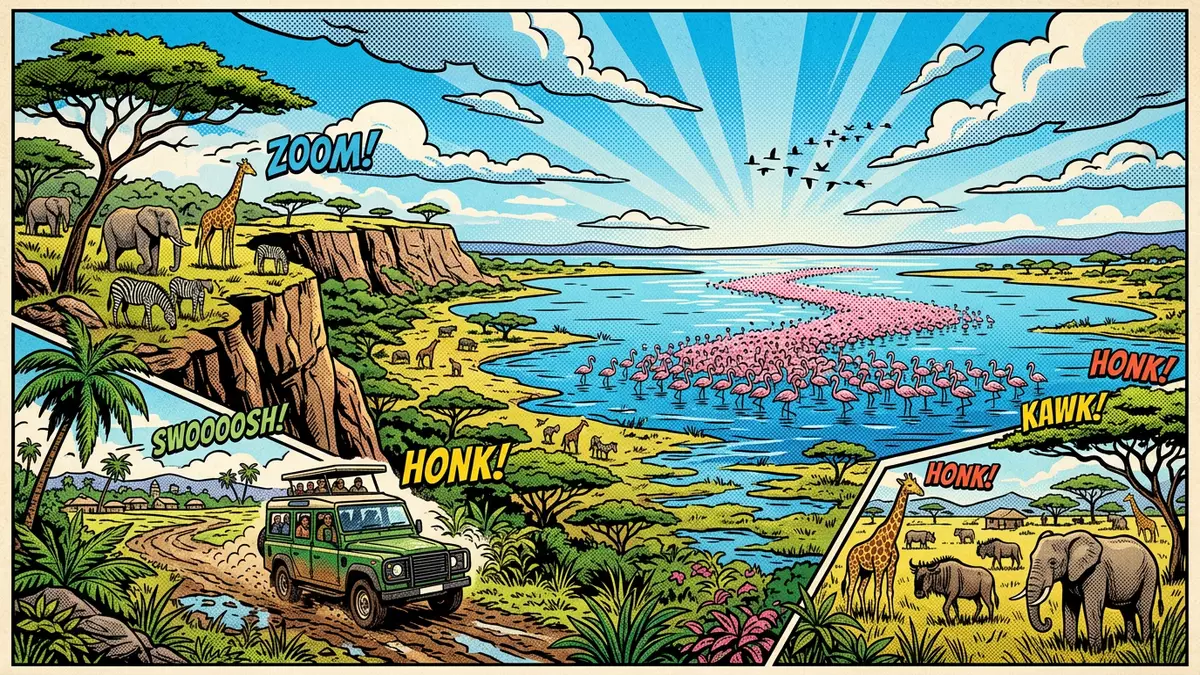
Lake Manyara National Park in northern Tanzania spreads along the base of the Great Rift Valley escarpment, with the shallow soda waters of Lake Manyara on one side and forested slopes on the other. Its protected status as a national park, formalised in 1960, and its later recognition as a UNESCO Biosphere Reserve place this compact landscape among the country’s established conservation areas.Lake Manyara National Park lies close to the market town of Mto wa Mbu, forming part of Tanzania’s northern safari circuit and linking routes towards Tarangire, Ngorongoro and the Serengeti.Northern safari circuit
Between Rift Valley wall and alkaline lake
The defining impression of Lake Manyara National Park is the way it stretches between two strong landforms: the vertical face of the Great Rift Valley escarpment and the flat, shimmering surface of its soda lake. The park lies in the Lake Manyara Basin within the Gregory Rift, a branch of the East African Rift System, with elevations rising from around 960 m to roughly 2,000 m above sea level.Gregory Rift setting Groundwater emerging from the escarpment feeds rivers and springs that spread out across the low ground before reaching the lake, creating saturated belts of forest and wetland.
Within a relatively modest area, sources give figures around 325 to 330 km², Lake Manyara National Park gathers a sequence of habitats that visitors encounter one after another.Park size and habitats Close to the escarpment, dense groundwater forest grows along the moist foot of the slope. Further out, acacia woodland and open floodplain spread towards the lake edge. The lake itself, a shallow alkaline basin, often covers around two thirds of the park’s surface, its waterline shifting with the seasons and creating broad mudflats when levels fall.Shallow alkaline lake
Wildlife in a compact safari landscape
Despite its relatively small size compared with larger Tanzanian reserves, Lake Manyara National Park has become known for dense wildlife concentrated into a narrow strip of land. Elephant herds move through the groundwater forest and woodland, using the cover of tall trees and riverine vegetation, and hippos wallow in the channels and pools where freshwater meets lake shallows.Elephants and hippos Lions occur here as well, including individuals observed resting above the ground in trees, a behaviour that has become closely associated with the park.
The soda lake and its wetlands support prolific birdlife. Flocks of flamingos feed in the shallow alkaline waters, drawing their colour from algae and small organisms that thrive in these conditions, while pelicans, storks and other waterbirds work the edge of the lake and its reedbeds.Flamingos and bird diversity Over 400 bird species are recorded, reflecting the range from forest through woodland to open water. On the drier floodplains, grazing animals such as wildebeest and zebra feed on grasses, and smaller antelopes use patches of cover near the forest edge.Habitats and wildlife
Origins, protection and the wider biosphere reserve
Lake Manyara National Park grew out of earlier protection efforts that began with a game reserve in the late 1950s and continued with national park status in 1960, placing a defined area under state management for wildlife and habitat conservation.Gazetted as a national park in 1960 In 1981, UNESCO included Lake Manyara within its Man and the Biosphere Programme, recognising the wider basin as a biosphere reserve that links protected core zones with surrounding buffer and transition areas used by people.UNESCO biosphere reserve
The name “Manyara” traces back to Emanyara, a term in the Maasai language for the drought-resistant plant Euphorbia tirucalli, reflecting pastoralist knowledge of local vegetation.Origin of the park’s name Surrounding the park, Maasai communities and other residents live in settlements including Mto wa Mbu, where agriculture, small-scale trade and tourism-related work are part of everyday life. The park’s inclusion in routes between Tarangire, Ngorongoro and Serengeti makes it a frequent stop on multi-day safaris, giving visitors a chance to see groundwater forest, soda lake and Rift Valley wall in one place.
Visiting Lake Manyara National Park: what travellers from Western Europe should know
- Lake Manyara National Park lies in northern Tanzania, close to the town of Mto wa Mbu, on the main road linking Arusha with the Ngorongoro Highlands and the Serengeti.
- The terrain inside the park ranges from flat lakeshore and open floodplain to forested slopes and sections of volcanic ground, with some tracks crossing soft mud when lake levels are low.
- The park forms part of Tanzania’s northern safari circuit, with road links towards Tarangire National Park and the Ngorongoro Conservation Area used by vehicles moving between these destinations.
- English and Kiswahili are widely used in northern Tanzania, while the official currency is the Tanzanian shilling.
- Entry requirements depend on your nationality; UK travellers can check the FCDO travel advice at gov.uk/foreign-travel-advice, Irish travellers the Department of Foreign Affairs at ireland.ie.
Searching for Lake Manyara National Park on social platforms
These links open searches for Lake Manyara National Park on each platform.
Frequently asked questions about Lake Manyara National Park
Where is Lake Manyara National Park?
Lake Manyara National Park lies in northern Tanzania, along the base of the Great Rift Valley escarpment, close to the town of Mto wa Mbu.
What can visitors expect on a visit?
Visitors travel through groundwater forest, acacia woodland, floodplain and lakeshore, with chances to see elephants, hippos, lions and diverse birdlife in a compact area.
What makes Lake Manyara National Park distinctive?
The park’s setting between a steep Rift Valley wall and a shallow soda lake, combined with its dense mix of habitats and its biosphere reserve status, give it a distinctive character among Tanzanian reserves.


