
Lal Qila: Delhi’s red sandstone palace-fort
Published on 09/24/2026 at 06:04 | Editorial responsibility: Rafael Müller, Editor-in-Chief AD HOC NEWS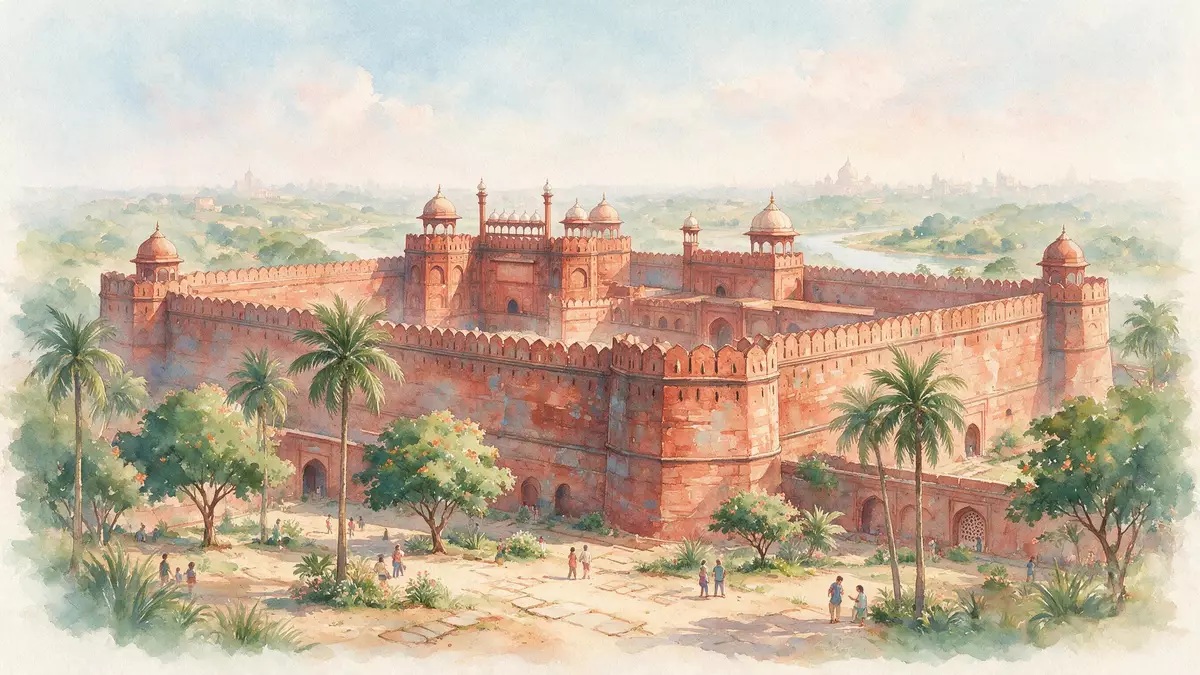
Lal Qila rises in Old Delhi as a vast red sandstone palace-fort linked to Shah Jahan and the Mughal capital of Shahjahanabad. Its walls, gates, halls and gardens form an architectural complex rather than a single monumental building.
Red sandstone walls and a Mughal palace-fort
Construction began in 1639 under Mughal emperor Shah Jahan and reached completion in 1648. The fort served as the principal residence of Mughal emperors for almost two centuries, placing courtly life, administration and ceremonial architecture within one enclosed complex.
The name Lal Qila means Red Fort, a reference to the red sandstone used prominently in the enclosing walls and bastions. Inside, the material palette extends to white marble, carved stone, painted surfaces, inlaid decoration, water channels and planted courtyards.
Shah Jahan’s capital in stone, water and marble
Lal Qila belonged to Shahjahanabad, the Mughal city established when Shah Jahan moved the imperial capital from Agra to Delhi. The fort occupied the eastern part of the walled city, close to the Yamuna, and combined defensive architecture with the formal spaces of an imperial residence.
Its architectural language brings together Islamic, Persian, Timurid and Hindu traditions. The complex contains monumental gates, audience halls, private apartments, gardens, mosques and service spaces. Water channels and courtyards connect different parts of the palace precinct, while red sandstone provides the dominant exterior character.
The Diwan-i-Aam served as a public audience hall, while the Diwan-i-Khas belonged to the more restricted ceremonial world of the court. The Moti Masjid, the Hayat Bakhsh Bagh and the Nahr-i-Bihisht add religious, garden and residential dimensions to the compound.
From Mughal residence to national symbol
Lal Qila changed function as political control over Delhi changed. British forces occupied the complex after the uprising of 1857, and military uses altered parts of the Mughal palace landscape. The surviving buildings preserve both the imperial design and the marks of later administration.
The fort also carries a major place in the public history of India. Its association with the country’s independence gives the Mughal complex a national meaning alongside its architectural history. The Red Fort Complex entered the UNESCO World Heritage List in 2007.
That designation recognises the site as a cultural property with outstanding universal value. Lal Qila’s importance rests on the relationship between its massive enclosure, its palace interiors, its gardens and the wider urban history of Shahjahanabad.
Visiting Lal Qila: what travellers from Western Europe should know
- Lal Qila stands in Old Delhi, near Chandni Chowk and the eastern edge of the historic city. Delhi Metro stations and the city’s road network connect the area with other parts of Delhi.
- The complex covers a large enclosed area with paved routes, courtyards, gateways and historic buildings. Several structures require walking across open ground and negotiating steps.
- Delhi’s official languages include Hindi and English, while India’s currency is the Indian rupee.
- The nearby streets of Old Delhi contain Chandni Chowk, historic religious buildings, markets and long-established food districts.
Searching for Lal Qila on social platforms
These links open searches for Lal Qila on each platform.
Frequently asked questions about Lal Qila
Where is Lal Qila?
Lal Qila is in Old Delhi, India, beside the historic core associated with Shahjahanabad and near Chandni Chowk.
What does a visit to Lal Qila include?
The complex contains gates, defensive walls, audience halls, palace buildings, gardens, a mosque and courtyards connected by internal routes.
What makes Lal Qila distinctive?
Its red sandstone enclosure surrounds a Mughal palace complex shaped by Islamic, Persian, Timurid and Hindu architectural traditions.


