
Lineas de Nazca: drawings etched into the desert
Published on 09/24/2026 at 01:56 | Editorial responsibility: Rafael Müller, Editor-in-Chief AD HOC NEWS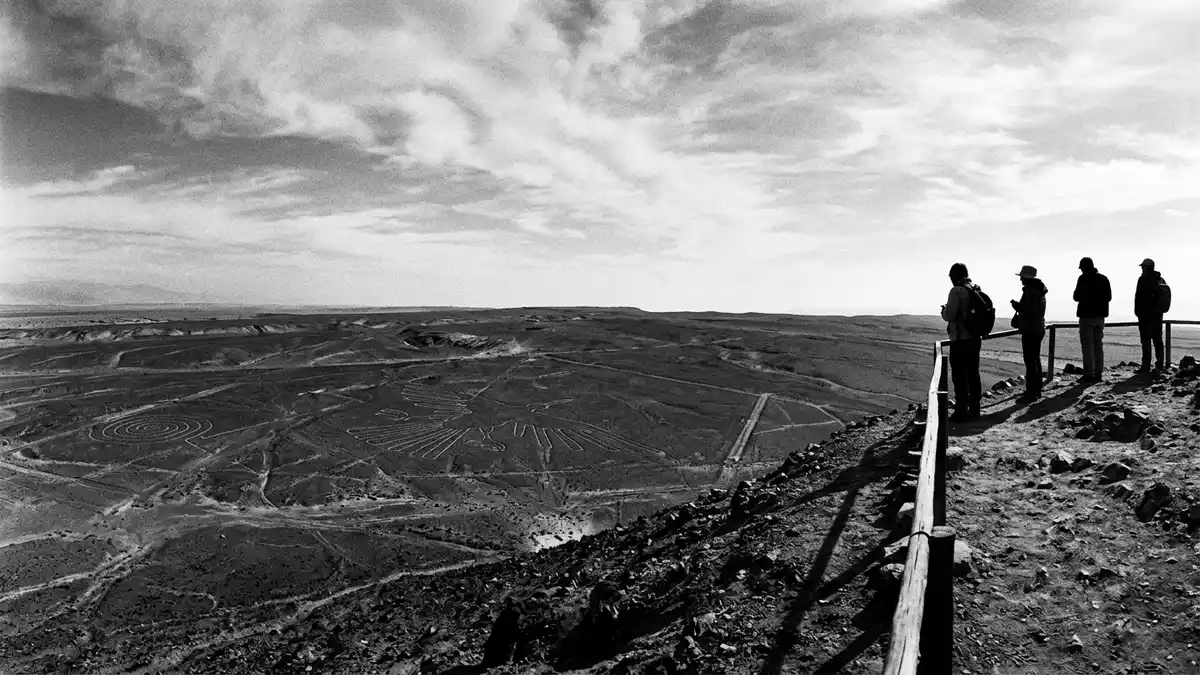
Lineas de Nazca are immense geoglyphs drawn across the arid coastal plain near Nazca in southern Peru. Their scale becomes clear from above, where animal figures, long straight lines and broad geometric forms appear across the desert surface.
Figures drawn across an arid plain
The geoglyphs lie on the Pampa Colorada and the Pampas de Jumana, a desert landscape between Nazca and Palpa. The wider protected area covers about 450 square kilometres, while the drawings extend across a much larger cultural landscape of plains, slopes and low Andean foothills.
Some designs represent living forms. A spider, hummingbird, monkey, condor and other animals are associated with the site, alongside plant-like figures and human forms. Other marks consist of long lines, cleared bands and geometric shapes crossing the reddish ground. the desert geoglyphs near Nazca are visible as changes in the surface rather than raised constructions.
A pre-Hispanic landscape of lines and figures
Most of the geoglyphs belong to the Nazca culture, which flourished in southern Peru between about 200 BC and AD 600. Some lines and designs predate that culture and are linked with the earlier Paracas tradition. The wider tradition therefore spans several centuries of pre-Hispanic history.
The drawings were made by removing the darker surface stones and exposing the lighter ground beneath. Their preservation is connected with the desert’s aridity, which leaves the broad marks legible across the plain. the UNESCO World Heritage property identifies the Lines and Geoglyphs of Nasca and Palpa as a cultural landscape linked with ancient societies of Peru’s south coast.
Seeing the drawings from ground and air
From the ground, many figures are difficult to recognise because the designs are spread across a wide, nearly level landscape. Elevated viewpoints reveal selected shapes, while aircraft routes provide a broader view of the larger compositions and their relationship with the surrounding plain.
The site is not a single monument with one entrance or one central building. It is a dispersed archaeological landscape containing thousands of lines, sweeps and figures. the ancient lines and figures belong to a tradition that continued across a long period, making the desert itself the principal setting.
Visiting Lineas de Nazca: what travellers from Western Europe should know
- Lineas de Nazca lie near Nazca in southern Peru, about 400 km south of Lima. The Pan-American Highway connects the region with Peru’s coastal cities, and flights over the geoglyphs depart from local airfields.
- The landscape is an arid desert plain with exposed stones, loose ground and low Andean foothills. Ground viewpoints show selected designs, while aerial viewing reveals the scale of the wider patterns.
- Nazca is inland from Peru’s Pacific coast, within the Department of Ica. The nearby towns of Nazca and Palpa are associated with different parts of the protected archaeological landscape.
- The official language is Spanish and the currency is the Peruvian sol.
- Entry requirements depend on your nationality; UK travellers can check the FCDO travel advice at gov.uk/foreign-travel-advice, Irish travellers the Department of Foreign Affairs at ireland.ie.
Searching for Lineas de Nazca on social platforms
These links open searches for Lineas de Nazca on each platform.Frequently asked questions about Lineas de Nazca
Where are Lineas de Nazca?
They lie in southern Peru, near Nazca, across the arid coastal plain between Nazca and Palpa. The principal protected landscape is associated with the Pampas de Jumana.
What can visitors expect to see?
Visitors encounter desert plains marked by animal figures, human forms, long lines, cleared bands and geometric designs. Ground viewpoints reveal selected figures, while aerial views show wider relationships.
What makes the site distinctive?
Lineas de Nazca combine enormous scale with delicate surface markings. The drawings belong to a pre-Hispanic cultural landscape created across centuries by the Nazca and earlier Paracas traditions.


