
Lotus Temple in Delhi unfolds as a marble flower
Published on 09/23/2026 at 12:48 | Editorial responsibility: Rafael Müller, Editor-in-Chief AD HOC NEWS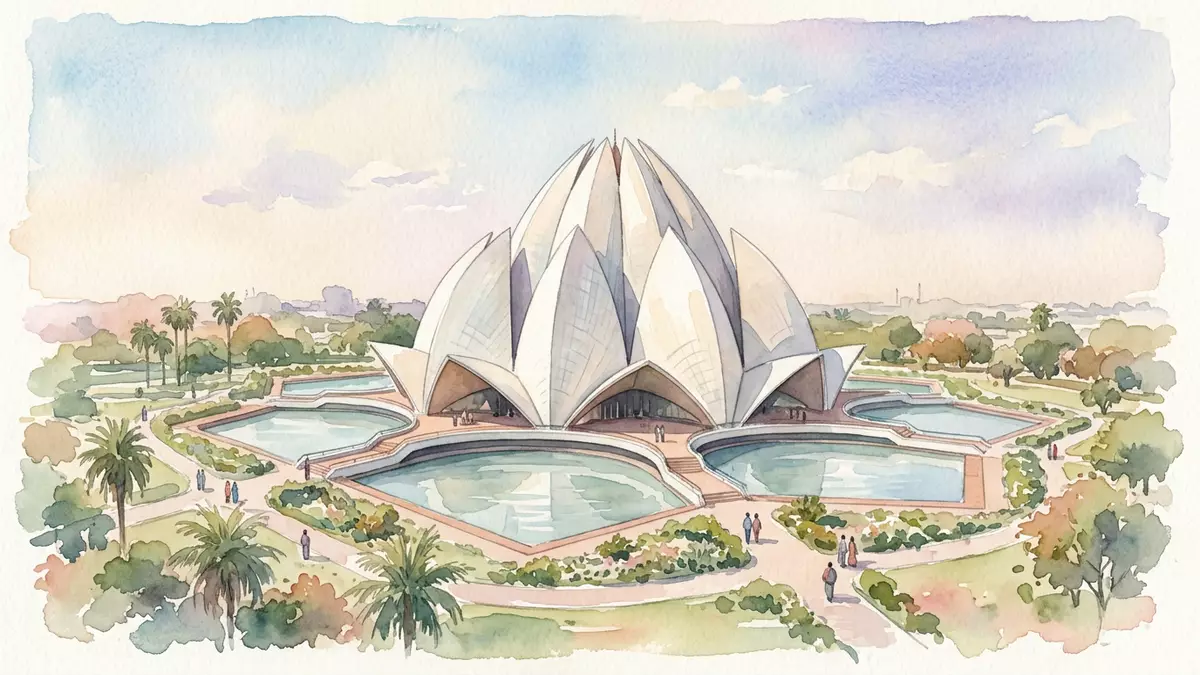
Lotus Temple rises in South Delhi as a white marble flower assembled from independent petals. Designed by Iranian-Canadian architect Fariborz Sahba, the Bahá’í House of Worship opened for worship in December 1986.
Lotus Temple and the architecture of an unfolding flower
The building takes the form of a half-open lotus. Its 27 marble-clad concrete petals are arranged in three groups of nine, creating a layered outline around the central hall. The petals are free-standing structural elements, rather than a flat decorative pattern applied to a conventional façade.
Nine entrances open into the temple, reflecting the nine-sided plan associated with Bahá’í Houses of Worship. The outer petals project over the entrances, the middle petals form the surrounding roofline, and the inner petals curve towards the prayer hall. Britannica’s Lotus Temple description records the building’s nine-sided construction, marble petals and concentric arrangement.
White marble, red sandstone and water
White marble gives the petals their pale surface, while red sandstone appears in the elevated platform and paths around the building. Nine pools border the temple, placing the flower form within a designed landscape of water, stone and planted ground.
The marble came from Penteli in Greece, and the petals cover reinforced-concrete shells. This combination joins a highly engineered structure with a recognisable natural image. From a distance, the separate petals read as a single bloom; closer views reveal the joints, ribs and changing curves that make the form possible.
The central prayer hall rises above the surrounding pools and paths. Its interior is dedicated to worship and prayer, without an altar or pulpit. Bahá’í Houses of Worship welcome people of every religion, and the hall is used for prayers and readings from different faith traditions.
Fariborz Sahba’s Bahá’í House of Worship
Fariborz Sahba developed the design during the 1970s, and construction ran from 1980 to 1986. The completed building was consecrated and opened to the public in December 1986. The December 1986 opening places Lotus Temple within the late twentieth-century history of religious architecture in India.
Its formal name is Mashriqu’l-Adhkar, an Arabic expression connected with a place where the name of God is uttered at dawn. The Delhi temple belongs to the Bahá’í tradition of Houses of Worship, whose architecture uses a nine-sided plan and nine entrances.
The number nine appears through the building’s parts: nine entrances, nine pools and three ranks of nine petals. The repeated geometry gives the structure a clear order, while the lotus image supplies its most immediate visual identity. The nine-petal arrangement describes the three layers and their relationship with the central hall.
Visiting Lotus Temple: what travellers from Western Europe should know
- Lotus Temple stands in Bahapur, South Delhi, near Kalkaji and east of Nehru Place. The nearest railway reference is New Delhi Railway Station, and Indira Gandhi International Airport serves Delhi.
- The temple complex includes an elevated platform, landscaped paths, red sandstone walkways and pools around the building. The central hall is reached through the temple entrances.
- The official language is Hindi and the currency is the Indian rupee.
- Entry requirements depend on your nationality; UK travellers can check the FCDO travel advice at gov.uk/foreign-travel-advice, Irish travellers the Department of Foreign Affairs at ireland.ie.
Searching for Lotus Temple on social platforms
These links open searches for Lotus Temple on each platform.Frequently asked questions about Lotus Temple
Where is Lotus Temple?
Lotus Temple is in Bahapur, in South Delhi, near Kalkaji and east of Nehru Place. It stands within a landscaped temple complex shaped by paths, pools and planted areas.
What can visitors expect inside?
The central hall is a Bahá’í place of worship without an altar or pulpit. Prayer and readings from different faith traditions form part of its religious use.
What makes Lotus Temple distinctive?
Its identity comes from 27 white marble-clad concrete petals arranged in three groups of nine. The petals, nine entrances and surrounding pools create the visible lotus form associated with the building.


