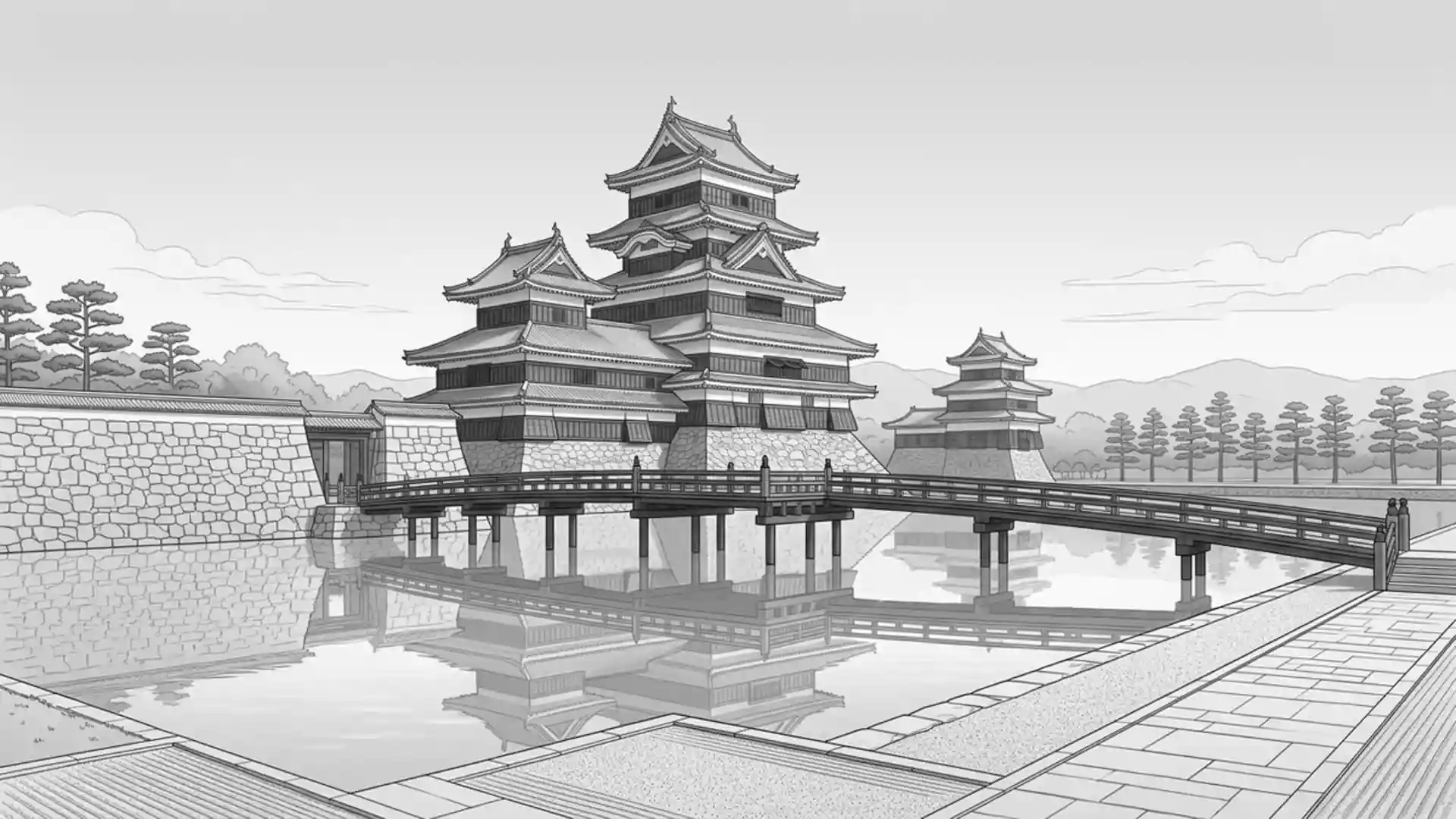
Matsumoto-jo, the black castle above Matsumoto’s moat
Published on 09/03/2026 at 19:27 | Editorial responsibility: Rafael Müller, Editor-in-Chief AD HOC NEWS
Matsumoto-jo, better known in English as Matsumoto Castle, rises over the city of Matsumoto in central Japan with a black timber keep reflected in a wide moat. Completed in the 1590s as a fortified stronghold of the Azuchi–Momoyama period, it is now recognised as one of Japan’s National Treasure castles and preserves an original multi-storey wooden tower rather than a modern reconstruction.Matsumoto Castle is one of the oldest castles
A black “crow castle” from the sixteenth century
Matsumoto-jo stands in Matsumoto City in Nagano Prefecture, on a flat plain ringed by the Northern Japan Alps rather than on a hill. The main keep was built in the late sixteenth century, with fortification of the site dating back to the Warring States period between 1467 and 1600.Fortification of the site dates back to the Warring States period The castle became a base for feudal lords who controlled this inland route between the Nakasendo highway and the mountain passes of central Honshu.
The keep’s dark exterior gives Matsumoto-jo its nickname “Crow Castle”, contrasting with the white plaster bands that divide the timber walls and projecting roofs.Matsumoto Castle's black-painted wooden keep From the outside the tower shows five main levels, but inside there are six floors, including a hidden level used for defence during the age of matchlock guns.the oldest surviving example of a castle with five external stories but six internal floors This combination of black cladding, layered roofs and concealed interior storey gives the whole ensemble a compact yet complex silhouette above the water.
An original wooden keep and connected towers
Matsumoto-jo belongs to the small group of Japanese castles whose central keeps survived the end of the feudal era and the destruction of the nineteenth century without complete rebuilding. Its main tower, smaller Inui (north-west) keep and linking structures form a connected-towers complex that visitors can walk through today.The Matsumoto Castle structure group consists of the great keep and smaller connected towers Inside, steep wooden staircases climb between the levels, and the rooms retain exposed beams, weapon racks and openings for archers and gunners.
Windows in the upper floors frame views over the city, the moat and the distant mountains rather than onto an inner bailey filled with later buildings. The timber floors and columns show the wear of centuries, reinforced where necessary during twentieth-century repairs but still largely in their original material. Information panels along the route explain the castle’s role as a defensive stronghold and the way the keep’s interior spaces were divided between storage, watch posts and martial displays.
From threatened demolition to National Treasure
Like many Japanese castles, Matsumoto-jo faced demolition in the Meiji era after 1868, when Japan’s new government dismantled symbols of the old feudal domains. Matsumoto’s wooden towers suffered structural problems and decay, and proposals to remove them gained momentum. Local citizens raised funds and pressed for preservation, leading to repairs instead of demolition and fixing the castle at the centre of civic identity.Matsumoto Castle was nearly torn down during the Meiji era and was saved through the work of local residents
Matsumoto-jo was declared a historic site in 1930 and received National Treasure status under pre-war legislation in 1936, before being re-designated as a National Treasure in 1952 under the post-war Cultural Properties Protection Law.Matsumoto Castle was designated a National Historic Site in 1930 and as a National Treasure in 1936 and 1952 This sequence of protections anchors the black castle not only in local memory but in the official catalogue of Japan’s most important cultural properties.
Visiting Matsumoto-jo: what travellers from Western Europe should know
- Matsumoto-jo stands in the Marunouchi district of Matsumoto City in Nagano Prefecture, in central Honshu, within walking distance of JR Matsumoto Station on the main railway line through the city.
- The castle complex includes the main keep, smaller connected towers and extensive grounds around a broad water-filled moat, so a visit involves walking on gravel paths, wooden floors and narrow interior staircases.
- The official language is Japanese and the currency is the yen.
- Entry requirements depend on your nationality; UK travellers can check the FCDO travel advice at gov.uk/foreign-travel-advice, Irish travellers the Department of Foreign Affairs at ireland.ie.
Searching for Matsumoto-jo on social platforms
These links open searches for Matsumoto-jo on each platform.
Frequently asked questions about Matsumoto-jo
Where is Matsumoto-jo situated in Japan?
Matsumoto-jo stands in Matsumoto City in Nagano Prefecture, in central Honshu, surrounded by the mountains of the Japanese Alps and approached from JR Matsumoto Station.
What can visitors expect during a visit to Matsumoto-jo?
Visitors cross the moat into the castle grounds, then climb steep wooden staircases through the original multi-storey keep and smaller towers, passing historic interiors and views over the city.
What makes Matsumoto-jo distinctive among Japanese castles?
Matsumoto-jo combines a black-painted wooden keep with five outward storeys and six interior floors, preserved as an original National Treasure rather than a concrete reconstruction.