
Meenakshi Amman Temple and Madurai’s sculpted towers
Published on 09/24/2026 at 11:19 | Editorial responsibility: Rafael Müller, Editor-in-Chief AD HOC NEWS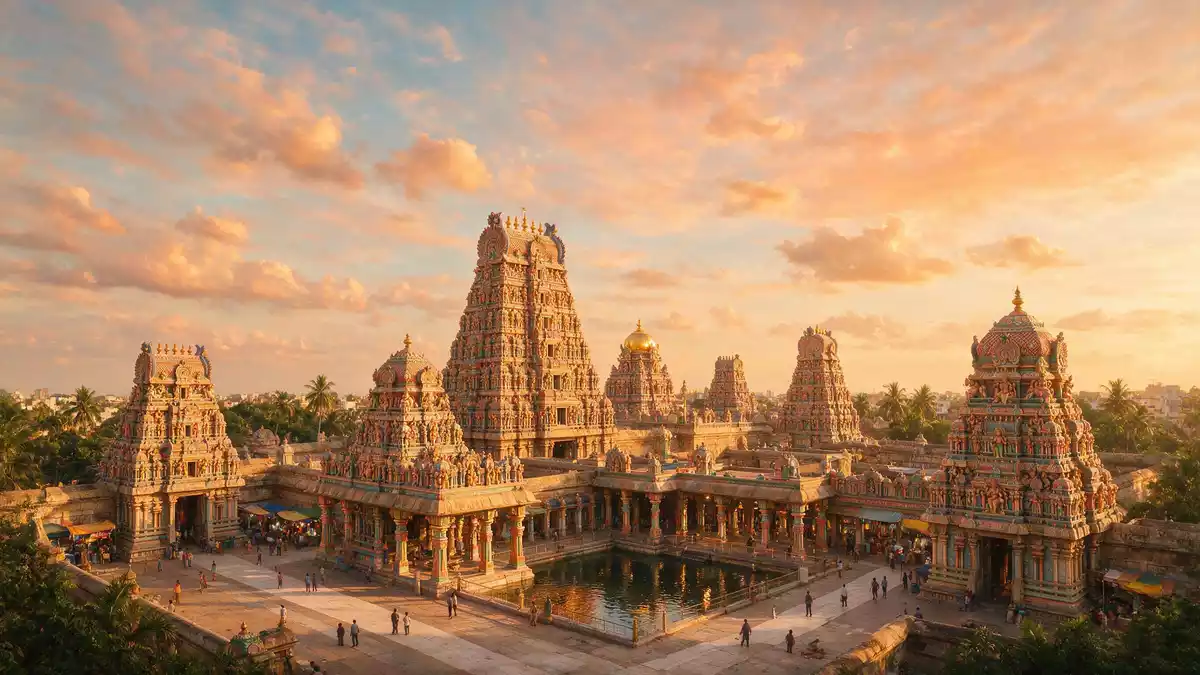
Meenakshi Amman Temple forms the architectural centre of Madurai, Tamil Nadu, with a dense complex of shrines, halls and sculpted gateway towers. Its present form belongs largely to the sixteenth and seventeenth centuries, when Nayak rulers shaped the temple precincts into the richly ornamented Dravidian ensemble visible today.
Madurai’s temple city in Dravidian form
The temple stands in the old part of Madurai, on the southern bank of the Vaigai River. Its principal deities are Meenakshi, a form of Parvati, and Sundareswarar, a form of Shiva. Their paired shrines give the complex its religious identity and its name.
Four major streets surround the temple, while gateways mark entrances into the enclosed precincts. The architecture belongs to the Dravidian tradition, defined here by monumental gopurams, layered halls, shrine roofs and extensive sculptural decoration. The complex has a sixteenth-century form that reflects the rebuilding and expansion of Madurai under the Nayak dynasty.
Gopurams, painted sculpture and the Golden Lotus Tank
The temple’s gateway towers rise above the surrounding streets and carry dense layers of brightly coloured figures. Deities, guardians, animals and scenes from Hindu mythology cover the surfaces, turning each tower into a vertical field of sculpture.
The complex includes the Golden Lotus Tank, shrine courtyards and halls supported by carved pillars. The Hall of a Thousand Pillars contains rows of stone columns with sculpted details, while murals on corridor walls depict episodes associated with the Thiruvilaiyadal Puranam. Tamil Nadu Tourism records fourteen temple towers, with the tallest group rising to roughly fifty metres.
From Pandya foundations to Nayak expansion
Madurai’s temple tradition reaches back to the Pandya period. References to the shrine appear in Tamil devotional literature, including the Thevaram hymns associated with the seventh century. The temple was badly damaged during Malik Kafur’s invasion in 1310, and the buildings visible today emerged through successive rebuilding.
Vishwanatha Nayak and Ariyanatha Mudaliar reshaped the temple and the surrounding city during the sixteenth century. Thirumalai Nayak added major structures during the seventeenth century, including the Puthu Mandapam outside the main precinct. The result is a religious complex where dynastic history remains legible through stone, painted surfaces and ceremonial spaces.
Visiting Meenakshi Amman Temple: what travellers from Western Europe should know
- Meenakshi Amman Temple stands in central Madurai, close to the Vaigai River and the city’s old streets. Madurai Junction railway station and Madurai Airport serve the city.
- The complex contains courtyards, halls, shrines and stone-pillared passages. Comfortable footwear is useful because the visit involves walking across extensive temple spaces.
- The official language of India includes Hindi and English, while Tamil is the principal language of Tamil Nadu. The currency is the Indian rupee.
- Madurai’s surrounding heritage includes the Thirumalai Nayak Palace and the Teppakulam tank, both associated with the city’s Nayak-era history.
Searching for Meenakshi Amman Temple on social platforms
These links open searches for Meenakshi Amman Temple on each platform.Frequently asked questions about Meenakshi Amman Temple
Where is Meenakshi Amman Temple?
It stands in central Madurai, in Tamil Nadu, on the southern bank of the Vaigai River. The temple is surrounded by the historic streets of the old city.
What can visitors see inside?
The complex contains deity shrines, sculpted gopurams, the Golden Lotus Tank, painted corridors and a large stone-pillared hall. Religious worship continues within these spaces.
What makes the temple distinctive?
Its identity comes from the combination of Meenakshi and Sundareswarar shrines with intensely decorated Dravidian towers. Nayak-era rebuilding gave the complex much of its present architectural character.


