
Mirski zamok and its layered Gothic brickwork
Published on 09/24/2026 at 09:20 | Editorial responsibility: Rafael Müller, Editor-in-Chief AD HOC NEWS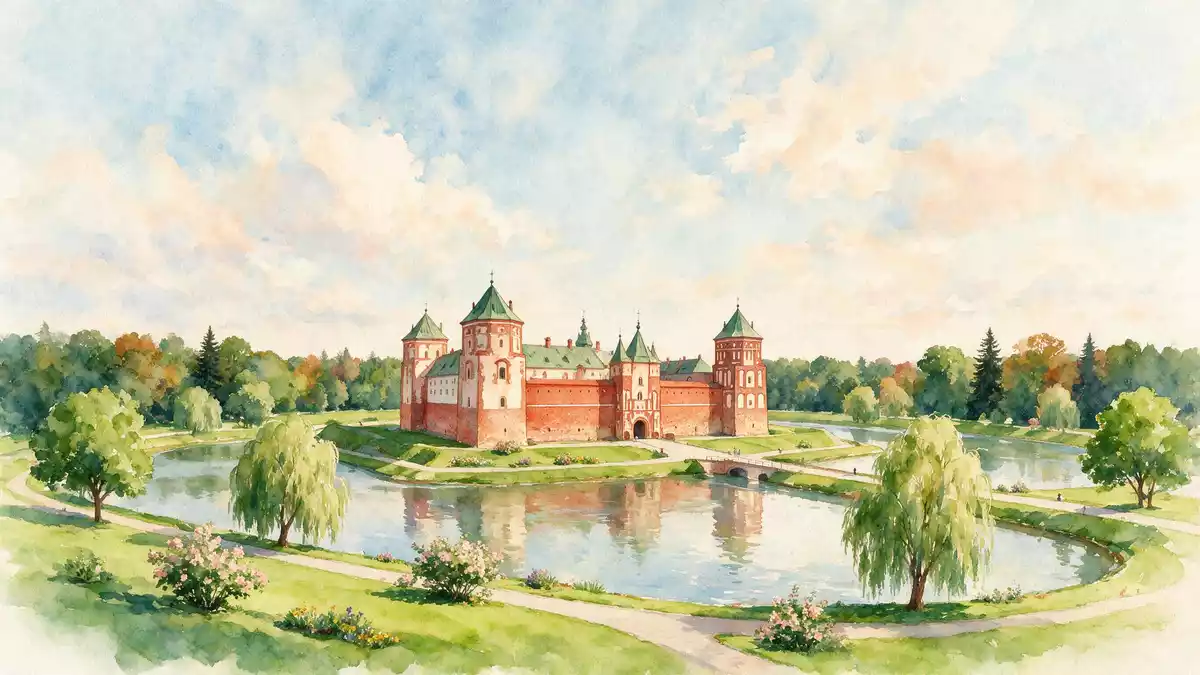
Mirski zamok rises beside ponds and parkland in Mir, western Belarus. Its red-brick walls, corner towers and enclosed courtyard bring several architectural periods into one visible ensemble. Gothic fortification, Renaissance residence and Baroque detail belong to the same castle complex.
Mirski zamok: a brick fortress beside the water
The castle is built in brick, with substantial walls, projecting towers and a moat enclosing the main stronghold. Its mass is compact and defensive, while the interior includes a courtyard and residential rooms.
The surrounding complex extends beyond the masonry. Earthen ramparts, a pond, landscaped grounds and associated buildings frame the castle. The relationship between hard brickwork and open water remains central to the appearance of Mirski zamok.
From Gothic stronghold to Renaissance residence
Construction began in the early sixteenth century under Yury Ilinich, a statesman of the Grand Duchy of Lithuania. The first phase established the castle’s Gothic character through brick walls, towers and defensive planning.
In 1568, the property passed to Miko?aj Radziwi??. The Radziwi?? family completed the complex with Renaissance elements, including palatial accommodation along the eastern and northern walls. The result combined a fortified exterior with a residence arranged for aristocratic life.
Gothic, Renaissance and Baroque in one ensemble
Mirski zamok is inscribed on the UNESCO World Heritage List, a status dating from 2000. Its cultural value rests on the way successive styles remain legible within one architectural group. UNESCO’s Mir Castle entry records the complex as an example of a central European castle shaped by Gothic, Renaissance and Baroque influences.
The Baroque layer belongs to the castle’s later history, while the Gothic brickwork remains the strongest visual element. The contrast is visible in the towers, walls, residential wings and decorative details. The complex therefore reads as a sequence of additions rather than a building from one moment.
Historical changes also affected the castle’s condition and use. Damage during the Napoleonic period was followed by restoration at the end of the nineteenth century. Mir Castle’s historical outline places its origins in the 1520s and identifies the Renaissance completion associated with Miko?aj Radziwi??.
The site belongs to the cultural landscape of the former Polish–Lithuanian Commonwealth. Its architecture reflects the borderland history of present-day Belarus through material, plan and changing style. The castle’s early history connects its foundation with Yury Ilinich and the Grand Duchy of Lithuania.
Visiting Mirski zamok: what travellers from Western Europe should know
- Mirski zamok is in Mir, in Belarus’s Grodno Region. Road travel connects the town with the wider western Belarusian network.
- The castle stands within a larger complex of ramparts, water, landscaped grounds and associated buildings. The approach includes uneven outdoor surfaces and historic masonry.
- The official language is Belarusian and the currency is the Belarusian rouble.
- Entry requirements depend on your nationality; UK travellers can check the FCDO travel advice at gov.uk/foreign-travel-advice, Irish travellers the Department of Foreign Affairs at ireland.ie.
Searching for Mirski zamok on social platforms
These links open searches for Mirski zamok on each platform.
Frequently asked questions about Mirski zamok
Where is Mirski zamok?
Mirski zamok is in the town of Mir, in the Grodno Region of Belarus. The castle stands within a landscaped complex beside ponds and historic ramparts.
What can visitors expect to see?
The complex includes brick defensive walls, towers, a courtyard, residential wings, earthen ramparts, water and parkland. Its architecture spans Gothic, Renaissance and Baroque periods.
What makes Mirski zamok distinctive?
Its main distinction is the visible combination of a sixteenth-century Gothic stronghold with Renaissance palatial additions and later Baroque details. UNESCO inscribed the complex in 2000.


