
Monasterio de Santa Catalina and its painted cloister city
Published on 09/23/2026 at 00:45 | Editorial responsibility: Rafael Müller, Editor-in-Chief AD HOC NEWS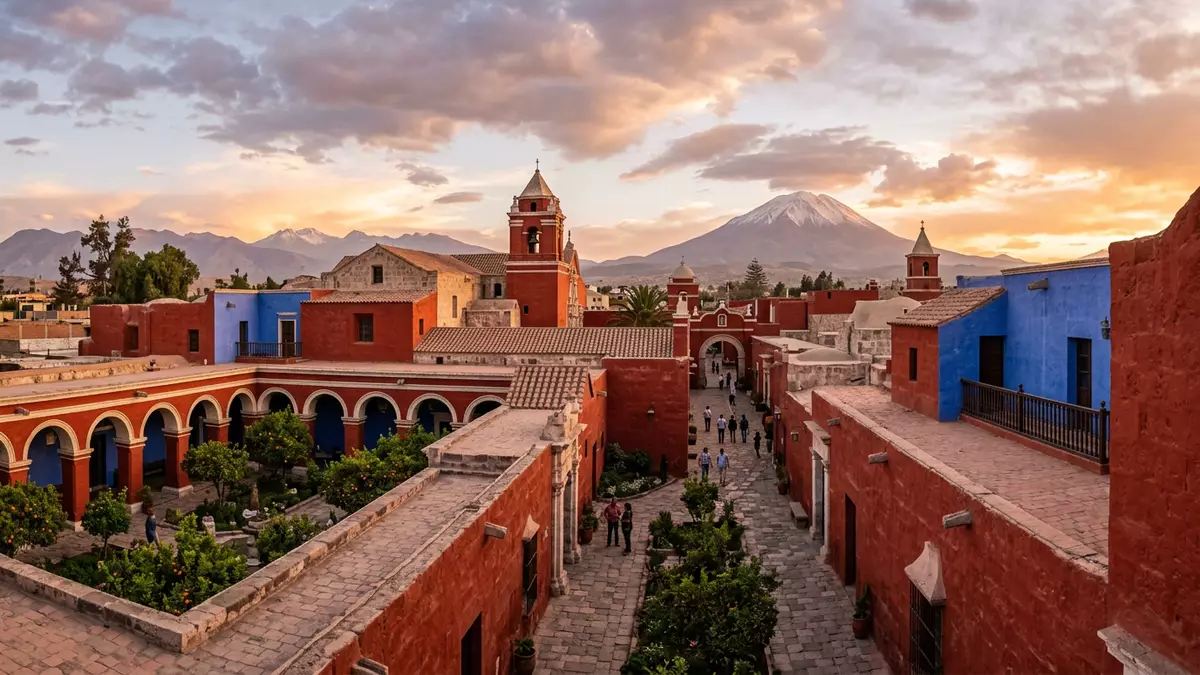
Monasterio de Santa Catalina occupies a full urban world inside Arequipa’s historic centre. Founded in 1579, the Dominican convent is formed from sillar, the pale volcanic stone associated with the city, and unfolds through lanes, courtyards, cloisters and chapels.
Sillar walls and a city-sized convent
The complex is not a single compact building. Its spaces form a network of streets and enclosed courts, with residential rooms, religious interiors and passages arranged behind the entrance on Santa Catalina Street. The walls use sillar, a porous stone formed from volcanic lava around Arequipa, and the material gives the convent a consistent pale surface.
Colour appears across that surface in painted walls, doorways and architectural details. Red, blue and ochre tones mark parts of the complex, while white sillar frames arches, openings and long passageways. The result is a sequence of distinct spaces rather than one uniform hall. sixteenth-century convent The complex belongs to the Viceroyal architectural tradition, with sections built across different centuries.
Founded in 1579, expanded across centuries
Monasterio de Santa Catalina was consecrated in 1579 during the Spanish colonial period. María de Guzmán is associated with its foundation and is recorded as the monastery’s first prioress. The convent belonged to the Dominican Second Order and housed women in an enclosed religious community.
Its buildings reflect architectural changes from the sixteenth to the nineteenth century. Colonial forms, Mestizo Baroque decoration and Neoclassical details appear across the ensemble, while chapels, cloisters and domestic rooms preserve different parts of its religious and social history. sixteenth to nineteenth centuries The monastery forms part of the Historical Centre of the City of Arequipa, inscribed on the UNESCO World Heritage List in 2000.
Passages, courtyards and enclosed religious life
The plan reveals a community organised around inward-facing spaces. Cloisters connect rooms and chapels, narrow lanes cross the complex, and small plazas interrupt the runs of painted and sillar walls. Religious and domestic spaces stand together within the same enclosed precinct.
For centuries, the convent’s life was separated from the surrounding city. The surviving layout records that separation through walls, controlled entrances and a sequence of spaces that conceal the full extent of the complex from the street. Its scale becomes clear only after passing through the entrance and reaching the inner lanes. national cultural heritage Monasterio de Santa Catalina was recognised as cultural heritage in Peru in 1944, and Arequipa’s historic centre received World Heritage status in 2000.
Visiting Monasterio de Santa Catalina: what travellers from Western Europe should know
- Monasterio de Santa Catalina is on Santa Catalina Street in the historic centre of Arequipa, near the city’s Plaza de Armas. The complex is reached through the urban streets of central Arequipa.
- The visit passes through sillar corridors, courtyards, cloisters, chapels and narrow lanes. Uneven historic surfaces and changes between enclosed spaces form part of the route.
- Arequipa lies in southern Peru, with the Andes and volcanic landscapes surrounding the city. The historic centre contains other sillar buildings near the monastery.
- The official language is Spanish and the currency is the Peruvian sol.
- Entry requirements depend on your nationality; UK travellers can check the FCDO travel advice at gov.uk/foreign-travel-advice, Irish travellers the Department of Foreign Affairs at ireland.ie.
Searching for Monasterio de Santa Catalina on social platforms
These links open searches for Monasterio de Santa Catalina on each platform.Frequently asked questions about Monasterio de Santa Catalina
Where is Monasterio de Santa Catalina?
It stands on Santa Catalina Street in the historic centre of Arequipa, southern Peru. The monastery is close to the city’s Plaza de Armas.
What can travellers expect inside?
The complex contains sillar lanes, painted walls, cloisters, courtyards, chapels and former domestic rooms. The route moves through enclosed spaces with historic surfaces and changing architectural details.
What makes the monastery distinctive?
Its scale and internal layout make it resemble a small urban district enclosed within Arequipa. Its 1579 foundation, volcanic sillar construction and painted spaces connect religious history with the architecture of the city.


