
Mont-Saint-Michel and its layered stone silhouette
Published on 09/10/2026 at 06:47 | Editorial responsibility: Rafael Müller, Editor-in-Chief AD HOC NEWS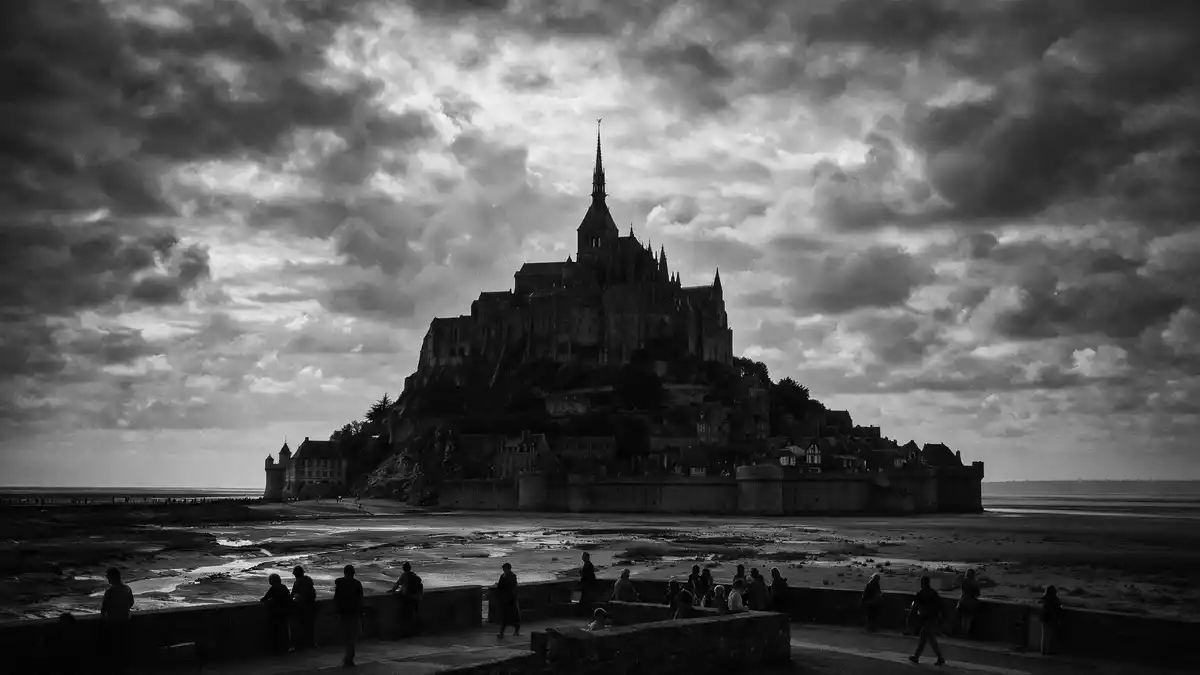
Mont-Saint-Michel rises as a granite tidal island crowned by a Benedictine abbey and a compact medieval village. The site sits in Manche, Normandy, and Mont-Saint-Michel and its bay were inscribed on the UNESCO World Heritage List in 1979UNESCO World Heritage List.
Granite rock, abbey walls and a village above the bay
The island rises from sandbanks and tidal water rather than from an ordinary plain. Its rocky core and stone buildings create a vertical profile that is easy to read from the shore and from the causeway approach.
The abbey dominates the summit, while the village clings to the lower slopes inside protective walls. This layered arrangement gives the place a clear sequence of rock, street, gate and churchrocky island.
A monastic centre with Norman roots
The religious story is tied to the eighth century and to Saint Aubert of Avranches, whose dedication to Michael belongs to the foundation legend of the site. The later Benedictine presence gave Mont-Saint-Michel its defining religious character and linked the mountain to Norman power and medieval pilgrimageSaint Aubert of Avranches.
The abbey church and its monastic buildings were developed over the Middle Ages, and the complex combines Romanesque and Gothic work. The result is a fortified religious landscape in which church, cloister, refectory and defensive masonry sit close togetherRomanesque and Gothic.
Fortification, prison and heritage status
Mont-Saint-Michel also carries a military and administrative history. The abbey became a fortified place in the Middle Ages, and after the French Revolution it was used as a prison before its later restoration as a heritage monumentused as a prison.
That second life matters because it changed the way the place is read. Visitors see not just a religious house, but a stone complex that carries traces of worship, defence and confinement within the same wallsheritage monument.
Visiting Mont-Saint-Michel: what travellers from Western Europe should know
- The island is in Manche, Normandy, on the coast between Brittany and Normandy. Rail travellers usually continue by bus or road transfer from the nearest mainland access points.
- The approach includes ramped streets, steps and steep changes of level. The abbey sits above the village, and the upper terraces demand a steady climb.
- The bay is tidal, with broad sandbanks around the rock. The landscape changes between water, mudflat and exposed shore.
- The official language is French and the currency is the euro.
Searching for Mont-Saint-Michel on social platforms
These links open searches for Mont-Saint-Michel on each platform.
Frequently asked questions about Mont-Saint-Michel
Where is Mont-Saint-Michel?
Mont-Saint-Michel stands in Manche, in Normandy, on the French coast facing the tidal bay between Brittany and Normandy.
What does a visit involve?
The place combines a village, steep lanes and the abbey above it. The climb is short in distance but layered in levels, with stone streets leading up to the monastic buildings.
What makes Mont-Saint-Michel distinctive?
Its profile combines a granite tidal island, a Benedictine abbey and a fortified village in one compact landmark. The UNESCO listing of 1979 recognises Mont-Saint-Michel and its bay as a single heritage landscape.
Searching for Mont-Saint-Michel on social platforms
These links open searches for Mont-Saint-Michel on each platform.
Frequently asked questions about Mont-Saint-Michel
Where is Mont-Saint-Michel?
Mont-Saint-Michel stands in Manche, in Normandy, on the French coast facing the tidal bay between Brittany and Normandy.
What does a visit involve?
The place combines a village, steep lanes and the abbey above it. The climb is short in distance but layered in levels, with stone streets leading up to the monastic buildings.
What makes Mont-Saint-Michel distinctive?
Its profile combines a granite tidal island, a Benedictine abbey and a fortified village in one compact landmark. The UNESCO listing of 1979 recognises Mont-Saint-Michel and its bay as a single heritage landscape.


