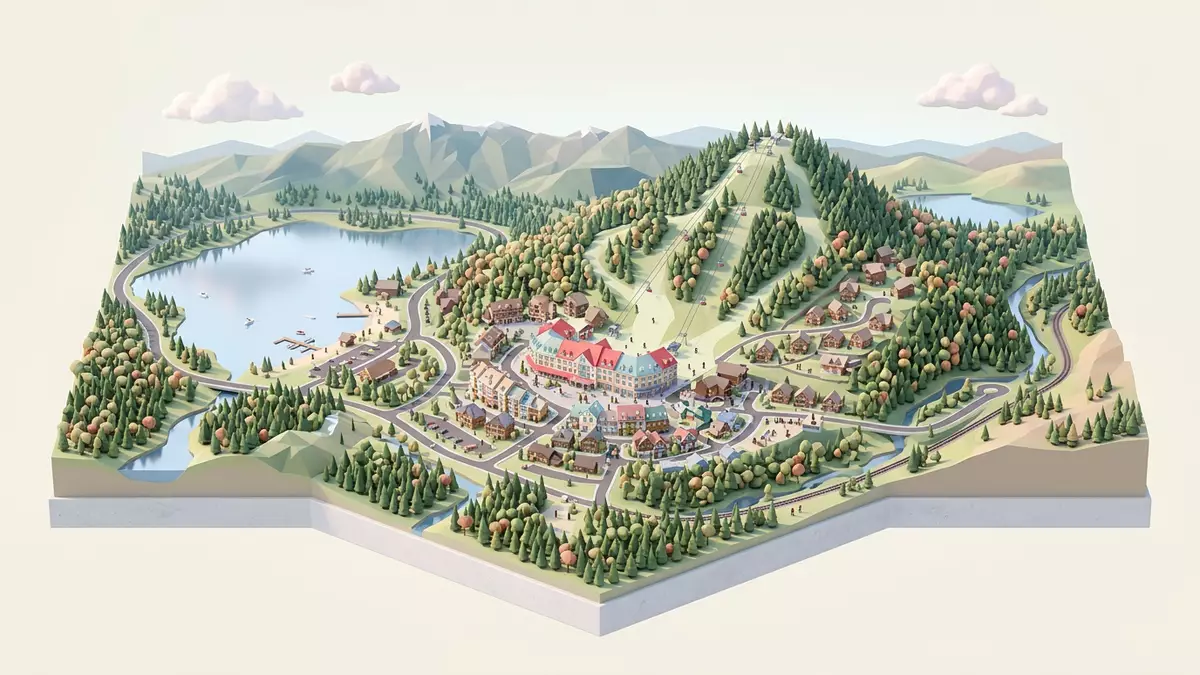
Mont Tremblant’s mountain village and Laurentian landscape
Published on 08/06/2026 at 22:35 | Editorial responsibility: Rafael Müller, Editor-in-Chief AD HOC NEWS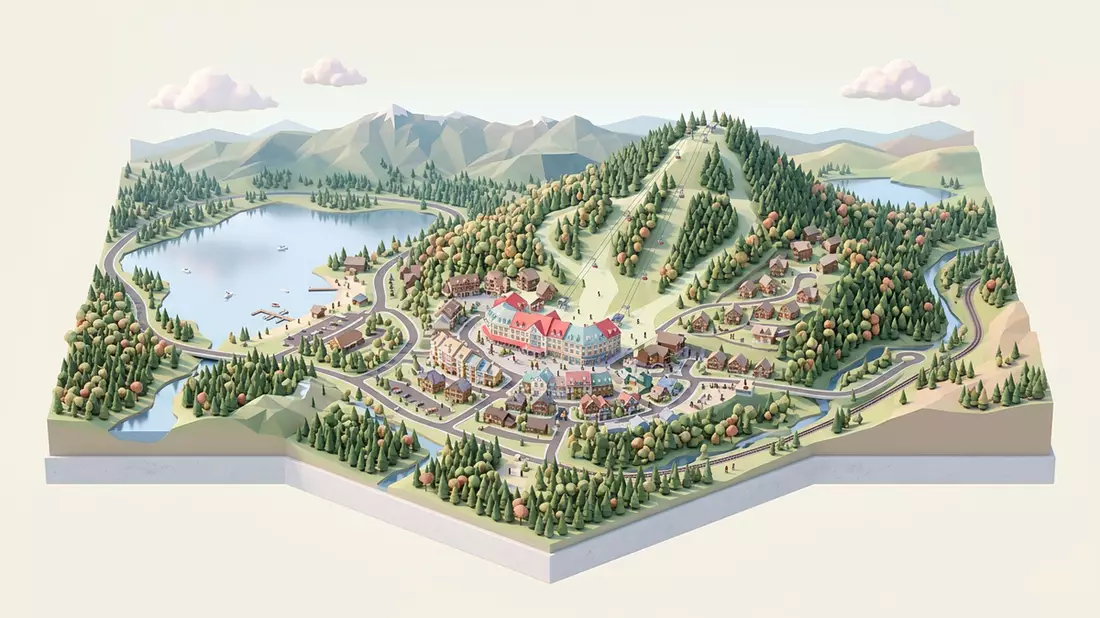
Mont Tremblant is a mountain resort above the town of Mont-Tremblant in Quebec, Canada, known for its long-established ski slopes and a colourful pedestrian village at the base built in the 1990s. The mountain rises from the Laurentian hills north of Montréal, and the resort is organised around lifts, pistes and year-round outdoor activities rather than a single landmark building.
A Laurentian peak shaped by seasons
The mountain that carries the resort stands in the Laurentian Mountains, a low, rounded range of ancient rock that stretches across southern Quebec. From the base area the slopes rise in broad faces and wooded ridges, with ski runs cut as clear bands through the trees. In winter these bands form a white network from base to summit, while in summer the same corridors appear as grassy stripes within a dense green forest.
Mont Tremblant’s summit is reached by ski lifts that climb above the treeline towards a rounded crest, where views extend across lakes, forests and the wider Laurentian landscape. On clear days visitors see wide expanses of water between the hills, including the long outline of Lac Tremblant close to the resort and other lakes scattered across the plateau. The mountain’s profile is soft rather than jagged, but the overall height above the valley gives it a clear presence within the region.
The pedestrian village at the base
At the base of the ski area lies a purpose-built pedestrian village that functions as the resort’s focal point. It was developed in the 1990s by Intrawest, a Canadian company known for large ski villages in North America, and laid out as a compact network of streets, small squares and stepped lanes climbing gently up the slope. Buildings are arranged along these streets in close succession, forming a continuous frontage that gives the village a dense, urban character.
The architecture takes visible cues from French-Canadian towns such as Old Quebec, with pitched roofs, dormer windows and facades in painted plaster or timber. Many buildings carry bright colours — reds, blues, yellows and greens — which stand out against snow in winter and against the surrounding forest in other seasons. Ground floors accommodate cafés, restaurants, shops and ski services, while upper levels contain hotel rooms, apartments and holiday residences, so the village remains in active use throughout the day.
From winter ski hub to summer outdoor base
Mont Tremblant was first developed as a ski destination in the twentieth century, when lifts and runs were created on the slopes above Lac Tremblant. In the decades that followed it gained a reputation among skiers from Quebec, Ontario and the north-eastern United States, helped by its relative proximity to Montréal. Downhill skiing and snowboarding remain the best-known activities on the mountain, with marked pistes for different ability levels and snowmaking equipment installed along key routes.
In the warmer months the resort shifts its focus to hiking, mountain biking, golf and lake-based activities. Trails leave from the village and from the summit lift stations, leading into the forest and along ridgelines, while dedicated mountain bike routes use some of the ski terrain with adapted surfaces and signage. The presence of Lac Tremblant and other nearby lakes means that water sports, sailing and paddle-based activities can be combined with time on the mountain, giving the area a distinctly multi-season character.
Visiting Mont Tremblant: what travellers from Western Europe should know
- Mont Tremblant lies in Quebec, Canada, north of Montréal; travellers usually reach it by road from Montréal or by internal flight to the small airport that serves the resort area.
- Admission arrangements and opening hours are set by the site's operator and change with the season; the official website is the only binding source.
- Winter brings reliable cold and snow suitable for skiing, while late spring, summer and early autumn favour hiking, cycling and lake activities with milder temperatures.
- The resort is built on a mountain slope, with steep streets, stairways and uneven ground between the car parks, the pedestrian village and the lift stations, so expect walking on gradients.
- French is the main language in Quebec, though English is widely understood in the resort; cards are accepted in most businesses, and tipping follows North American practice.
- Entry requirements depend on your nationality. UK travellers should check the FCDO travel advice at gov.uk/foreign-travel-advice; Irish travellers the Department of Foreign Affairs at ireland.ie; EU and EEA citizens their own national foreign ministry.
Searching for Mont Tremblant on social platforms
These links open searches for Mont Tremblant on each platform.Frequently asked questions about Mont Tremblant
Where is Mont Tremblant and how far is it from Montréal?
Mont Tremblant is in the Laurentian region of Quebec, Canada, north of Montréal, and is reached by road or by internal flight to the nearby regional airport.
What should visitors expect during a stay in the resort?
Visitors find a pedestrian village with hotels, restaurants and shops at the base of a ski mountain that offers skiing in winter and hiking, biking and lake access in warmer seasons.
What makes Mont Tremblant distinctive among mountain resorts?
The combination of a Laurentian peak, lakes such as Lac Tremblant and a compact, French-Canadian-style pedestrian village gives Mont Tremblant a clearly defined character in eastern North America.