
Monument Valley and its layered sandstone towers
Published on 09/24/2026 at 00:50 | Editorial responsibility: Rafael Müller, Editor-in-Chief AD HOC NEWS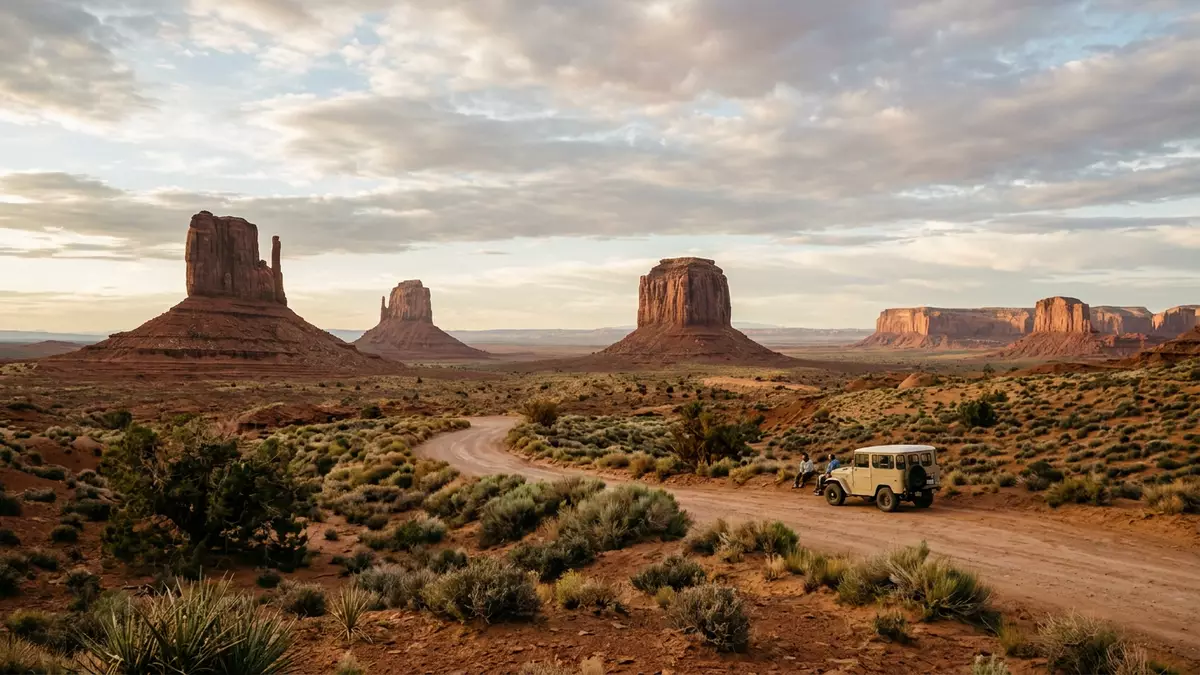
Monument Valley is a vast red-rock landscape near Oljato, on the Arizona–Utah border within the Navajo Nation. Its most recognisable feature is the contrast between broad, level mesas and isolated sandstone towers rising from the valley floor. The Navajo name Tsé Bii? Ndzisgaii means “Valley of the Rocks”.
Monument Valley: a landscape built in layers
The valley belongs to the Colorado Plateau, where sedimentary rock records ancient seas, rivers and desert environments. During the Permian period, sediments accumulated in layers that hardened into sandstone and related rock. Tectonic uplift raised the plateau, after which wind and water removed softer material.
The exposed strata give the landforms their stepped profiles. Darker lower slopes, pale-red cliff bands and resistant upper layers appear across the buttes. Iron oxides colour the sandstone and siltstone red, while manganese compounds create blue-grey streaks on some cliff faces. The valley floor contains sand and siltstone derived from the surrounding formations. Permian sandstone layers form the geological foundation of the scene.
Mitten Buttes, Merrick Butte and the Navajo Nation
From the visitor centre, the panorama includes the Mitten Buttes and Merrick Butte. Their vertical walls rise from open desert, while mesas and smaller pinnacles extend across the wider landscape. The forms are not isolated curiosities; they are remnants of a once-continuous plateau, separated by erosion.
Monument Valley lies within the sovereign territory of the Navajo Nation and is managed as a Navajo Tribal Park. The park was established in 1958. That designation joins geological scenery with Navajo cultural stewardship and gives the landscape a setting distinct from the federal national-park system. The park’s formal name is Monument Valley Navajo Tribal Park. Navajo Tribal Park identifies the protected area.
Film landscapes and cultural geography
Monument Valley became closely associated with the visual language of the American West through cinema. Director John Ford used the landscape in films including Stagecoach, helping place its buttes within international popular culture. The valley also appears in photography, painting and landscape writing.
The cultural geography reaches beyond the viewpoints. Navajo communities, artists and guides remain connected with the park, and Navajo names preserve relationships between landforms and place. Tsé Bii? Ndzisgaii refers to the valley as a landscape of rocks, not simply as a backdrop. Trading posts and roadside craft stalls around the region connect travel with Navajo commerce and artistic practice.
The park covers roughly 92,000 acres across Arizona and Utah. Its red formations rise above a broad desert floor, while the surrounding plateau continues towards distant mesas and ridges. This combination of scale and layered rock gives Monument Valley its recognisable appearance without reducing it to a single viewpoint. three geological layers are visible in the principal buttes.
Visiting Monument Valley: what travellers from Western Europe should know
- Monument Valley lies near Oljato on the Arizona–Utah border. U.S. Route 163 passes through the park, and the landscape is reached by road from settlements in the Four Corners region.
- The scenic route crosses desert terrain with sand, exposed rock and uneven surfaces. The Wildcat Trail forms a walking route around West Mitten Butte.
- The park’s elevation is about 1,696 m (5,564 ft) above sea level. Summer heat, limited shade and dry ground are permanent features of the setting.
- The official language is English and the currency is the US dollar.
- Entry requirements depend on your nationality; UK travellers can check the FCDO travel advice at gov.uk/foreign-travel-advice, Irish travellers the Department of Foreign Affairs at ireland.ie.
Searching for Monument Valley on social platforms
These links open searches for Monument Valley on each platform.
Frequently asked questions about Monument Valley
Where is Monument Valley?
Monument Valley is near Oljato, within the Navajo Nation on the Arizona–Utah border. U.S. Route 163 crosses the wider park area.
What can travellers expect on a visit?
The landscape contains a scenic route, desert walking terrain, broad viewpoints and named formations such as the Mitten Buttes and Merrick Butte.
What makes Monument Valley distinctive?
Its isolated sandstone buttes rise from a broad red desert floor, revealing layered sedimentary rock shaped by uplift, wind and water.


