
Museo Guggenheim Bilbao and its sculptural titanium form
Published on 09/22/2026 at 00:29 | Editorial responsibility: Rafael Müller, Editor-in-Chief AD HOC NEWS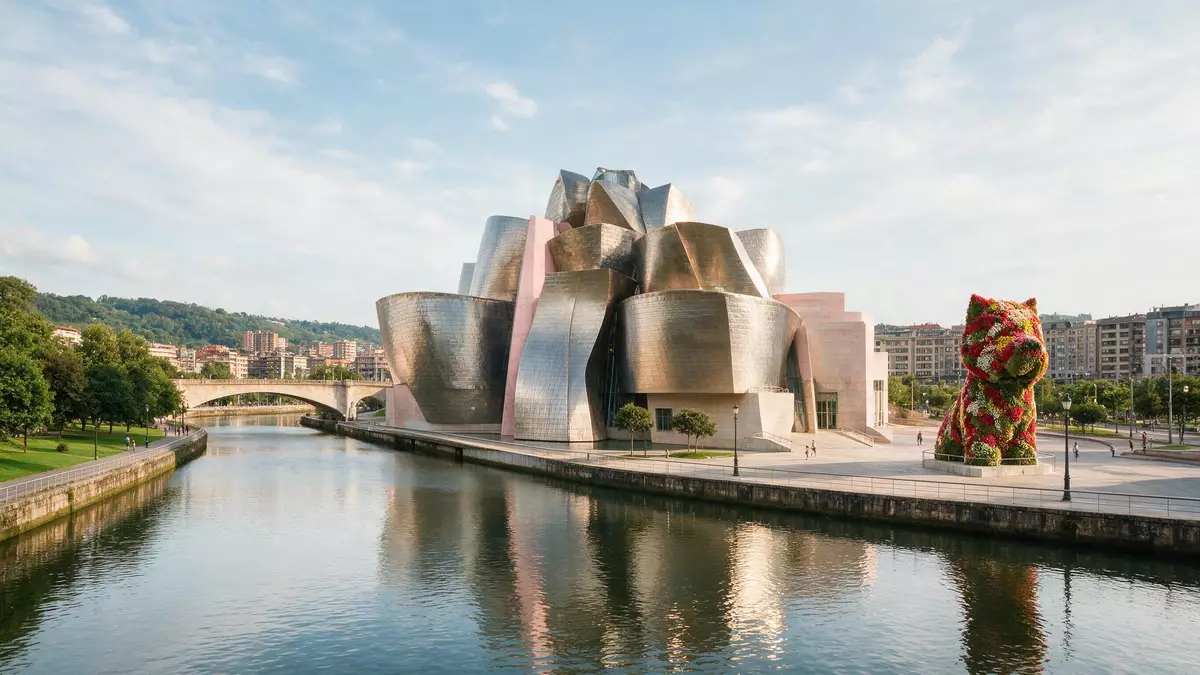
Museo Guggenheim Bilbao on the river in Bilbao is as much a sculptural object as a museum, its sweeping titanium surfaces signalling a late twentieth?century turn in architecture and art.
A riverside landmark of deconstructivist architecture
The Guggenheim Museum Bilbao stands beside the Nervión estuary in the Abandoibarra district, west of Bilbao’s historic centre and close to the La Salve bridge.Guggenheim Museum Bilbao Designed by Canadian?American architect Frank Gehry for the Solomon R. Guggenheim Foundation and the Basque institutions, it opened to the public in October 1997 as a museum of modern and contemporary art.Designed by Canadian American architect Frank Gehry
The building occupies a riverside plot on a curve of the Nervión where port and industrial structures once stood, part of a wider reorganisation of Bilbao’s waterfront into a cultural and urban promenade.The Guggenheim Museum Bilbao was built between October 1993 and October 1997 Three main levels are arranged around a high central atrium, linked by staircases, lifts and curved walkways that look onto the river and the city.
Titanium, limestone and glass: the museum as sculpture
The museum’s striking presence comes from its outer skin of thin titanium panels, set over a complex steel structure in forms that twist, fold and flare above the riverbank.approximately 33,000 extremely thin titanium sheets These panels are combined with large areas of glass and blocks of pale limestone, giving the exterior a contrast between metallic surfaces and stone volumes. The composition has been linked with deconstructivist architecture, yet Gehry’s building reads directly on site as a free?form sculpture in metal and masonry.
Behind the outer envelope the museum provides a total floor area of around 24,000 m², with a substantial portion dedicated to exhibition spaces that vary in size and proportion.Total floor area 24,000 sqm Galleries with more regular walls accommodate paintings and smaller works, while larger volumes with long spans and generous height are suited to installations and large?scale sculpture. The contrast between tight passages, expansive halls and glimpses of the city outside turns a visit into a sequence of spatial experiences as much as a tour of artworks.
Inside the atrium and along the riverfront
Entry to the museum brings visitors into the atrium, a tall, irregularly shaped hall that acts as both orientation space and structural knot of the building.three levels of the building are organized around the Atrium Bridges and platforms cross this space on several levels, and from many points it is possible to look out through glass to the Nervión, the La Salve bridge and the neighbouring city blocks. The interior materials continue the palette of stone, glass and exposed metal, with polished surfaces catching daylight from above and from the riverfront openings.
Outside, the museum extends into terraces and landscaped areas that step down towards the water and frame outdoor works of art placed near the building.It is located in the banks of the Nervión’ estuary in Bilbao The structure is aligned with the riverside promenade, so the faceted titanium forms can be seen from the opposite bank, from the bridges and from streets leading down from the centre of Bilbao. Whether approached along the water or from inland, the museum appears as a cluster of interlocking volumes that change aspect with each shift in viewpoint.
Visiting Museo Guggenheim Bilbao: what travellers from Western Europe should know
- Museo Guggenheim Bilbao stands on Avenida Abandoibarra, 2 in central Bilbao, on the riverside west of the old town and close to the La Salve bridge.
- The museum interior is arranged over several levels connected by staircases and walkways, and some galleries are large, open spaces that require longer walks on foot.
- The building faces the Nervión estuary, with paved terraces and steps leading down towards the river, so parts of the site are exposed to wind and rain.
Searching for Museo Guggenheim Bilbao on social platforms
These links open searches for Museo Guggenheim Bilbao on each platform.
Frequently asked questions about Museo Guggenheim Bilbao
Where is Museo Guggenheim Bilbao located?
Museo Guggenheim Bilbao is in the Abandoibarra district of Bilbao, Spain, on Avenida Abandoibarra beside the Nervión estuary.
What can visitors expect inside the museum?
Visitors encounter a tall central atrium and a network of galleries of different sizes, with contemporary artworks presented across several levels.
What makes Museo Guggenheim Bilbao distinctive?
The museum is distinctive for its titanium?clad sculptural form by Frank Gehry and its riverside position integrating architecture, art and the urban landscape.


