
Museo Guggenheim Bilbao and its titanium riverside curves
Published on 09/18/2026 at 13:44 | Editorial responsibility: Rafael Müller, Editor-in-Chief AD HOC NEWS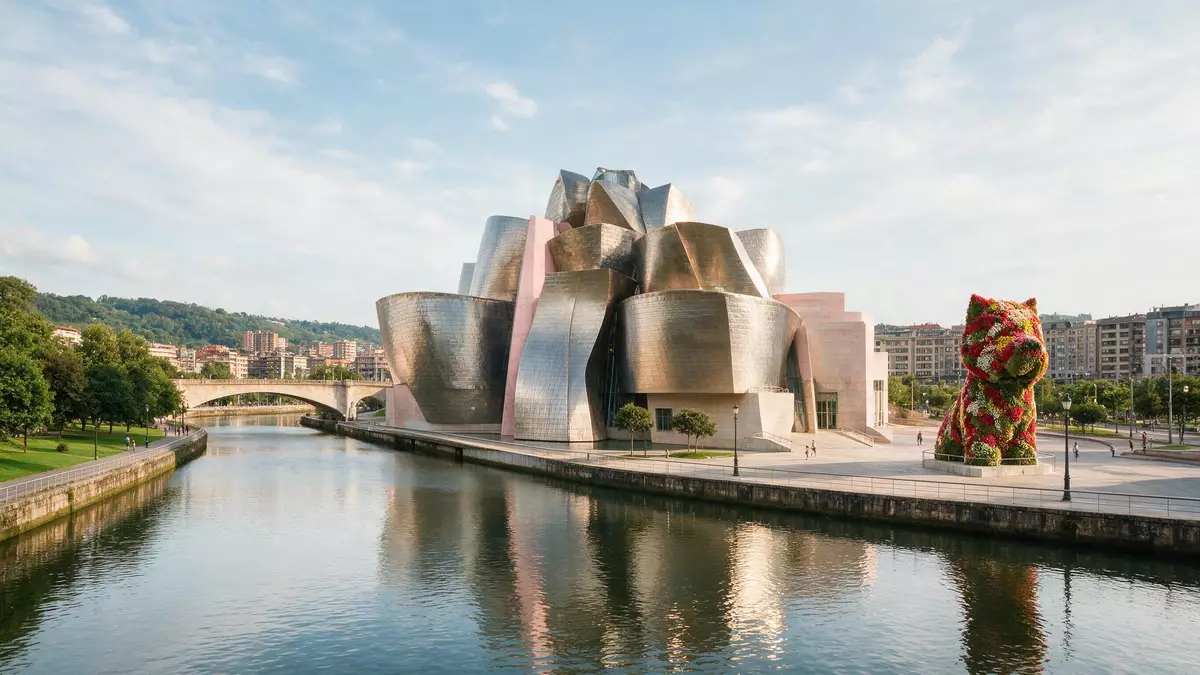
Museo Guggenheim Bilbao is a contemporary art museum on the banks of the Nervión river in Bilbao, Spain, where Frank Gehry’s titanium-clad architecture has become as significant as the artworks it houses. Opened in October 1997, the museum stands in the Basque Country as a landmark of late twentieth-century design and a symbol of Bilbao’s shift from heavy industry towards culture.
A titanium sculpture of a building beside the river
The most striking aspect of Museo Guggenheim Bilbao is its exterior, where sweeping forms are clad in thin titanium panels that catch the Atlantic light over the Nervión.titanium panels The building’s exterior combines titanium, limestone and glass and rises beside the river at Abandoibarra in Bilbao, with the metal wrapping complex, non-orthogonal volumes and setting up a direct contrast with plainer stone areas.titanium, glass and limestone
Frank Gehry’s design assembles a series of intersecting forms: some are straighter limestone-clad volumes, while others are free-flowing titanium elements that extend towards the Nervión and the nearby bridge.rises on the Nervión riverfront Viewed from the riverside promenade, the museum reads almost like an enormous piece of sculpture placed in the city, its surfaces shifting in tone with cloud and sun.
Frank Gehry’s late twentieth-century experiment
Museo Guggenheim Bilbao was designed by Canadian-American architect Frank Gehry for the Solomon R. Guggenheim Foundation and the Basque authorities, with construction beginning in 1993 and completion in October 1997.construction beginning in 1993 It was inaugurated on 18 October 1997 with contemporary art exhibitions and has since been associated with deconstructivist architecture, a movement that embraces fragmented forms, non-orthogonal geometries and expressive materials.inaugurated on 18 October 1997
Gehry’s practice adopted extremely thin titanium sheets fixed over a galvanised steel framework, producing an exterior skin of tens of thousands of panels whose subtly dented surfaces appear to ripple in changing light.titanium, limestone and glass This approach places Museo Guggenheim Bilbao within a wider family of Gehry projects, but the combination of titanium cladding, riverfront setting and varied volumes in Bilbao has become one of the clearest expressions of late twentieth-century experimentation in museum design.Guggenheim Museum, Bilbao
Inside the galleries: contemporary art in sculptural spaces
Behind the titanium surfaces, Museo Guggenheim Bilbao contains a sequence of galleries that negotiate between orthogonal rooms and irregular spaces shaped by the building’s curves. Several galleries are more rectilinear and are clad in limestone, providing calmer backgrounds for works of modern and contemporary art, while other galleries inherit the swirling geometry of the exterior, becoming settings for large-scale installations and site-specific pieces.orthogonal and irregular galleries
Since its opening in 1997, the museum has built a collection focused on key movements in the second half of the twentieth century and the early twenty-first century, with works by artists from America, Europe and the Basque Country.contemporary art collection Many pieces are conceived in dialogue with Gehry’s architecture, using the height of the atrium, the scale of the river-facing galleries or the character of specific spaces to shape how visitors encounter the art.
Visiting Museo Guggenheim Bilbao: what travellers from Western Europe should know
- Museo Guggenheim Bilbao stands on the riverfront at Abandoibarra in central Bilbao, on the banks of the Nervión and within the wider Bilbao metropolitan area.
- The museum is reached on foot along level riverside walks, with internal circulation arranged around an atrium and walkways that link the different gallery levels.
- Bilbao lies in Spain’s Basque Country, where the official languages are Spanish and Basque and the currency is the euro.
- Entry requirements depend on your nationality; UK travellers can check the FCDO travel advice at gov.uk/foreign-travel-advice, Irish travellers the Department of Foreign Affairs at ireland.ie.
Searching for Museo Guggenheim Bilbao on social platforms
These links open searches for Museo Guggenheim Bilbao on each platform.
Frequently asked questions about Museo Guggenheim Bilbao
Where is Museo Guggenheim Bilbao located?
Museo Guggenheim Bilbao stands in Bilbao in Spain’s Basque Country, on Abandoibarra Etorbidea beside the Nervión river in the city’s central area.
What can visitors expect inside Museo Guggenheim Bilbao?
Visitors encounter modern and contemporary artworks displayed in a mix of orthogonal and irregular galleries, with some pieces conceived specifically for Gehry’s sculptural interior spaces.
What makes Museo Guggenheim Bilbao distinctive among European museums?
Its combination of Frank Gehry’s titanium, limestone and glass architecture with a contemporary art collection beside a working riverfront gives the museum a rare fusion of building and setting.


