
Museo Nacional Centro de Arte Reina Sofia and the art of 20th-century Spain
Published on 09/21/2026 at 11:07 | Editorial responsibility: Rafael Müller, Editor-in-Chief AD HOC NEWS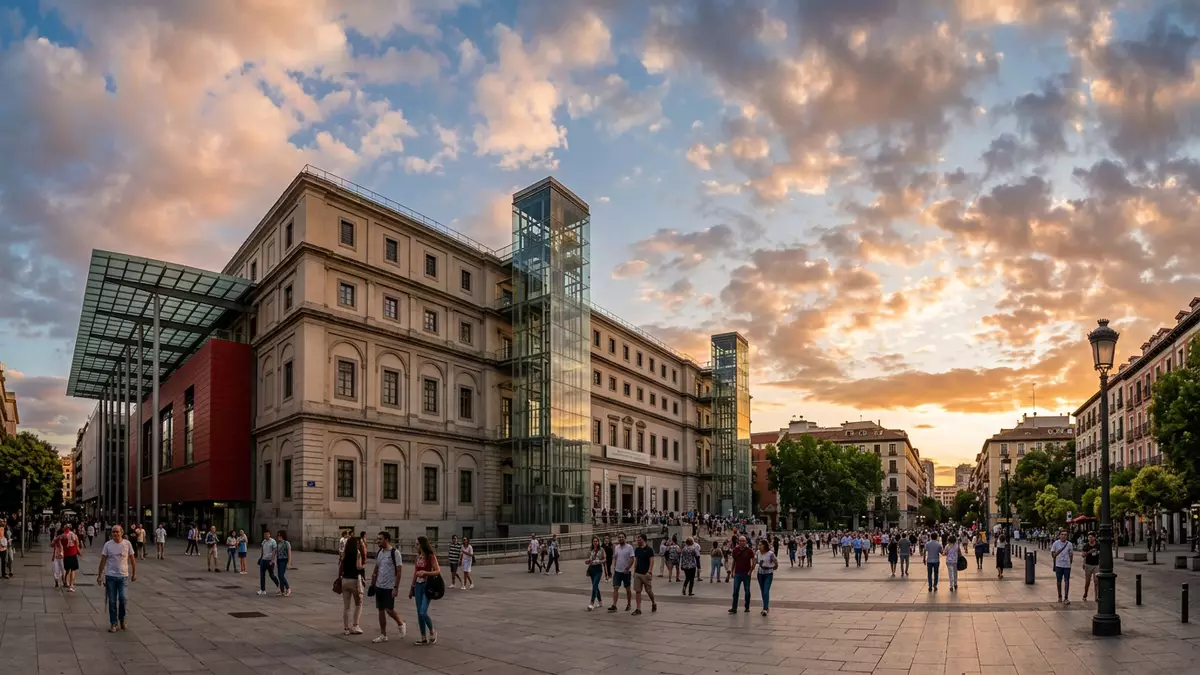
Museo Nacional Centro de Arte Reina Sofia in Madrid brings together Spain’s turbulent twentieth century, modern architecture and a former hospital into a single museum complex dedicated to modern and contemporary art. Its galleries are best known for Pablo Picasso’s “Guernica”, yet the institution’s history, from a sixteenth-century hospital to a national museum opened in 1990, gives the visit a layered sense of place.
From royal hospital to national museum
The story of Museo Nacional Centro de Arte Reina Sofia begins with the royal foundation of San Carlos Hospital in the sixteenth century under King Felipe II, who centralised Madrid’s dispersed hospitals on this site.San Carlos Hospital in the sixteenth century The present-day building took shape in the eighteenth century, when King Carlos III ordered a new hospital complex to respond to Madrid’s growing needs, entrusting architects José de Hermosilla and Francisco Sabatini with the design.architects José de Hermosilla and Francisco Sabatini
The hospital functioned into the twentieth century before closing in the 1960s, leaving a large neoclassical shell near Madrid’s Atocha railway district.the hospital was shut down in 1965 Restoration work directed by architect Antonio Fernández Alba began in 1980, leading to the opening of the Centro de Arte Reina Sofia in 1986 and its designation as a national museum by royal decree in 1988, with the museum in its present form welcoming visitors from 1990.opened its doors in 1990
Sabatini courtyards and Nouvel’s red volumes
The physical experience of Museo Nacional Centro de Arte Reina Sofia is defined by the interplay between the Sabatini Building and the later extension by French architect Jean Nouvel. The original hospital structure, set on Calle de Santa Isabel, frames enclosed courtyards and long corridors, expressing eighteenth-century classicism in its ordered façades and regular windows.the present building is the work of architects José de Hermosilla and Francisco Sabatini Three external lift towers in steel and glass, designed in collaboration with British architect Ian Ritchie, stand against these walls like contemporary appendages, giving visitors transparent views over the surrounding Madrid streets as they move between levels.three steel and glass lifts designed with Ian Ritchie
To the south, along Ronda de Atocha, Jean Nouvel’s extension increases the museum’s surface area with bold volumes and metal canopies that contrast with the older masonry. This Nouvel Building, completed in 2005 after construction starting in 2001, houses temporary exhibition spaces, an auditorium and other cultural facilities that broaden the museum’s role beyond a traditional gallery sequence.new building by Jean Nouvel opened in September of 2005 The result is a campus-like ensemble in which visitors may cross from historic wards to contemporary halls while remaining within a single institution.
Guernica and the focus on twentieth-century Spain
Museo Nacional Centro de Arte Reina Sofia serves as Spain’s national museum of twentieth-century art, concentrating especially on Spanish artists within an international context.Spain's national museum of 20th-century art The permanent collection traces movements from early avant-garde experiments through surrealism, informalism and conceptual practices, with major works by Pablo Picasso, Salvador Dalí and Joan Miró among others.highlights include Picasso, Dalí and Miró The curatorial emphasis on the twentieth century and the Spanish Civil War gives the galleries a distinct narrative compared with Madrid’s Prado and Thyssen-Bornemisza museums along the Paseo del Prado.
At the centre of this narrative stands Picasso’s “Guernica” from 1937, which occupies a dedicated room on Floor 2 of the Sabatini Building.Guernica as the centrepiece of the Picasso collection The painting stretches to 3.49 m (11.45 ft) in height and 7.76 m (25.46 ft) in width, its monochrome palette and fragmented figures confronting visitors with the violence of the bombing of the Basque town of Guernica during the Spanish Civil War.Guernica measures 3.49 metres tall by 7.76 metres wide Surrounding displays contextualise the work with preparatory sketches, documents and pieces by contemporaries, turning one canvas into a wider exploration of art, politics and memory.
Visiting Museo Nacional Centro de Arte Reina Sofia: what travellers from Western Europe should know
- Museo Nacional Centro de Arte Reina Sofia stands on Calle de Santa Isabel in central Madrid, near the transport hub of Atocha railway station and the Estación del Arte metro stop.
- The museum complex comprises the Sabatini Building and the Nouvel Building, linked by covered walkways and courtyards that require some walking between different wings and floors.
- The Sabatini Building retains long corridors and staircases from its hospital layout, while external glass lifts provide vertical circulation along the main façade.
- The official language is Spanish and the currency is the euro.
Searching for Museo Nacional Centro de Arte Reina Sofia on social platforms
These links open searches for Museo Nacional Centro de Arte Reina Sofia on each platform.
Frequently asked questions about Museo Nacional Centro de Arte Reina Sofia
Where is Museo Nacional Centro de Arte Reina Sofia located in Madrid?
Museo Nacional Centro de Arte Reina Sofia stands on Calle de Santa Isabel in central Madrid, close to Atocha railway station and the Estación del Arte metro station.
What can visitors expect inside Museo Nacional Centro de Arte Reina Sofia?
Visitors encounter galleries devoted to twentieth-century and contemporary art, including major works by Spanish artists and the dedicated room housing Picasso’s “Guernica”.
What makes Museo Nacional Centro de Arte Reina Sofia distinctive among Madrid’s museums?
Its combination of a former royal hospital, Jean Nouvel’s extension and a collection focused on twentieth-century Spain, centred on “Guernica”, distinguishes it from other museums along the Paseo del Prado.


