Myeongdong’s hillside streets between cathedral and commerce
Published on 09/02/2026 at 14:25 | Editorial responsibility: Rafael Müller, Editor-in-Chief AD HOC NEWS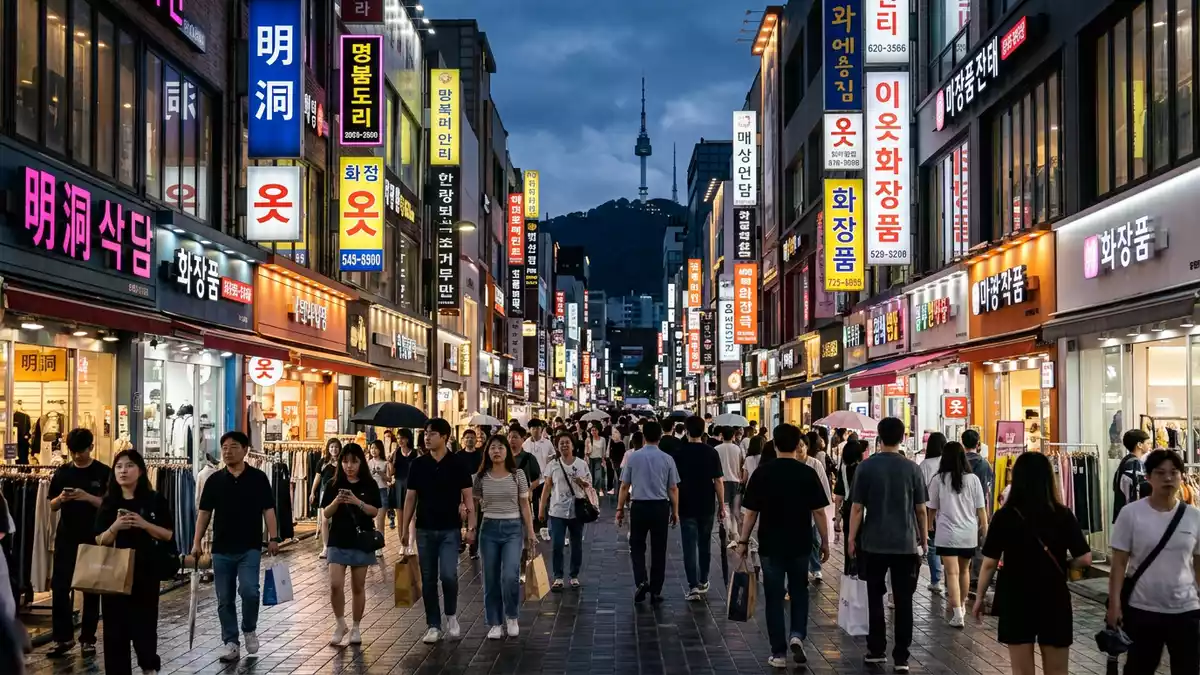
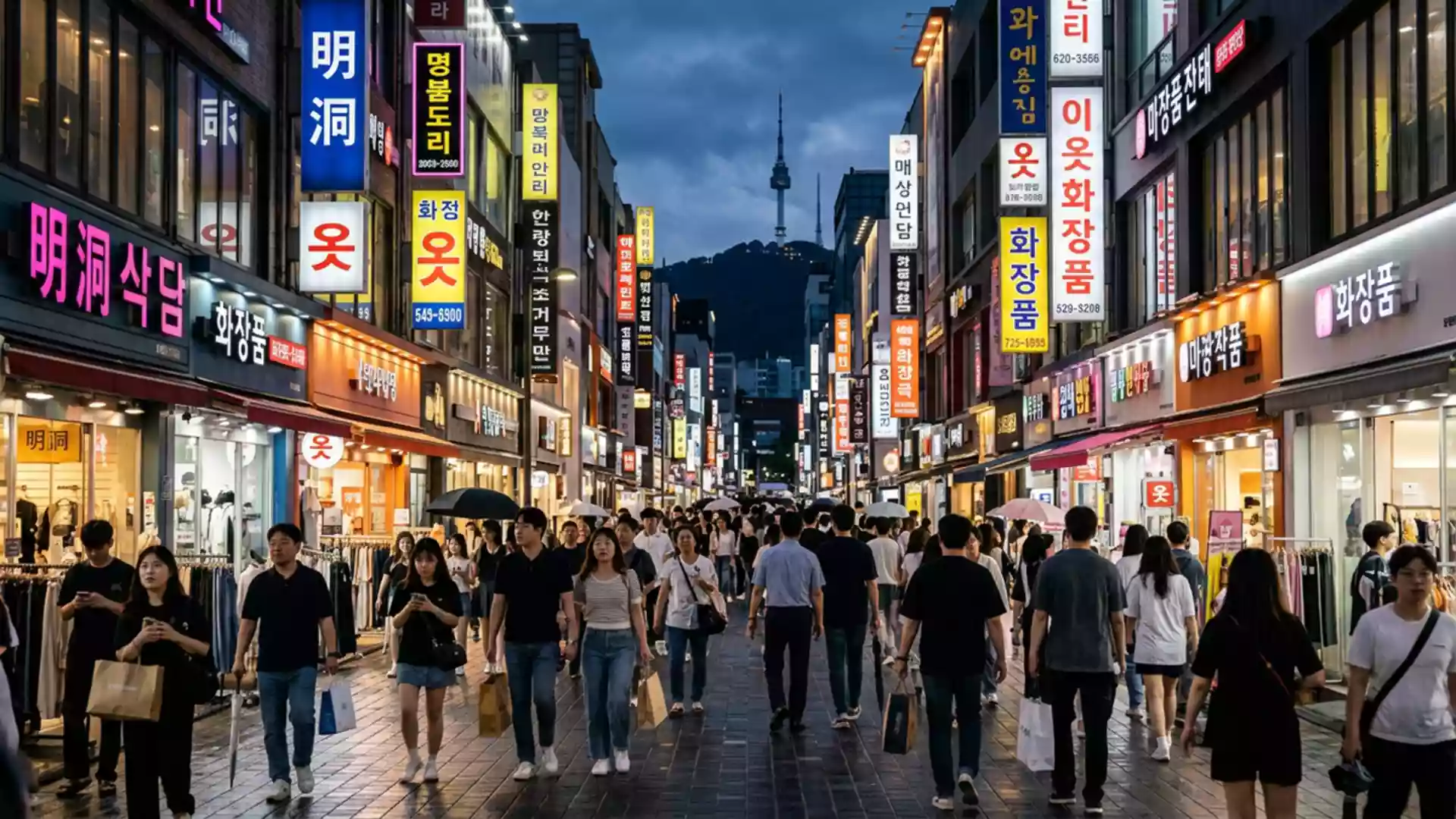
Myeongdong in central Seoul is a compact hillside district where a Gothic brick cathedral rises above dense streets lined with shops, banks and small alleys on the slopes below Namsan Mountain. Its name, tracing back to the Joseon dynasty, marks an area that has shifted from residential quarter to commercial centre and political stage over more than a century.
From Joseon hillside to colonial shopping district
Long before neon signs and department stores arrived, the area now called Myeongdong formed part of the southern ward of Hanseong, the Joseon-era name for Seoul. Historical records refer to it as Myeongryebang or Myeongryebanggol, and also as Chonghyeon, terms connected with its position on a hill and with the administrative divisions of the capital.Myeongryebang or Myeongryebanggol This hillside location placed it in Namchon, the “southern village” below the Cheonggyecheon stream, where scholars and officials once lived among lanes and modest dwellings.Namchon below the Cheonggyecheon
During the Japanese colonial period in the early twentieth century, Myeongdong changed character. The district was renamed Meijicho, taking its name from Emperor Meiji, and Japanese residences and shops transformed the locality into a busy commercial area with modern infrastructure and new streets.renamed Meijicho during colonial rule After liberation from colonial rule, the earlier Japanese name was dropped and the district officially took on the modern name Myeongdong in 1946, retaining the commercial structure while reclaiming a Korean identity.officially named Myeongdong in 1946
Myeongdong Cathedral on the ridge
On the hill above the shopping streets stands Myeongdong Cathedral, formally dedicated as the Cathedral Church of Our Lady of the Immaculate Conception and serving as the national cathedral of the Archdiocese of Seoul.Cathedral Church of Our Lady of the Immaculate Conception Construction of this brick Gothic building began in 1892 and was completed in 1898, giving Seoul a new parish church that would later become a symbol of Korean Catholicism and an important landmark in the city’s religious landscape.construction started in 1892 and was completed in 1898
The cathedral occupies a prominent position within the district, with its brick exterior and pointed towers rising above the surrounding commercial buildings. It has been recognised as Historic Site No. 285 in Korea and is described as the first Gothic-style building constructed in the country, which gives it a special architectural status among Seoul’s churches.Historic Site No. 285 Over the twentieth century, Myeongdong Cathedral also became associated with gatherings and demonstrations during periods of political tension, and its forecourt and interior have appeared repeatedly in accounts of Korea’s democratic movement.linked to Korea’s democratic movement
Dense streets, department stores and finance
Below the cathedral, Myeongdong’s streets form a dense grid of lanes, mid-rise buildings and larger commercial blocks. After the Korean War, financial institutions from nearby Namdaemun-ro and Euljiro expanded into the district, turning parts of Myeongdong into an important centre for banking and securities alongside retail activity.financial sector expanded into Myeongdong Department stores and shopping centres rose along the main streets, bringing escalator halls, wide shopfronts and offices into an area previously characterised by smaller houses.
Through the 1960s and 1970s, Myeongdong became known for fashion and youth culture, with boutiques and cafés occupying floors above street level and international brands joining local businesses. It has often been described as one of Seoul’s primary shopping districts, where visitors encounter cosmetics shops, fashion chains, smaller arcades and street-level stalls packed into a relatively small area.one of the primary shopping districts The presence of banks, company offices and retail complexes side by side gives the district a layered commercial character, with pedestrian streets leading up towards the cathedral ridge.
Visiting Myeongdong: what travellers from Western Europe should know
- Myeongdong lies in Jung-gu, central Seoul, south of the Cheonggyecheon stream and below Namsan Mountain, and is reached by metro with stations on the Seoul Subway system.
- The terrain rises from lower streets toward the cathedral, with slopes, stairways and narrow alleys that can involve short climbs between shopping areas and the church precinct.
- Neighbouring areas include Namdaemun Market and Gwangjang Market within the wider central city, giving access to further traditional stalls and food halls a short metro ride away.
- The official language is Korean and the currency is the South Korean won.
Searching for Myeongdong on social platforms
These links open searches for Myeongdong on each platform.Frequently asked questions about Myeongdong
Where is Myeongdong in Seoul?
Myeongdong is a central district in Jung-gu, Seoul, lying south of the Cheonggyecheon stream and below Namsan Mountain, with metro access on the city’s subway network.
What can visitors expect on a visit to Myeongdong?
Visitors encounter dense shopping streets with department stores, cosmetics and fashion shops, alongside banks, offices and the brick Gothic cathedral rising above the lanes.
What makes Myeongdong distinctive among Seoul’s districts?
The combination of a nineteenth-century Gothic cathedral, colonial-era commercial layout and later finance and retail concentration on a compact hillside gives Myeongdong a distinctive urban character.