
Naqsh-e Jahan and the monumental square of Isfahan
Published on 09/24/2026 at 05:57 | Editorial responsibility: Rafael Müller, Editor-in-Chief AD HOC NEWS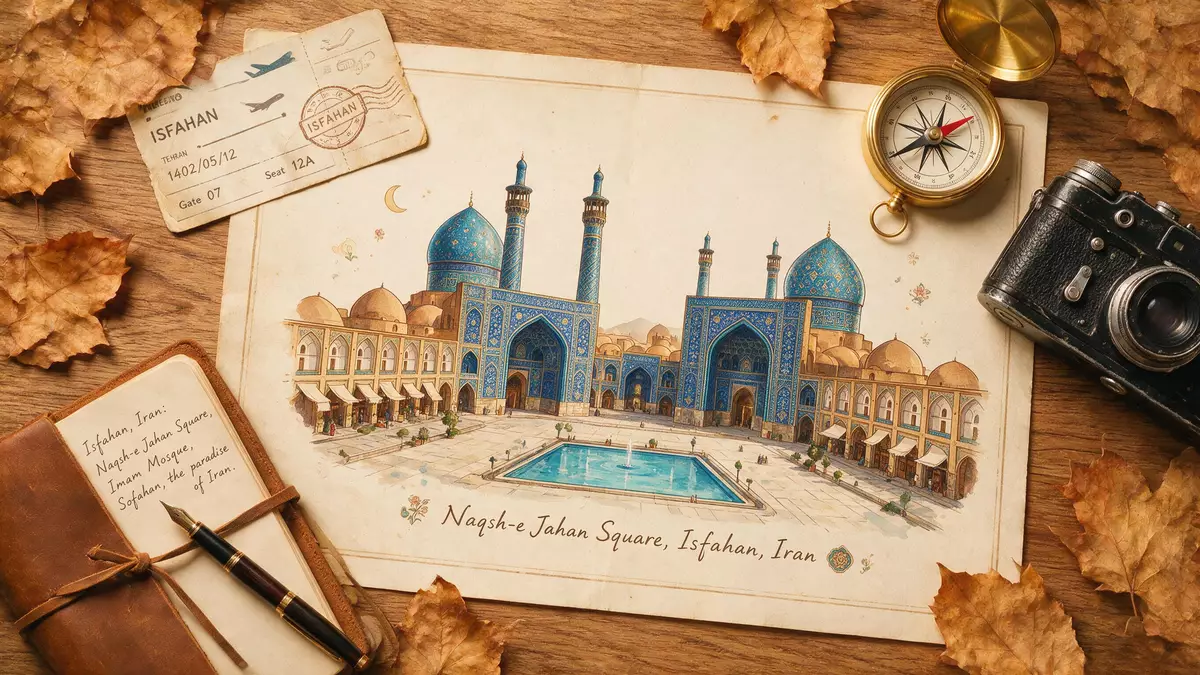
Naqsh-e Jahan is a vast public square at the centre of Isfahan, Iran. Its long open ground is enclosed by arcades, mosques, a palace and a bazaar, creating a Safavid urban ensemble on an exceptional scale.
Naqsh-e Jahan: a square measured in hundreds of metres
The square measures 560 metres (1,837 ft) from north to south and 160 metres (525 ft) across. Its area is close to nine hectares, with the long rectangle forming a clear stage for the buildings around its edges. UNESCO’s Meidan Emam record gives the same dimensions and identifies the site as an outstanding example of Iranian and Islamic architecture.
Two-storey arcades run around the perimeter. Shops occupy the lower level, while the continuous frontage gives the open centre a strong architectural boundary. Enamelled ceramic tiles and painted decoration cover the surrounding buildings, with floral ornament, calligraphic panels and patterned surfaces appearing across the ensemble.
Shah Abbas I and the Safavid urban ensemble
Naqsh-e Jahan was built under Shah Abbas I at the beginning of the seventeenth century. Construction took place between 1598 and 1629, during the Safavid dynasty, whose rule shaped Isfahan’s monuments, public spaces and religious architecture.
The square is anchored by four major buildings. The Royal Mosque, also called Masjed-e Shah, occupies the south side. Sheikh Lotfollah Mosque faces it from the east, Ali Qapu pavilion rises on the west, and Qeyssariyeh portico marks the northern side beside the bazaar. The Safavid square’s four landmarks define its principal axes.
Ali Qapu forms a tall entrance to the royal quarter behind the western arcade. Its terrace and painted rooms overlook the square. The northern Qeyssariyeh portico opens towards Isfahan Bazaar, a covered market route extending through the historic city.
Four monuments around one public space
The Royal Mosque is connected to the square by a monumental entrance portal. Its prayer hall and dome belong to the colourful architectural language of Safavid Iran, with glazed tilework covering major surfaces. The mosque’s axis turns away from the square’s alignment before reaching the sanctuary.
Sheikh Lotfollah Mosque has a more private character within the ensemble. Its dome and entrance decoration face the square across from Ali Qapu. Together, the two religious buildings provide a visual counterpoint to the palace and market entrance.
The square’s history includes commerce, royal ceremony, public gatherings and polo. The open centre also accommodated military assemblies and public performances, while shops around the edges connected the royal precinct with the working city. These uses made Naqsh-e Jahan a civic space as well as an architectural composition.
Naqsh-e Jahan entered the UNESCO World Heritage List in 1979 under the name Meidan Emam, Esfahan. Its listed significance covers the square, its arcades and the principal monuments around it, linking architecture with the social and cultural life of the Safavid period. The 1979 heritage inscription records the square’s place within Iran’s historic legacy.
Visiting Naqsh-e Jahan: what travellers from Western Europe should know
- Naqsh-e Jahan lies in central Isfahan, with the Royal Mosque to the south and Qeyssariyeh portico opening towards the bazaar.
- The square is a broad paved urban space surrounded by arcades. Visits involve walking across the open centre and along the perimeter.
- The surrounding monuments contain portals, courtyards, domes, terraces and decorated interiors, so the experience extends beyond the central square.
- The official language is Persian and the currency is the Iranian rial.
- Entry requirements depend on your nationality; UK travellers can check the FCDO travel advice at gov.uk/foreign-travel-advice, Irish travellers the Department of Foreign Affairs at ireland.ie.
Searching for Naqsh-e Jahan on social platforms
These links open searches for Naqsh-e Jahan on each platform.
Frequently asked questions about Naqsh-e Jahan
Where is Naqsh-e Jahan?
Naqsh-e Jahan is in central Isfahan, Iran. The square forms part of the city’s historic urban centre.
What surrounds the square?
Two-storey arcades surround the open centre, with the Royal Mosque, Sheikh Lotfollah Mosque, Ali Qapu pavilion and Qeyssariyeh portico at the principal sides.
What makes Naqsh-e Jahan distinctive?
Its 560-metre length, Safavid monuments and continuous decorated arcades combine civic space, worship, royal architecture and commerce in one ensemble.


