
Notre-Dame de Paris and its layered Gothic form
Published on 09/24/2026 at 04:09 | Editorial responsibility: Rafael Müller, Editor-in-Chief AD HOC NEWS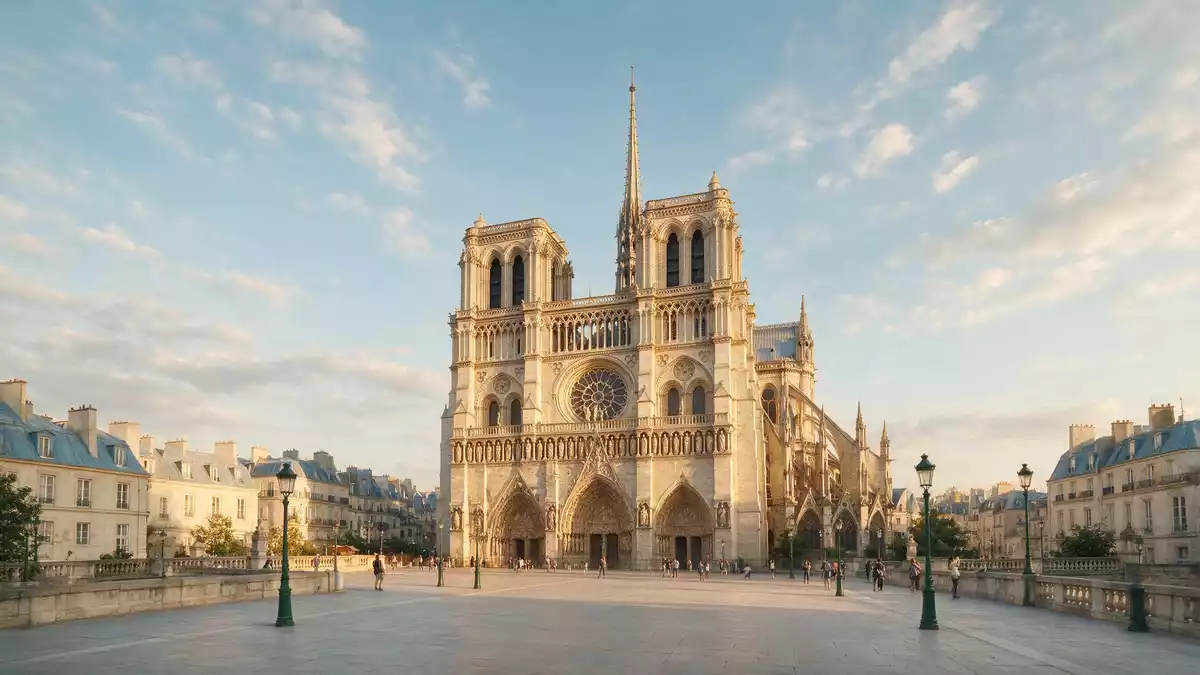
Notre-Dame de Paris rises on the Île de la Cité as a Gothic cathedral assembled across generations. Its broad western façade, pointed arches, rose windows and flying buttresses form a single architectural composition, while the building’s long history remains visible in its different layers.
Notre-Dame de Paris: a cathedral built across centuries
Construction began in 1163, when Maurice de Sully was bishop of Paris. Pope Alexander III took part in laying the foundation stone, and the choir was consecrated in 1189. The main medieval campaign continued through the twelfth and thirteenth centuries, with additional chapels and architectural elements appearing afterwards. the medieval construction phases show how the cathedral developed through successive stages.
The western façade and nave had reached completion by 1250, while further work continued into the following century. This extended building history belongs to the character of Notre-Dame de Paris: the cathedral is not a single frozen design, but a Gothic ensemble whose parts belong to different moments.
Stone, glass and the language of French Gothic
The cathedral’s exterior is defined by pale masonry, deep portals, sculpted figures and two massive western towers. Pointed arches organise the portals and windows, while flying buttresses project from the sides and support the high walls of the nave and choir. These elements remain visible from the surrounding streets and quays.
Large rose windows bring coloured glass into the western and transept façades. The nave connects the western entrance with the choir, and side aisles extend the interior beneath the higher central vessel. Galleries, chapels and an ambulatory add further layers to the plan. the cathedral’s Gothic character comes from the relationship between its vertical walls, stone vaults, pointed openings and external supports.
Notre-Dame de Paris on the Île de la Cité
The cathedral occupies the historic island in the Seine at the centre of Paris. Its position places medieval architecture beside river quays, bridges and the dense urban fabric of the French capital. The building’s western front faces the island’s civic routes, while the eastern end extends towards the Seine.
Notre-Dame de Paris has served as a place of Christian worship through the centuries and has also hosted major ceremonies in French history. Its architectural and historical importance forms part of the “Paris, Banks of the Seine” World Heritage site, inscribed in 1991. the World Heritage setting includes Notre-Dame within the protected river landscape of central Paris.
The cathedral also carries the marks of restoration and alteration. Eighteenth-century changes and nineteenth-century restoration form part of its recorded history, alongside the medieval fabric. its recorded history therefore extends from the twelfth century into later phases of French architectural conservation.
Visiting Notre-Dame de Paris: what travellers from Western Europe should know
- Notre-Dame de Paris stands on the Île de la Cité in central Paris, beside the Seine. Metro, RER, buses and walking routes connect the island with the surrounding districts.
- The approach crosses city streets and paved quays. Inside, the cathedral’s scale is defined by a high central nave, side aisles, chapels and an ambulatory.
- The official language is French and the currency is the euro.
Searching for Notre-Dame de Paris on social platforms
These links open searches for Notre-Dame de Paris on each platform.
Frequently asked questions about Notre-Dame de Paris
Where is Notre-Dame de Paris?
Notre-Dame de Paris stands on the Île de la Cité, an island in the Seine at the historic centre of Paris.
What can visitors expect from the building?
The cathedral presents a Gothic interior with a high nave, side aisles, chapels, stone vaults, coloured glass and an ambulatory around the choir.
What makes Notre-Dame de Paris distinctive?
Its distinctive character comes from the combination of a twelfth-century foundation, medieval Gothic additions, later restorations and a prominent position beside the Seine.


