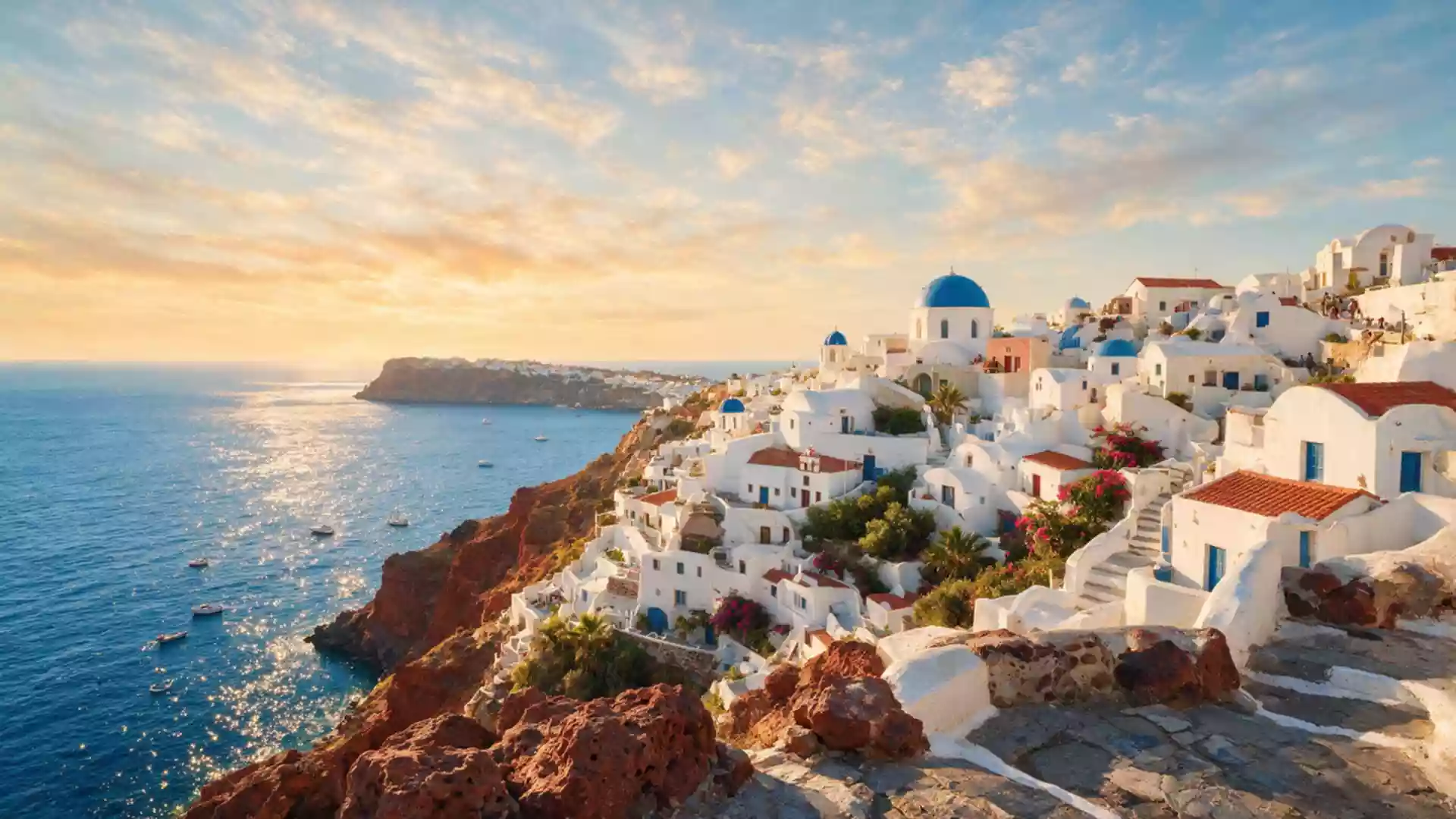
Oia’s cliffside village above the Santorin caldera
Published on 09/03/2026 at 17:25 | Editorial responsibility: Rafael Müller, Editor-in-Chief AD HOC NEWS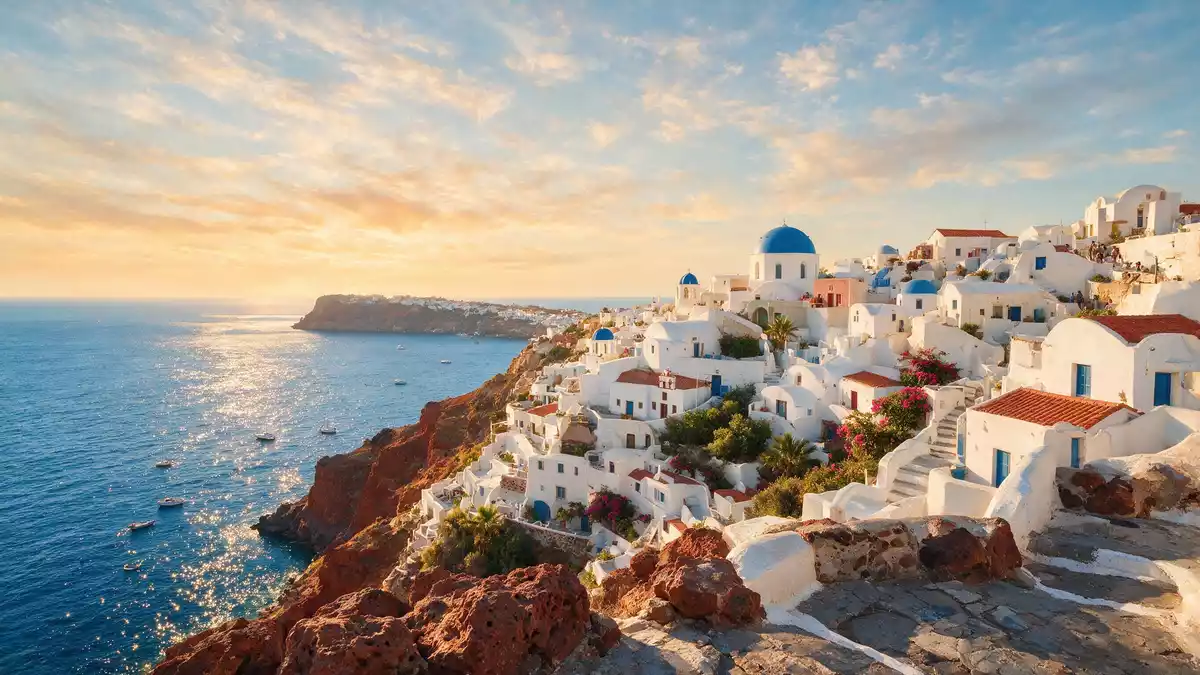
Oia on Santorin in Greece is a cliffside village built on the rim of a volcanic caldera, where whitewashed houses and blue-domed churches overlook the Aegean Sea far below.
Clinging to the caldera rim
Oia occupies the northern end of Santorin’s caldera, set on steep cliffs above the sea where the island curves around the remains of a volcano.The settlement lies at the highest section of the caldera, so much of the village looks down on water enclosed by dark volcanic rock. The houses follow the line of the cliff in terraces, with narrow lanes and stairways threading between them.
The village is commonly described as Cycladic in character, with cubic houses, white limewashed walls and churches whose domes stand out against the rock and sea.Traditional Cycladic and Thiran architecture is preserved in Oia, and the pattern of white façades and blue roofs has become closely associated with Santorin. From many points in the village there are views across the caldera to other parts of the island and to smaller volcanic islets in the basin.
From medieval fortress to protected settlement
Oia’s history reaches back to the late medieval period, when it formed one of the fortified sites on Santorin under Latin rule.The village was built around the thirteenth century during Frankish rule and was known as the castle of Agios Nikolaos, one of several castles on the island. Later sources refer to this fortified settlement and its role in guarding the northern approaches to Santorin.The castle of Saint Nicholas is documented from the fifteenth century, providing a named anchor for the early village.
Over time the fortified core expanded into a larger settlement that came to be known as Oia, also referred to as Apanomeria or Pano Meria in some accounts.The name Oia replaced earlier forms such as Apano Meria in the nineteenth century, reflecting the shift from a castle-centred hamlet to a recognised village. In the twentieth century Oia was formally designated a traditional settlement, and the protected status helps to maintain its historic building forms and materials.Oia has been declared a traditional settlement preserving its architecture, so its medieval roots and later seafaring prosperity remain visible in the street pattern and house types.
Cave houses and captains’ mansions
Oia’s built fabric is defined by two main types of dwelling: houses cut into the volcanic rock and larger surface-built homes associated with ship owners.The settlement includes undercut cavern houses and kapetanospita, both arranged along and above the caldera rim. The cavern houses occupy niches in the cliff, with compact interiors and domed roofs, while the kapetanospita are broader, rectilinear houses standing above ground, for families linked to maritime trade.
In the nineteenth century shipowners and captains in Oia invested in larger residences that still stand out among the smaller cliff dwellings.Wealthy ship captains of the late nineteenth century built neoclassical mansions in Oia, giving parts of the village higher façades, carved details and more regular street frontages. The contrast between rock-cut houses and mansions is visible in the layout: one side of the central road faces the caldera with many cave houses, while the other carries more conventional buildings.Yposkafa carved into volcanic rock stand opposite the kapetanospita, and the two types together express the village’s maritime and local social history.
White and blue churches above the sea
Among Oia’s most photographed features are the Greek Orthodox churches whose white walls and blue domes line the caldera edge. Two small churches in the village, Agios Spyridonas and the Anastasi Church, are often identified with images of blue domes above the sea.The blue-domed churches of Oia include Agios Spyridonas and the Anastasi Church, both active places of worship as well as landmarks. Their domes stand near other white structures and cascades of cave houses, forming a layered scene over the caldera basin.
In the centre of the village, Panagia Platsani is another important church with a distinctive dome and bell tower.Panagia Platsani is a nineteenth-century church with a blue dome, positioned off the main pedestrian route. The blue-and-white colour scheme seen on these churches became widespread on Santorin in the second half of the twentieth century, echoing the Greek flag and reinforcing a visual link between religious buildings, village houses and the sky and water surrounding the island.Blue-and-white church colours became common in the later twentieth century, and they now define much of the village’s appearance.
Visiting Oia: what travellers from Western Europe should know
- Oia lies on the north-western side of Santorin, on the rim of the volcanic caldera above the Aegean Sea; the island’s main town, Fira, stands further south along the same arc.
- The village climbs steep cliffs, with many lanes made up of steps and sloping paths; moving between different levels often involves staircases cut into or built against the rock.
- Below Oia, small bays such as Ammoudi sit at sea level; reaching them from the village involves a descent on foot along paths that link the cliffside settlement to the water.
- The official language is Greek and the currency is the euro.
Searching for Oia on social platforms
These links open searches for Oia on each platform.Frequently asked questions about Oia
Where is Oia on Santorin?
Oia is located on the north-western part of Santorin, built on steep cliffs along the rim of the island’s volcanic caldera above the Aegean Sea.
What should visitors expect in Oia’s streets?
Visitors encounter stepped lanes, cave houses cut into the rock, neoclassical captains’ mansions and churches with white walls and blue domes overlooking the caldera.
What makes Oia distinctive among Greek island villages?
Oia combines a medieval castle origin, a maritime past expressed in captains’ houses and cavern dwellings, and a dramatic setting on the edge of a volcanic basin.