
Opera Garnier and its grand staircase of marble and light
Published on 08/29/2026 at 14:35 | Editorial responsibility: Rafael Müller, Editor-in-Chief AD HOC NEWS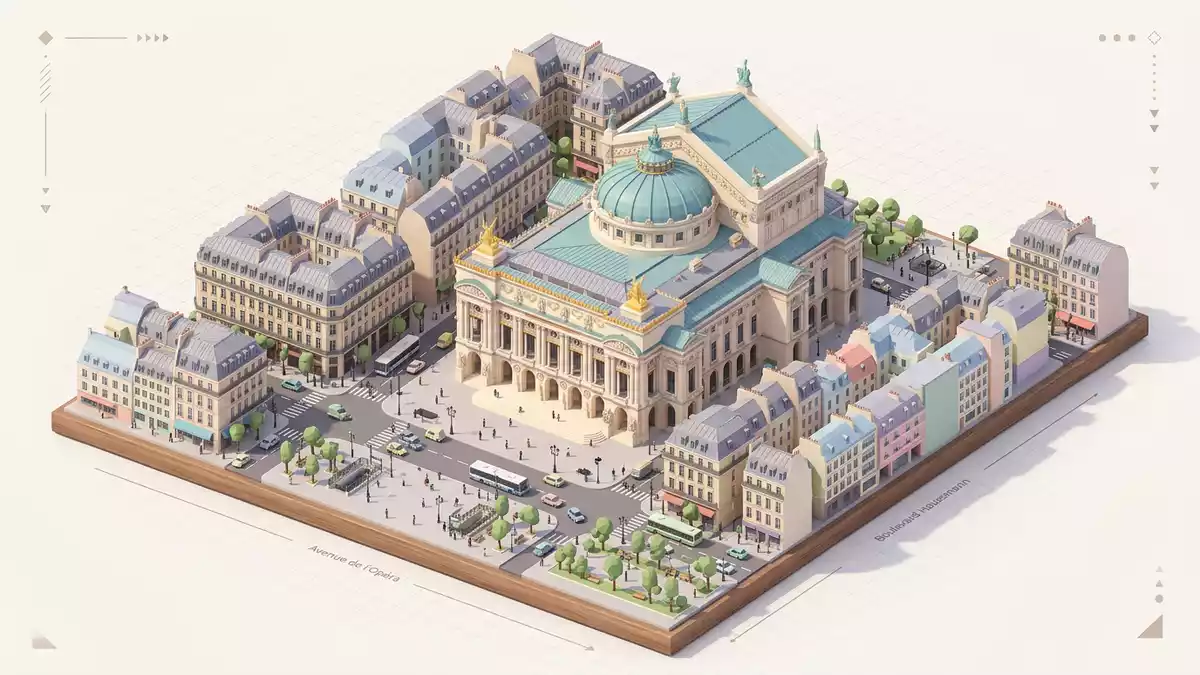
Opera Garnier in Paris is a nineteenth?century opera house whose cascading marble staircase and gilded foyers turn arrival itself into a performance. Built as the Palais Garnier for the Paris Opera in the later years of the Second Empire and completed in 1875, it carries the name of its architect, Charles Garnier, and anchors the wide Place de l’Opéra in the city’s 9th arrondissement.
A palace of opera in the 9th arrondissement
Opera Garnier stands on the Place de l’Opéra in the 9th arrondissement of Paris, surrounded by Haussmann?era boulevards and aligned with the avenue de l’Opéra. Conceived as the main theatre of the Paris Opera and its ballet company, it was built between 1861 and 1875 for a capacity of about 1,979 seats in an Italian?style auditorium, making it one of the larger historic opera houses in Europe.Italian?style auditorium Behind its name lies architect Charles Garnier, whose design won an 1861 competition called under Emperor Napoleon III and brought together classical and Baroque influences in a single elaborate composition.competition announced in 1861
The building’s role has shifted since its inauguration in 1875. For much of its history it served as the principal home of the Paris Opera, but from 1989 the opera company’s main performances moved to the Opéra Bastille on the Place de la Bastille, while Opera Garnier became the primary venue for the Paris Opera Ballet and a site open to visitors exploring its architecture.principal home of the Paris Opera The building itself has been listed as a historical monument in France since 1923, securing its status as part of the capital’s architectural heritage.listed as a historical monument since 1923
Marble, gilding and the grand staircase
Inside Opera Garnier, the lead experience is a movement through space, beginning with the grand staircase that rises from the entrance hall. This staircase is built of different marbles and flanked by colonnades, balustrades and sculpted candelabra, giving it a theatrical presence that mirrors the performances staged above.sweeping marble staircase The surrounding foyers, including the grand foyer, are lined with mirrors, gilded mouldings and painted ceilings, so that the spaces for circulation have the richness of a palace ballroom.
Beyond the staircase and foyers lies the horseshoe?shaped auditorium, designed in the Italian tradition with tiers of boxes and galleries around a deep stage. The auditorium ceiling is a later intervention, repainted in 1964 by Marc Chagall, whose colourful composition encircles the central chandelier and adds a twentieth?century layer to the nineteenth?century interior.ceiling painted in 1964 by Marc Chagall Behind and above the visible public areas, the building houses rehearsal studios, workshops and a museum?library, making it not only a performance venue but also a working base for artists and craftspeople associated with the Paris Opera.rehearsal studios and workshops
Second Empire grandeur on the Paris streetscape
Opera Garnier is a textbook example of Second Empire architecture in Paris, with a facade combining columns, sculpture, archways and rich ornament along the Haussmannian axis of the avenue de l’Opéra.architectural masterpiece of the Second Empire The exterior carries allegorical statuary, including figures representing music and dance, and is crowned by a prominent dome above the auditorium; this dome is visible from surrounding streets and has become part of the recognisable skyline of central Paris.
The city layout around Opera Garnier was shaped by the broader transformation of Paris under Baron Haussmann in the nineteenth century, and the opera house occupies a key position at the northern end of the avenue de l’Opéra.end of a Haussmannian axis The building’s placement on a wide square, with streets radiating away from it, emphasises its role as both a cultural institution and a piece of urban theatre, fronted by regular lines of façades and shops that belong to the broader grands boulevards district.
Visiting Opera Garnier: what travellers from Western Europe should know
- Opera Garnier stands on Place de l’Opéra in the 9th arrondissement; the entrance for visits is at the corner of rue Scribe and rue Auber, close to Opéra métro station on lines 3, 7 and 8.
- The building’s interior includes staircases, foyers and galleries; visiting involves walking and climbing steps, particularly around the grand staircase and the higher levels of the auditorium.
- Opera Garnier is in France; the official language is French and the currency is the euro.
Searching for Opera Garnier on social platforms
These links open searches for Opera Garnier on each platform.
Frequently asked questions about Opera Garnier
Where is Opera Garnier in Paris?
Opera Garnier stands on Place de l’Opéra in the 9th arrondissement, at the northern end of avenue de l’Opéra and close to Opéra métro station.
What can visitors expect inside Opera Garnier?
Visitors encounter a grand marble staircase, richly decorated foyers, an Italian?style auditorium with a ceiling painted by Marc Chagall, and various circulation spaces.
What makes Opera Garnier distinctive among opera houses?
Its combination of Second Empire architecture, Charles Garnier’s elaborate design and the way the staircase and foyers turn movement through the building into part of the spectacle give it a distinctive character.


