
Palacio de La Moneda and Santiago’s neoclassical seat of power
Published on 09/24/2026 at 00:24 | Editorial responsibility: Rafael Müller, Editor-in-Chief AD HOC NEWS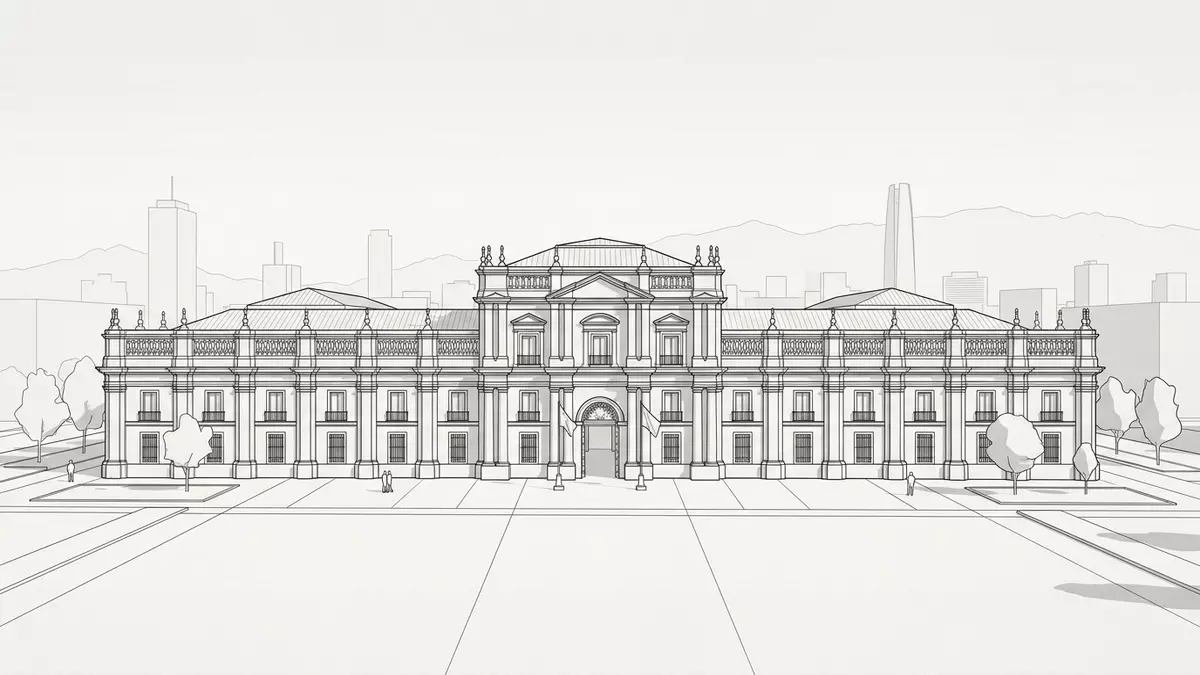
Palacio de La Moneda occupies a full city block in Santiago de Chile, its long pale façades enclosing courtyards behind ordered neoclassical walls. Designed by the Italian architect Joaquín Toesca, it opened in 1805 as the Royal Mint of Santiago before becoming the seat of Chile’s executive power.
Palacio de La Moneda began as a royal mint
Construction began in 1784 during the Spanish colonial period. The project created a specialised building for producing coins, a function reflected in the name La Moneda, meaning “the mint”.
Toesca shaped the palace in a restrained neoclassical language with Roman Doric influences. Its composition is horizontal, with regular façades, strong wall surfaces and a measured rhythm of openings. The building’s formal appearance differs from the industrial work carried out inside it.
Joaquín Toesca’s neoclassical block
Palacio de La Moneda is associated with Joaquín Toesca’s design, which belongs to the late eighteenth-century architectural culture of the Spanish Empire. The palace uses a clear geometric arrangement rather than an elaborate sculptural exterior.
The building extends between Moneda Street, Morandé Street, Teatinos Street and Avenida Libertador Bernardo O’Higgins. Internal courtyards form part of its plan, while the surrounding streets place the palace directly within Santiago’s civic centre.
From coin production to executive government
Palacio de La Moneda became the seat of government and a presidential residence in 1846 during the administration of Manuel Bulnes. Its earlier industrial role continued alongside its political use, linking the building’s colonial origins with Chile’s republican institutions.
Coin production continued within the complex into the twentieth century. The palace then became identified primarily with the Presidency, government ministries and the public history of Chile. Its façades and courtyards therefore belong to two distinct chapters: monetary production and executive government.
The building is also associated with the military coup of 11 September 1973, when the palace was bombed during the overthrow of President Salvador Allende. This event remains part of Palacio de La Moneda’s historical meaning and Chile’s political memory.
Visiting Palacio de La Moneda: what travellers from Western Europe should know
- Palacio de La Moneda stands in central Santiago between Plaza de la Constitución and Plaza de la Libertad. The palace is reached through the city’s central streets and public-transport network.
- The building occupies an entire urban block, with façades facing Moneda, Morandé, Teatinos and Avenida Libertador Bernardo O’Higgins. Its courtyards and entrances form distinct parts of the complex.
- The official language is Spanish and the currency is the Chilean peso.
- Entry requirements depend on your nationality; UK travellers can check the FCDO travel advice at gov.uk/foreign-travel-advice, Irish travellers the Department of Foreign Affairs at ireland.ie.
Searching for Palacio de La Moneda on social platforms
These links open searches for Palacio de La Moneda on each platform.
Frequently asked questions about Palacio de La Moneda
Where is Palacio de La Moneda?
Palacio de La Moneda is in central Santiago de Chile, between Plaza de la Constitución and Plaza de la Libertad. Its city-block plan is bounded by Moneda, Morandé, Teatinos and Avenida Libertador Bernardo O’Higgins.
What can visitors expect from the building?
The palace presents long neoclassical façades, Roman Doric influences and internal courtyards. Its architectural form can be read alongside its history as a mint and a government building.
What makes Palacio de La Moneda distinctive?
Its distinctive character comes from the change between its original role as the Royal Mint of Santiago and its later function as Chile’s executive centre. Joaquín Toesca’s 1805 building remains tied to both monetary history and national politics.


