
Palazzo Ducale and the layered architecture of Venetian power
Published on 09/24/2026 at 00:53 | Editorial responsibility: Rafael Müller, Editor-in-Chief AD HOC NEWS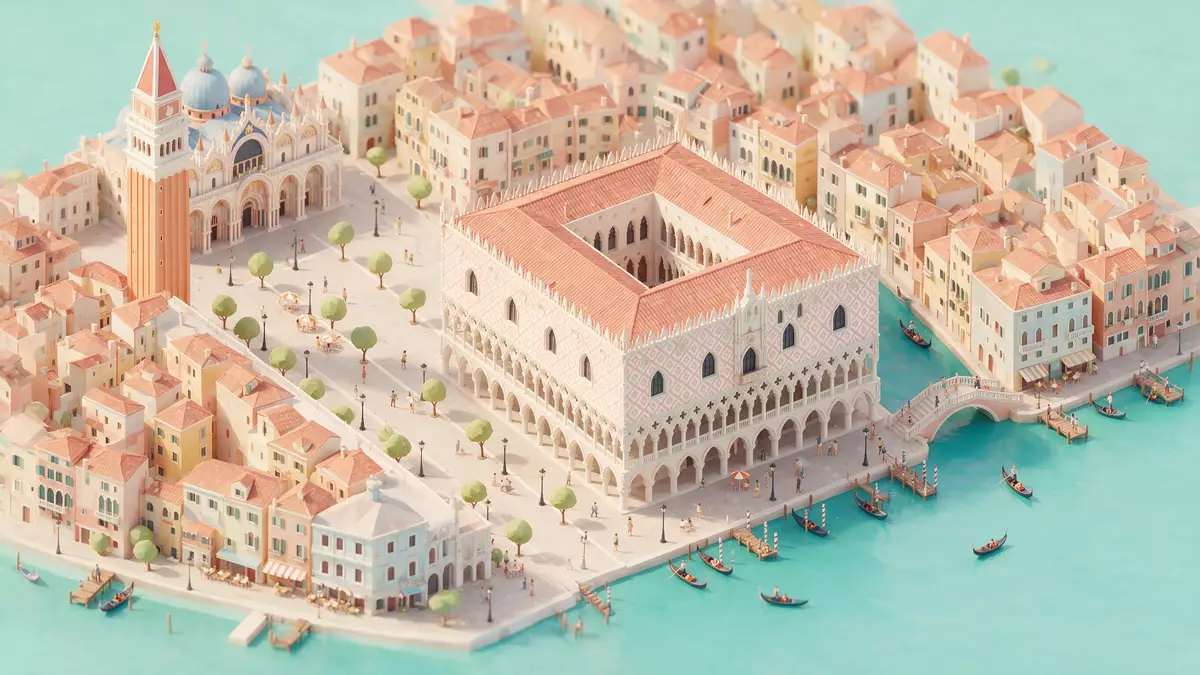
Palazzo Ducale is a palace of contrasting layers beside St Mark’s Square in Venedig. Its white stone arcades, patterned upper walls and richly decorated chambers preserve the former seat of the Doge and the Venetian Republic.
Palazzo Ducale rises from Gothic arcades
The palace presents a remarkable arrangement of weight and openness. At ground level, pointed arches and columns form a long loggia. Above them, a lighter arcade extends beneath walls faced with pink and white stone.
The building is a major work of Venetian Gothic architecture, but its appearance also contains Renaissance and Mannerist elements. The result is not a single-period monument. It is a complex assembled through successive rebuilding, extension and decoration.
The oldest surviving wing faces the Bacino di San Marco and was rebuilt from 1340 onwards. The side facing St Mark’s Square reached its present form from 1424, while the canal-side wing belongs largely to the Renaissance and was built between 1483 and 1565.
From Venetian government to museum rooms
The origins of Palazzo Ducale reach back to the ninth century. In 810, Doge Angelo Partecipazio moved the seat of government to the Rialto area, establishing the palace’s place within the political history of Venice.
The Doge’s residence occupied the same complex as the governing councils, magistrates and administrative offices of the Venetian Republic. The palace therefore combined ceremonial rooms with spaces connected to government and justice.
Venice’s political order ended with Napoleon Bonaparte’s conquest in 1797. Palazzo Ducale later became a public museum, and its rooms preserve the relationship between civic authority, religious imagery and Venetian artistic production.
The building belongs to Venice and its Lagoon, inscribed on the UNESCO World Heritage List in 1987. Venice and its Lagoon is recognised for its historical, urban and artistic heritage.
Tintoretto, Veronese and the Great Council Chamber
The institutional chambers contain paintings and decoration by Jacopo Tintoretto, Domenico Tintoretto, Paolo Veronese and other Venetian artists. These rooms connect the visual richness of the palace with the work of the republic’s political institutions.
The Great Council Chamber measures 53 metres long and 25 metres wide. Its walls and ceiling carry an extensive programme of paintings, including Tintoretto’s Paradise, produced with his workshop between 1588 and 1592.
The chamber was used for meetings of the Great Council, the principal political body of the republic. Nearby rooms served other councils and magistracies, creating a sequence of spaces associated with deliberation, scrutiny and law.
Palazzo Ducale also connects political interiors with a darker part of Venetian civic history. The Bridge of Sighs, built in 1614, links the palace with the New Prisons across the canal. the Bridge of Sighs forms an enclosed passage between the two structures.
The palace’s architectural history is visible in its materials, rooms and connections. Gothic stonework, Renaissance planning, painted chambers and the prison passage belong to one complex beside the lagoon.
Visiting Palazzo Ducale: what travellers from Western Europe should know
- Palazzo Ducale stands beside St Mark’s Square and the Bacino di San Marco in the San Marco district of Venedig. It is reached through Venice’s pedestrian streets and water-transport network.
- The visit includes courtyards, loggias, monumental staircases and large institutional chambers. The route also crosses the enclosed Bridge of Sighs towards the former prison complex.
- The official language is Italian and the currency is the euro.
Searching for Palazzo Ducale on social platforms
These links open searches for Palazzo Ducale on each platform.
Frequently asked questions about Palazzo Ducale
Where is Palazzo Ducale?
Palazzo Ducale stands beside St Mark’s Square in San Marco, Venedig. Its façades face the square, the lagoon basin and the surrounding Venetian waterways.
What can visitors expect inside?
The interior contains courtyards, monumental staircases, institutional chambers, painted ceilings and the Great Council Chamber. The route also includes the Bridge of Sighs and its connection with the former New Prisons.
What makes Palazzo Ducale distinctive?
Its distinctive character comes from the combination of Gothic arcades, Renaissance additions and Mannerist decoration. The palace also joins the former residence of the Doge with government rooms and prison passages.


