
Palazzo Ducale in Venedig: a marble palace of power and spectacle
Published on 09/18/2026 at 06:55 | Editorial responsibility: Rafael Müller, Editor-in-Chief AD HOC NEWS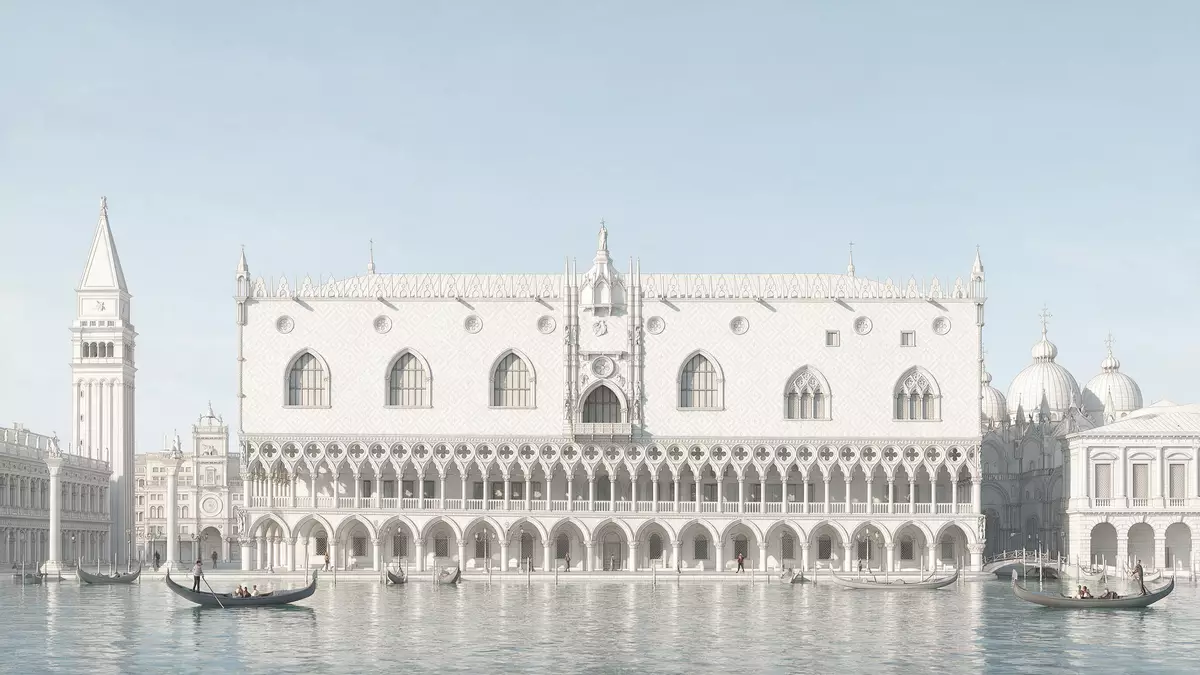
Palazzo Ducale, known in English as the Doge’s Palace, rises beside the waterfront in Venedig as a vast Gothic palace that once concentrated political power, ceremonial display and everyday administration in a single building. Its present form took shape between the fourteenth and sixteenth centuries, when the Venetian Republic rebuilt and extended earlier structures into the marble-clad palace that still dominates the approach to Piazza San Marco.
Gothic façades of pink marble and white stone
The most striking aspect of Palazzo Ducale is the way its outer façades combine mass and delicacy along the edges of St Mark’s Basin and the Piazzetta San Marco. The main elevations are faced in pink Verona marble laid over pale Istrian stone, set above two stacked levels of pointed arcades and tracery that have become a defining image of Venetian Gothic architecture.pink Verona marble and Istrian stone The lower storey forms a rhythmic sequence of sturdy columns and arches, carrying an upper loggia of slimmer supports and ornamental stonework, so that the heavy wall above seems to rest on a surprisingly open framework.
The wing facing the St Mark’s Basin is the oldest part of the present palace, rebuilt from 1340 onwards after earlier structures on the site were replaced.rebuilt from 1340 onwards Along the side towards the main square, the façade in its present form dates from work begun in 1424, extending the same pattern of arcades and marble cladding to form a continuous monumental edge to the civic space. At the junction between the palace and the neighbouring basilica stands the ornate Porta della Carta, the ceremonial gateway designed in the fifteenth century by Giovanni and Bartolomeo Bon, whose filigree stonework and sculpted figures mark the transition from the Gothic outer arcades to the enclosed courts within.Porta della Carta
Seat of the Venetian Republic: chambers, courts and prisons
For centuries Palazzo Ducale served as the nerve centre of the Venetian Republic, housing the residence of the Doge, the elected ruler of Venice, and the meeting rooms of the city’s governing councils, law courts and administrative offices.former residence of the Doge The building grew around internal courtyards, with different wings reflecting successive phases of construction. The canal-side range, which contained the Doge’s private apartments and many government offices, dates from the Renaissance and was built between 1483 and 1565, adding more massive masonry and grand staircases to the earlier Gothic structure.built between 1483 and 1565
Inside, the great halls used for assemblies of the ruling councils are arranged along the upper floors facing the water. The Sala del Maggior Consiglio, where the Great Council met, occupies one of the largest spaces in the palace and looks out towards the Bacino di San Marco, while nearby rooms housed smaller bodies such as the Council of Ten and the judiciary.Sala del Maggior Consiglio facing the basin Within the same complex, the palace incorporated prison cells and interrogation rooms, linked to the rest of the building by passageways and bridges over the adjacent canal. After the fall of the Republic in 1797 and Venice’s subsequent incorporation into wider political entities, Palazzo Ducale gradually took on a museum role, and it now forms part of the network of museums managed by the civic foundation in the city.museum role since the early twentieth century
Layers of construction from the ninth to the sixteenth century
The history of Palazzo Ducale extends back to the early ninth century, when Venice was establishing itself as an autonomous centre of power in the lagoon. A ducal palace was first built on or near the present site during the reign of Doge Agnello Participazio, who held office between 811 and 827, though little remains of that early structure in visible form.reign of Agnello Participazio Subsequent centuries brought rebuilding after fires and structural changes, so that the palace as seen today is largely a product of construction between the fourteenth and sixteenth centuries, while still standing on foundations that reach back to the medieval origins of the Venetian state.construction between the fourteenth and sixteenth centuries
The outer wings towards St Mark’s Basin and St Mark’s Square show the clearest Gothic character, with their superimposed arcades and patterned stone surfaces, while the inner courtyard elevations and major staircases reveal strong Renaissance influences. Among these later additions is the Scala dei Giganti, the monumental staircase begun in the late fifteenth century under the architect Antonio Rizzo, which provided a grand ceremonial route between the courtyard and the upper floors.Scala dei Giganti Fires in the fifteenth and sixteenth centuries destroyed earlier decorations and prompted further rebuilding, so that the palace became an architectural palimpsest in which Gothic, Renaissance and Mannerist elements coexist within one continuous governmental complex.combining Gothic, Renaissance and Mannerist elements
Visiting Palazzo Ducale: what travellers from Western Europe should know
- Palazzo Ducale stands on Piazza San Marco in the San Marco district of Venedig, between the Piazzetta and the waterfront, with the basilica of San Marco directly adjoining it on one side.
- The palace complex includes courtyards, grand staircases and extensive upper-floor halls reached by long internal routes, so a visit involves moving through large interior spaces and climbing several flights of stairs.
- The building is part of the civic museum network of Venice and is reached on foot from the surrounding historic centre, where the main vaporetto stops on the Grand Canal and in the Bacino di San Marco provide access by water.
- The official language in Venedig is Italian and the currency is the euro.
Searching for Palazzo Ducale on social platforms
These links open searches for Palazzo Ducale on each platform.
Frequently asked questions about Palazzo Ducale
Where is Palazzo Ducale located in Venedig?
Palazzo Ducale stands on Piazza San Marco in the San Marco district of Venedig, between the Piazzetta and the waterfront, directly beside the basilica of San Marco.
What can visitors expect inside Palazzo Ducale?
A visit leads through courtyards, monumental staircases, grand council halls and former government rooms, with decorated interiors reflecting Gothic and Renaissance phases of construction.
What makes Palazzo Ducale distinctive among Venetian landmarks?
The palace combines pink marble Gothic façades, Renaissance courtyard architecture and its long role as the seat of the Doge and councils of the Venetian Republic within one interconnected complex.


