
Pamukkale’s white terraces and the ruins of Hierapolis
Published on 09/24/2026 at 00:33 | Editorial responsibility: Rafael Müller, Editor-in-Chief AD HOC NEWS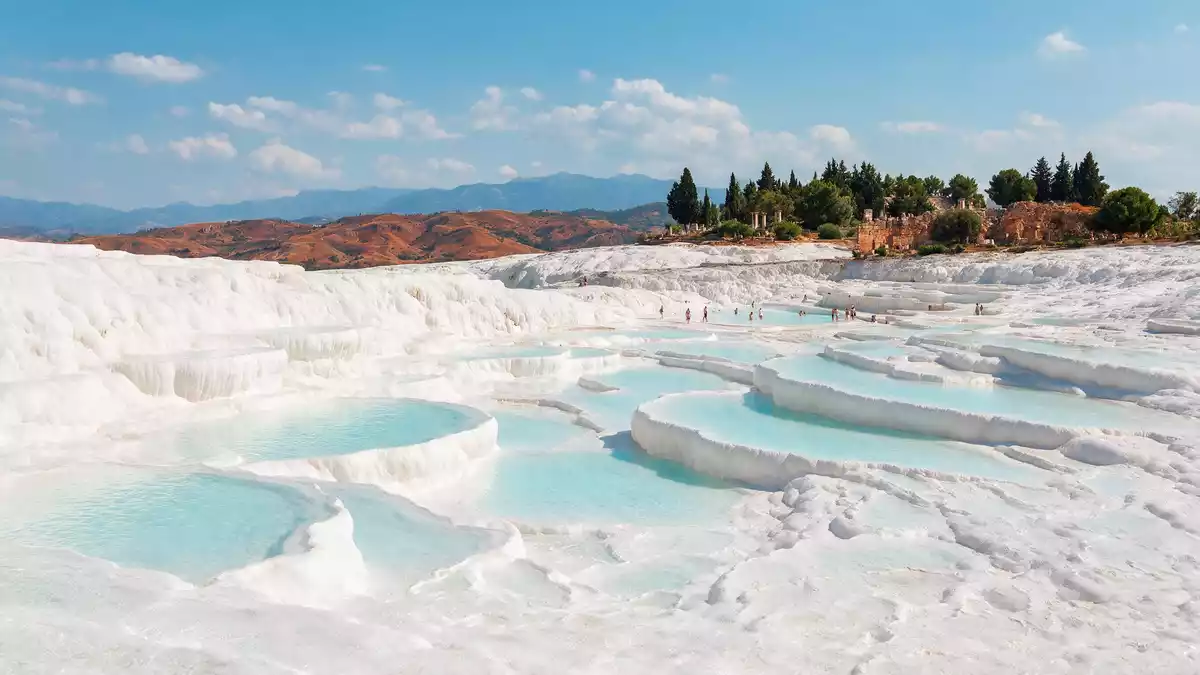
Pamukkale is a white hillside of travertine terraces in Denizli Province, where mineral-rich thermal water has formed stepped basins, petrified cascades and pale stone surfaces. Above the terraces stand the ruins of Hierapolis, a Hellenistic spa town founded by the Attalid kings of Pergamon in the late second century BC.
Pamukkale as a hillside of mineral terraces
The landscape begins with springs near the top of a cliff almost 200 m (656 ft) high. Water carrying calcium carbonate flows across the slope, leaving deposits that harden into travertine, a sedimentary rock associated with mineral springs.
The result is a broad formation of white terraces, shallow basins and stone cascades. Some terraces are less than 1 m high, while others reach about 6 m. The surface changes through pools, ridges and deposits shaped by water moving across the hillside.
The name Pamukkale means “cotton castle” in Turkish. It refers to the bright mineral landscape, whose pale surfaces rise above the plain of the Cürüksu in south-western Türkiye. The formation extends for roughly 2,700 m (8,858 ft), with a width of about 600 m (1,969 ft) and a height of approximately 160 m (525 ft). These measurements describe the whole travertine formation, not a single terrace.
Hierapolis above the thermal springs
Hierapolis occupies the plateau above Pamukkale. The city was established by the Attalid dynasty, rulers of Pergamon, at the end of the second century BC, beside an older cult setting. Its Hellenistic spa town developed around the thermal springs.
Rome took control of Hierapolis in 133 BC. An earthquake damaged the city in AD 60, after which rebuilding produced much of the Greco-Roman fabric visible in the ruins. Baths, temples, a monumental arch, a nymphaeum, a theatre, a necropolis and streets formed parts of the ancient settlement.
The theatre remains one of the clearest architectural features on the upper site. Its stone seating and decorated stage building belong to the Roman period. The necropolis extends across the ancient city and contains tombs associated with several periods of Hierapolis’ history.
Christian buildings add another layer to the site. Hierapolis became a bishopric during the Roman Empire’s Christian period, and the remains include churches, a baptistery and the Martyrium of St Philip, a fifth-century building associated with the apostle’s cult.
A mixed heritage landscape in Denizli
Pamukkale and Hierapolis form a single cultural and natural heritage property. The combination joins a geological landscape with the remains of a city that used the springs as a thermal centre. The relationship is visible across the hillside: white travertine occupies the slope, while colonnades, temples and civic ruins sit above it.
The property entered the UNESCO World Heritage List in 1988 under cultural and natural criteria. Its formal name is Hierapolis-Pamukkale. The designation recognises the terraces and springs alongside the archaeological remains of the Greco-Roman and Byzantine settlement.
Thermal water also shaped the wider ancient landscape. Canals carried water beyond Hierapolis towards settlements, fields and the Menderes valley. The system connected the springs with human use across the surrounding region, while the terraces preserved the visible mineral deposits at the hillside.
At the archaeological site, the remains are distributed across open ground above the white slope. The Temple of Apollo, the Frontinus Gate, the colonnaded street, baths and funerary monuments belong to a city whose buildings were repeatedly altered across the Hellenistic, Roman and Byzantine periods.
The shared setting gives Pamukkale its clearest visual character: natural terraces occupy the foreground and ancient masonry rises behind them. Neither part can be separated from the other when reading the landscape. The springs explain the travertine, while the plateau carries the urban remains of Hierapolis.
Visiting Pamukkale: what travellers from Western Europe should know
- Pamukkale lies in Denizli Province in south-western Türkiye, in the Cürüksu valley. Denizli is the principal nearby city, and the site is connected to the region by road and public transport.
- The approach crosses a hillside of uneven travertine. Bare feet are required on the designated white terraces, and the mineral surface may be irregular beneath the water.
- Hierapolis occupies the upper plateau. A visit combines open archaeological ground with sloping terrain, stone paths, ancient streets and exposed ruins.
- The official language is Turkish and the national currency is the Turkish lira.
- Entry requirements depend on your nationality; UK travellers can check the FCDO travel advice at gov.uk/foreign-travel-advice, Irish travellers the Department of Foreign Affairs at ireland.ie.
Searching for Pamukkale on social platforms
These links open searches for Pamukkale on each platform.
Frequently asked questions about Pamukkale
Where is Pamukkale?
Pamukkale is in Denizli Province in south-western Türkiye, above the Cürüksu valley. The ancient city of Hierapolis stands directly above the travertine terraces.
What can visitors expect at Pamukkale?
The site combines a white mineral hillside with open archaeological remains. The terrain includes sloping paths, uneven travertine and the stone streets, monuments and theatre of Hierapolis.
What makes Pamukkale distinctive?
Thermal water has formed a large travertine landscape beside a Hellenistic and Roman city. The terraces and Hierapolis together create the mixed heritage setting recognised in 1988.


