
Parc Guell: Gaudi’s architecture across a Barcelona hillside
Published on 09/24/2026 at 01:34 | Editorial responsibility: Rafael Müller, Editor-in-Chief AD HOC NEWS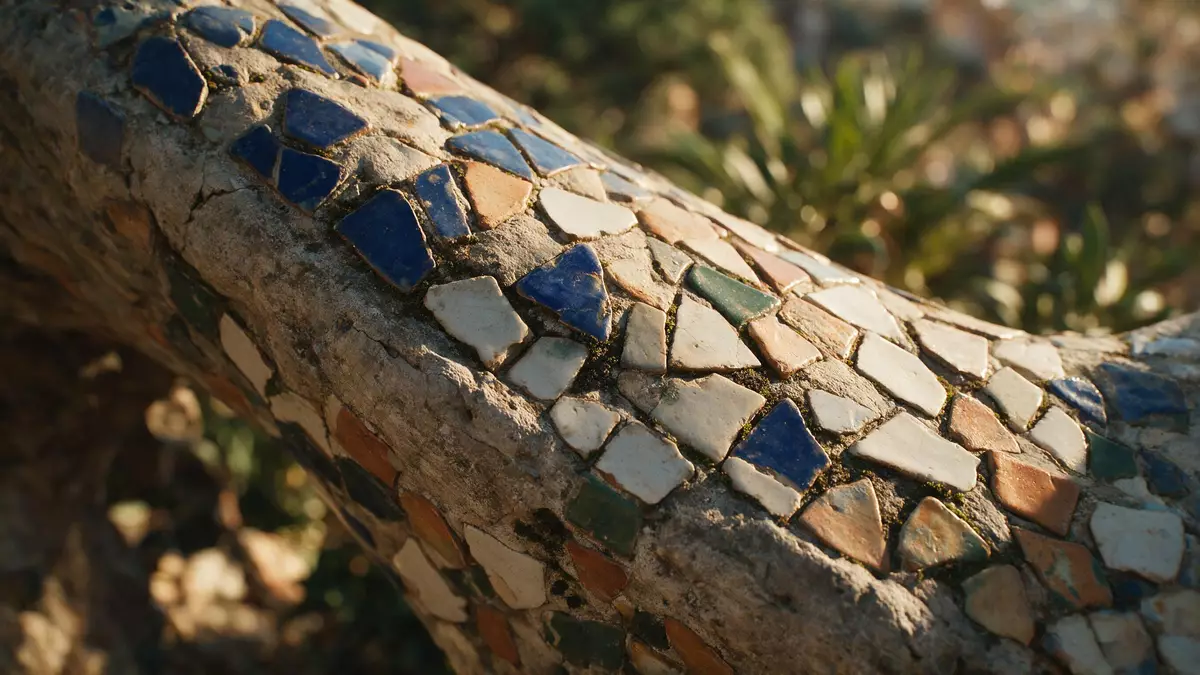
Parc Guell spreads across Carmel Hill in Barcelona as a landscape of stone, planting and ceramic colour. Antoni Gaudi created its architectural language between 1900 and 1914, leaving terraces, viaducts, stairways and covered spaces across the hillside.
Parc Guell and the architecture of the hillside
The park combines built forms with the contours of the hill. Stone retaining walls support paths and elevated spaces, while arcades and viaducts cross parts of the grounds. Their surfaces use rough local-looking masonry, irregular blocks and curved lines associated with Gaudi’s Catalan Modernism.
At the main monumental area, a broad terrace sits above the famous mosaic salamander and the entrance stairway. The terrace is bordered by a long, winding bench covered in fragments of coloured ceramic. Its continuous line follows the edge of the paved platform and frames views across Barcelona.
Gaudi’s treatment of materials changes from one part of the park to another. Bare stone appears in retaining walls and columns, while broken ceramic creates bright surfaces on the bench, stairway and entrance features. The contrast belongs to the place itself: heavy masonry anchors the hillside, and small coloured pieces cover selected architectural details.
From residential project to public park
Eusebi Guell commissioned Antoni Gaudi in 1900 to develop a residential estate on Carmel Hill. The project was conceived as a garden suburb with houses, shared facilities and roads integrated into a landscaped setting.
Construction continued until 1914, but the residential project did not develop as planned. The estate entered municipal ownership, and Parc Guell became a public park in 1926. Its surviving structures preserve the layout of a planned community, even though the place is experienced as a park rather than as a completed residential district.
Several buildings at the entrance belong to the original architectural composition. Their pitched roofs, textured surfaces and projecting forms create a gateway below the monumental stairway. Casa del Guarda, one of the small entrance buildings, is associated with the park’s early administration and forms part of its historic fabric.
The shift in function gives Parc Guell two identities. It is a public green space with paths, trees and planted slopes, and it is also an unfinished early twentieth-century urban project. Both aspects remain visible in the arrangement of roads, terraces, arcades and communal structures.
Gaudi’s symbols, surfaces and structural forms
Parc Guell is part of the UNESCO World Heritage property known as the Works of Antoni Gaudi, inscribed in 1984. The designation includes the park’s architectural elements and connects them with Gaudi’s wider contribution to Catalan Modernism. Parc Guell’s heritage status belongs to its architectural and artistic importance.
The park’s most recognisable surface is its trencadis mosaic. This technique uses irregular fragments of ceramic rather than large unbroken tiles. At Parc Guell, the pieces form bands, borders and changing colour fields across curved architectural features.
The monumental stairway contains sculptural forms associated with Catalan culture and Gaudi’s visual vocabulary. The mosaic salamander is positioned between the lower entrance area and the terrace above. Nearby walls and fountains use ceramic fragments and shaped stone in a single composition.
Columns beneath the terrace create a covered space with a strong rhythm of repeated supports. Above them, the open platform forms one of the park’s principal gathering areas. The relationship between the colonnade, terrace edge and hillside paths makes the central zone legible as both architecture and landscape.
Gaudi worked with collaborators including Josep Maria Jujol, whose contribution is associated with the park’s ceramic decoration. The result is not a collection of isolated ornaments. Stone, mosaic, planting and circulation belong to the same visible composition across Carmel Hill.
Visiting Parc Guell: what travellers from Western Europe should know
- Parc Guell lies on Carmel Hill in Barcelona, near the Gracia district. The park is connected with the city’s bus network and nearby metro routes, while Carrer d’Olot leads to the monumental area.
- The site occupies a hillside, with stairways, sloping paths, raised terraces and stone arcades. The monumental zone includes a substantial staircase between the entrance and the main terrace.
- Barcelona is in Spain. The official language is Catalan and Spanish, and the currency is the euro.
- Parc Guell contains both planted ground and built structures. Comfortable footwear is relevant to paths, steps and uneven stone surfaces.
Searching for Parc Guell on social platforms
These links open searches for Parc Guell on each platform.
Frequently asked questions about Parc Guell
Where is Parc Guell?
Parc Guell is on Carmel Hill in Barcelona, above the Gracia district. Its paths and architectural spaces occupy a substantial hillside area.
What can visitors see at Parc Guell?
The park contains the monumental stairway, the mosaic salamander, the curved bench, the main terrace, colonnades, stone viaducts and planted paths.
What makes Parc Guell distinctive?
Its distinctive character comes from the combination of Gaudi’s stone architecture, ceramic trencadis, hillside landscaping and the remains of an unrealised residential project.


