
Parque Nacional Talampaya and its Triassic red-rock canyons
Published on 09/24/2026 at 05:53 | Editorial responsibility: Rafael Müller, Editor-in-Chief AD HOC NEWS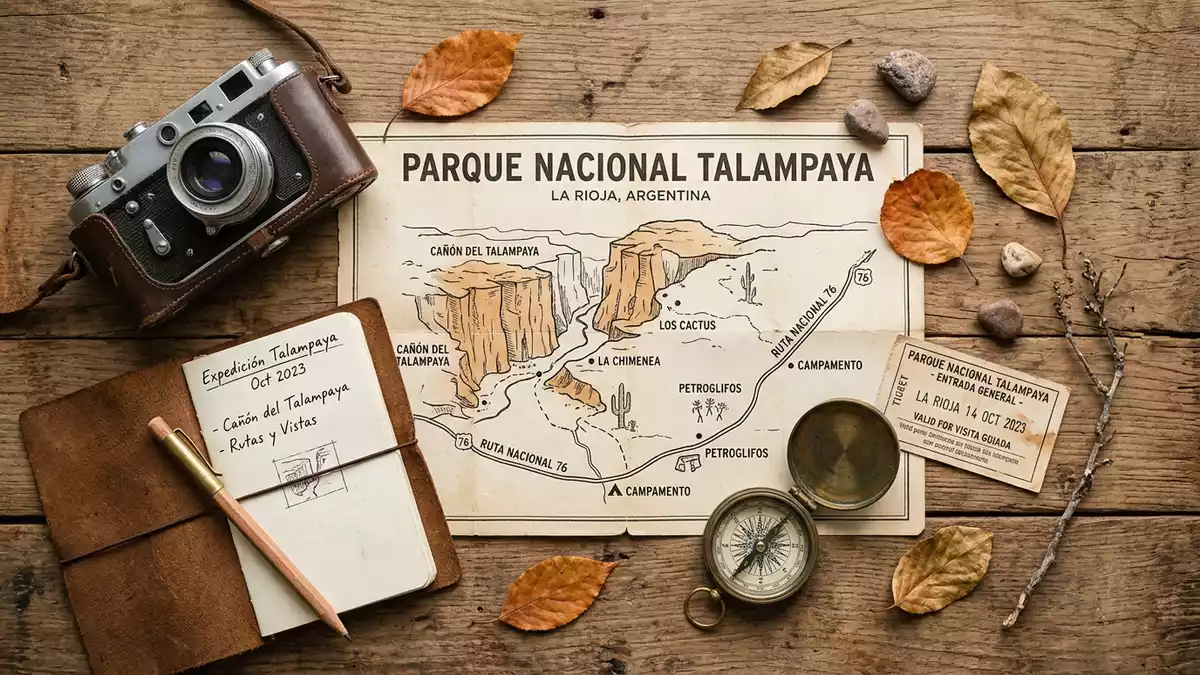
Parque Nacional Talampaya is a landscape of red sandstone cliffs, desert vegetation and deep geological time in La Rioja, Argentina. Its canyon walls rise from the Monte desert, while fossils and rock layers preserve a record of the Triassic Period.
Parque Nacional Talampaya: red sandstone on a desert scale
The park occupies an arid region beside the western edge of the Sierra Pampeanas. Talampaya National Park covers about 215,000 hectares within the larger Ischigualasto–Talampaya natural property, whose two protected areas together cover more than 275,000 hectares.
Red sandstone cliffs form the clearest visual signature. In Talampaya, exposed walls reach about 200 metres, with ravines, terraces and weathered formations extending through the desert landscape. Sparse shrubs, cacti and scattered trees grow across the Monte ecoregion, a warm scrub desert along the eastern Andean foothills. Talampaya’s red sandstone cliffs belong to a protected geological landscape rather than a single isolated viewpoint.
From Triassic sediments to a national park
The rocks belong to the Ischigualasto–Villa Unión Triassic Basin. Sediments accumulated during the Triassic Period, between roughly 245 million and 208 million years ago, when the first dinosaurs and early mammal relatives appeared.
Talampaya became a provincial park in 1975 and received national park status in 1997. The connected natural parks were inscribed on the UNESCO World Heritage List in 2000. National park status in 1997 forms part of a conservation history that links provincial protection, national legislation and international recognition.
Archaeology adds a human layer to the geological record. Rock art in the wider property includes petroglyphs dating from about 1,500 years ago. These markings belong to a much shorter timescale than the fossil-bearing strata, yet both remain visible within the same protected desert setting.
Fossils, formations and the wider protected landscape
The shared World Heritage property contains six geological formations with fossilised plants, dinosaurs, early mammal ancestors and other vertebrates. The sequence records changing terrestrial environments across approximately 50 million years of the Triassic.
Talampaya’s significance is inseparable from Ischigualasto Provincial Park in neighbouring San Juan Province. The two areas preserve connected parts of the same basin, although their landscapes differ in colour and form. Talampaya is marked by red cliffs and canyons, while Ischigualasto contains pale and multicoloured sediments.
The protected area also contains living desert ecology. Xeric shrubs and cacti occupy the dry terrain, with rare and endemic plants and animals associated with the Monte environment. Triassic fossils and desert life appear together in a landscape where geological history remains exposed at the surface.
Visiting Parque Nacional Talampaya: what travellers from Western Europe should know
- Parque Nacional Talampaya lies in La Rioja, western Argentina, near Villa Unión. Road access connects the park with the surrounding desert settlements.
- The terrain consists of arid valleys, exposed sedimentary rock, canyon walls and desert vegetation. Walks take place in a dry landscape with limited shade.
- The park forms part of the Ischigualasto–Talampaya World Heritage property. Ischigualasto Provincial Park lies in neighbouring San Juan Province.
- The official language is Spanish and the currency is the Argentine peso.
Searching for Parque Nacional Talampaya on social platforms
These links open searches for Parque Nacional Talampaya on each platform.
Frequently asked questions about Parque Nacional Talampaya
Where is Parque Nacional Talampaya?
Parque Nacional Talampaya is in La Rioja Province, western Argentina, near Villa Unión and the western edge of the Sierra Pampeanas.
What can visitors expect to see?
The park contains red sandstone cliffs, desert vegetation, canyon landscapes, Triassic rock formations and archaeological traces including petroglyphs.
What makes Parque Nacional Talampaya distinctive?
Its landscape combines tall red cliffs with fossil-bearing Triassic sediments. Together with Ischigualasto, it forms a World Heritage property documenting the evolution of terrestrial life.


