
Petergof and the architecture of water
Published on 09/23/2026 at 19:05 | Editorial responsibility: Rafael Müller, Editor-in-Chief AD HOC NEWS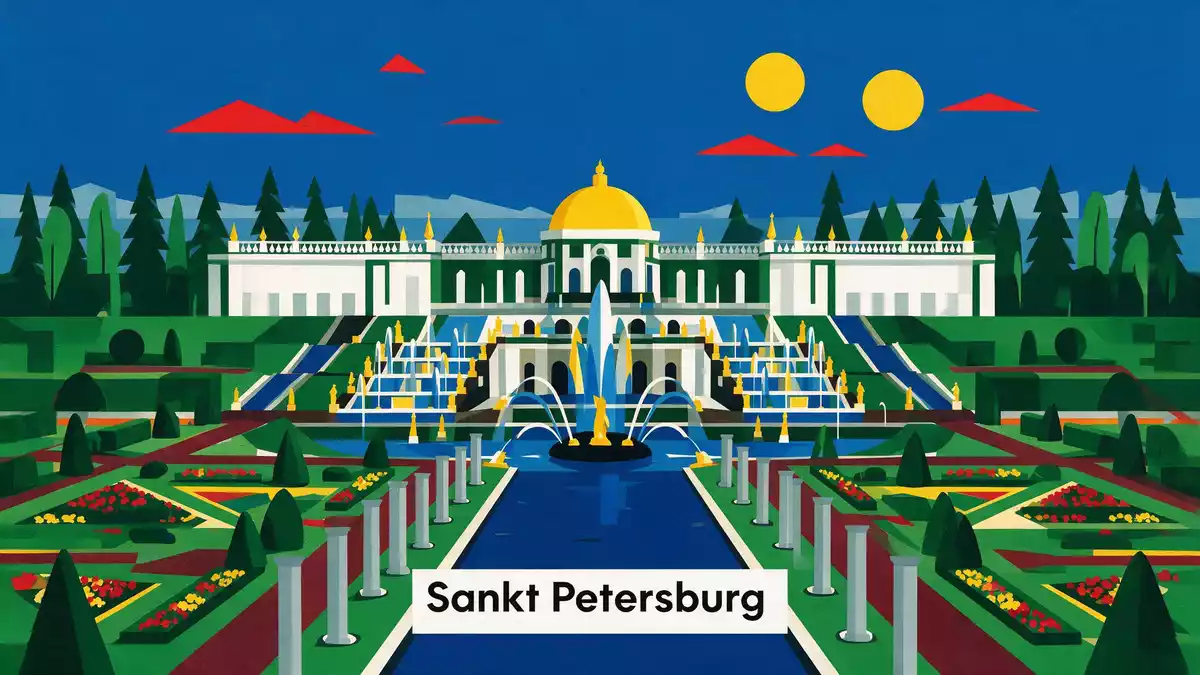
Petergof is a palace-and-garden ensemble near Sankt Petersburg where architecture and water occupy the same dramatic frame. Peter the Great began the complex in 1714, and its Grand Palace, formal parks and cascades form a landscape shaped by terraces, gilded sculpture and the Gulf of Finland.
Petergof: a palace above a chain of fountains
The Grand Palace occupies the crest between the Upper Garden and the Lower Park. Its long façade faces the gardens, while the Grand Cascade descends towards the Sea Canal in a sequence of water, sculpture and stonework.
The cascade is not an isolated fountain. It belongs to a connected composition of terraces, stairways, pools and gilded figures. Water runs through the centre of the palace grounds, linking the elevated building with the coast beyond the park.
Peter the Great and the making of an imperial residence
Peter the Great commissioned Petergof in the early eighteenth century. Construction began in 1714, and the ensemble opened ceremonially on 15 August 1723. Petergof’s building dates place its first completed phase within the reign of its founder.
The first designs involved Jean-Baptiste Alexandre Le Blond, Johann Friedrich Braunstein and Nicola Michetti. Bartolomeo Francesco Rastrelli transformed the palace in the eighteenth century, giving the central building a more elaborate Baroque appearance associated with the imperial court.
Gardens, galleries and the Baltic horizon
The Upper Garden presents a formal arrangement close to the palace. The Lower Park extends towards the Gulf of Finland, with tree-lined avenues, smaller palaces, pavilions and water features distributed across the grounds.
Monplaisir Palace stands near the shoreline and preserves the scale of a private retreat within the larger court landscape. Marly Palace, the Hermitage pavilion and the Roman fountains add separate architectural episodes to the park ensemble. Together, these buildings make Petergof a collection of residences and gardens, not a single palace.
Petergof forms part of the Historic Centre of Sankt Petersburg and Related Groups of Monuments, inscribed on the UNESCO World Heritage List in 1990. The 1990 heritage inscription places the ensemble within a wider group of imperial sites around the city.
Visiting Petergof: what travellers from Western Europe should know
- Petergof lies south-west of Sankt Petersburg on the southern shore of the Gulf of Finland. Suburban trains reach Novy Peterhof station, while hydrofoils connect the city’s riverfront with the palace area.
- The grounds cover terraces and broad parkland. The Grand Cascade links the upper palace level with the Lower Park through steps, sloping paths and water channels.
- The ensemble includes the Grand Palace, Monplaisir Palace, Marly Palace, the Hermitage pavilion and the Lower Park’s fountains. The Gulf of Finland forms the northern edge of the grounds.
- The official language is Russian and the currency is the rouble.
- Entry requirements depend on your nationality; UK travellers can check the FCDO travel advice at gov.uk/foreign-travel-advice, Irish travellers the Department of Foreign Affairs at ireland.ie.
Searching for Petergof on social platforms
These links open searches for Petergof on each platform.Frequently asked questions about Petergof
Where is Petergof?
Petergof is a palace-and-park ensemble on the southern shore of the Gulf of Finland, within the wider Sankt Petersburg region.
What can visitors expect?
The grounds combine the Grand Palace, formal gardens, smaller residences, wooded avenues, terraces, cascades and fountains.
What makes Petergof distinctive?
Its central composition joins an elevated Baroque palace with the Grand Cascade, the Sea Canal and the coastal landscape beyond.


