
Philae Temple and the island sanctuary of Isis
Published on 09/23/2026 at 11:32 | Editorial responsibility: Rafael Müller, Editor-in-Chief AD HOC NEWS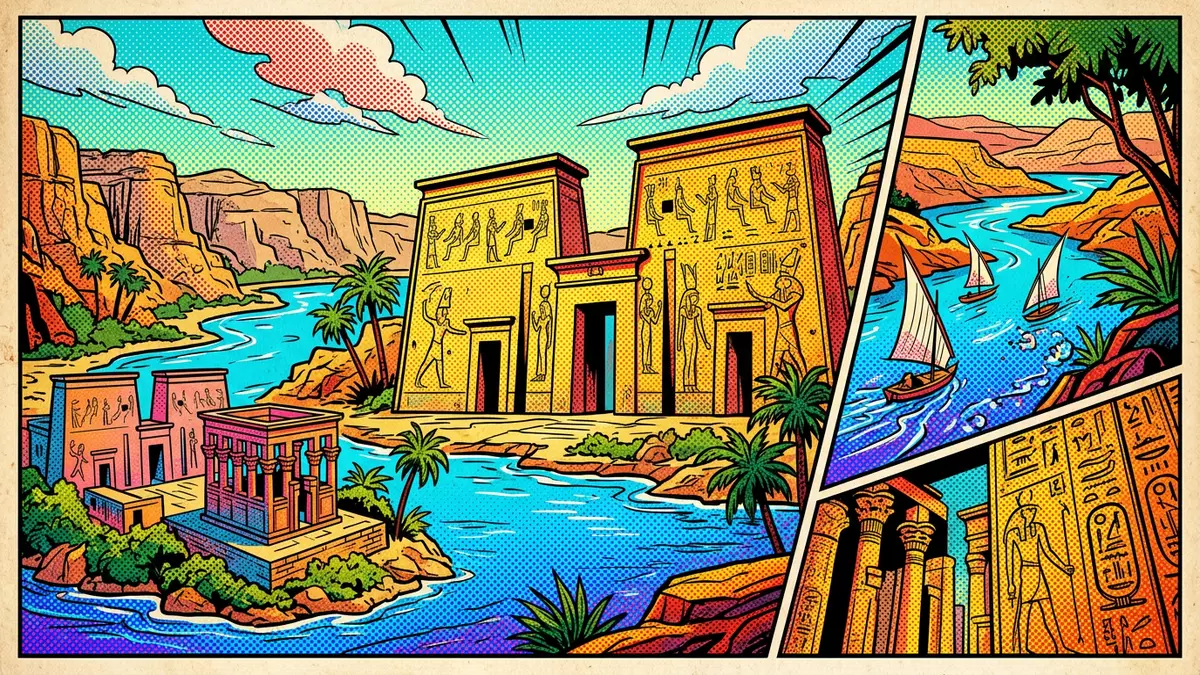
Philae Temple occupies Agilkia Island in the Nile near Assuan, with courtyards, pylons and columned sanctuaries arranged across a small island setting. Its visible form belongs chiefly to the Ptolemaic and Roman periods, while its principal sanctuary is dedicated to Isis.
The complex is also a place of relocation: the monuments were moved from the original Philae Island during the international Nubia Campaign. Ancient stonework and twentieth-century preservation therefore belong to the same story, written across the island’s terraces.
Philae Temple on an island of stone and water
The approach to Philae Temple reveals an architectural group rather than a single building. The Temple of Isis forms the central monument, accompanied by gateways, courts, chapels and the Kiosk of Trajan. Their walls carry carved figures, hieroglyphs and ritual scenes in the language of Egyptian temples.
The setting is inseparable from the appearance of the complex. Agilkia Island lies within the Nile landscape near the First Cataract, and the buildings occupy the island’s ground in a sequence of open and enclosed spaces. Pylons mark the principal approach, while colonnades frame the courtyards.
Isis, Horus and the Ptolemaic sanctuary
The monuments date predominantly from the Ptolemaic Period, between 332 and 30 BC. The principal temple was begun under Ptolemy II Philadelphus, who dedicated it to Isis, the mother of Horus and a central figure in the religious traditions of the sanctuary. the Ptolemaic temple remains the architectural centre.
Other buildings extend the chronology into Roman rule. The Temple of Hathor is associated with Ptolemy VI Philometor and Augustus, while the Kiosk of Trajan belongs to the Roman period. Its surviving columns form a distinct open structure beside the larger temple buildings.
From ancient worship to a rescued monument
Philae Temple remained an active centre of the cult of Isis into the late fourth century AD. A dated hieroglyphic inscription from 394 AD belongs to the final phase of ancient Egyptian temple writing, and the sanctuary was converted into a Christian church after pagan worship ended.
Water from the Aswan dam projects threatened the original island and its monuments. During the UNESCO Nubia Campaign, the complex was dismantled and reconstructed on Agilkia Island between 1960 and 1980. The relocation preserved the arrangement of the buildings while changing their island setting. the Nubian Monuments entered the World Heritage List in 1979 as a serial cultural property.
Visiting Philae Temple: what travellers from Western Europe should know
- Philae Temple stands on Agilkia Island near Assuan in southern Egypt. The island setting means that the final approach is made across the Nile by boat.
- The site combines open courtyards, raised stone surfaces, steps, gateways and columned halls. Uneven archaeological flooring and exposed stone form part of the route through the complex.
- Assuan lies in Upper Egypt, beside the First Cataract of the Nile. The official language is Arabic and the currency is the Egyptian pound.
- Philae Temple belongs to the World Heritage property named Nubian Monuments from Abu Simbel to Philae. The property includes monuments moved during the Nubia Campaign.
Searching for Philae Temple on social platforms
These links open searches for Philae Temple on each platform.
Frequently asked questions about Philae Temple
Where is Philae Temple?
Philae Temple is on Agilkia Island in the Nile near Assuan, in southern Egypt. The complex was relocated there from the original Philae Island.
What can visitors see at Philae Temple?
The complex contains the Temple of Isis, courtyards, pylons, colonnades, the Temple of Hathor and the Kiosk of Trajan. Carved scenes and inscriptions remain visible across the stone surfaces.
What makes Philae Temple distinctive?
Its architecture brings together Ptolemaic, Roman and Christian phases on an island setting. The entire complex also preserves the story of a major twentieth-century relocation.


