
Piazza del Campo and the shell-shaped heart of Siena
Published on 09/21/2026 at 09:29 | Editorial responsibility: Rafael Müller, Editor-in-Chief AD HOC NEWS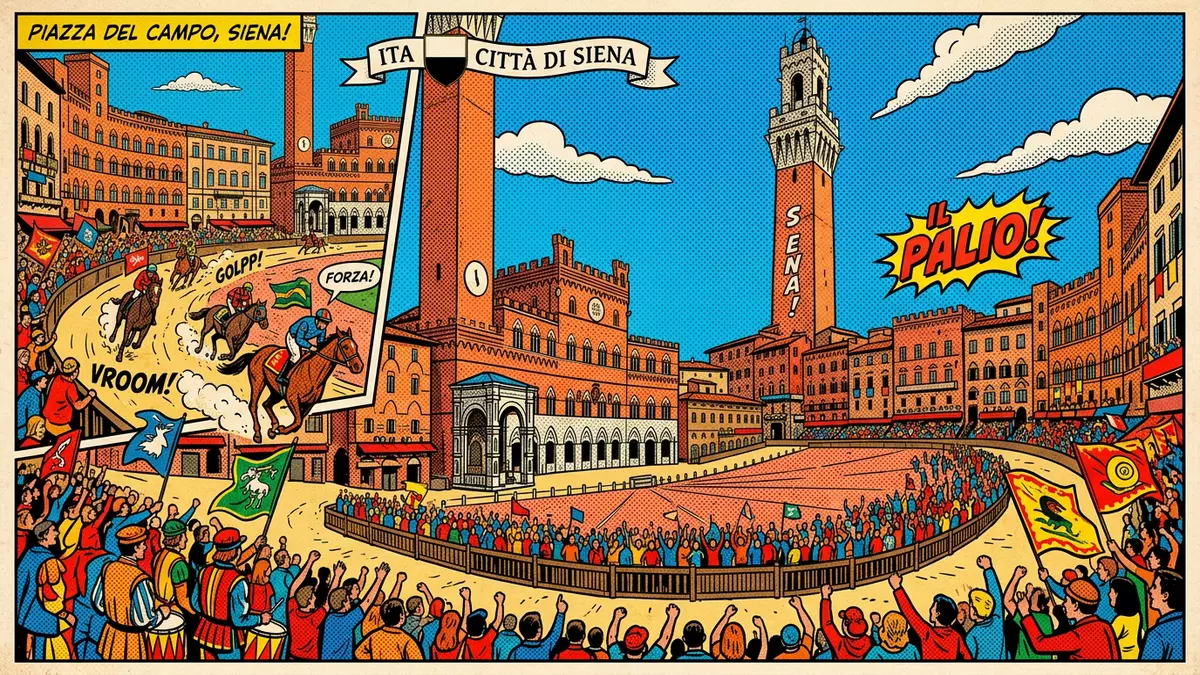
Piazza del Campo is the great civic square of Siena, a brick-paved bowl where the city’s medieval fabric converges around a shell-shaped space. Laid out in the thirteenth and fourteenth centuries as the focus of the republican city, it remains defined by its sloping form, its brick paving and the ring of palaces that follow the curve of the old streets.
A shell of brick and stone
The most striking feature of Piazza del Campo is its shell-like plan, a paved surface that falls gently towards a low point and fans out in a broad arc. The square is not a regular rectangle but follows the lines of the valley floor that once carried rainwater away from the surrounding hills, a hollow that was gradually formalised as Siena grew around it.The hollow that served to drain rainwater became the open space that later acquired its brick surface and civic role.
The paving that visitors see is laid in long bands of red brick set on edge, divided by pale stone lines that mark out nine distinct sections. This nine-part division commemorates the Governo dei Nove, the Government of the Nine, the oligarchic council that ruled Siena between 1287 and 1355 and presided over the city’s golden age.The brick paving divided into nine segments dates to the mid fourteenth century, a period when Siena’s civic authorities were reshaping the piazza as a coherent public space.
Republican power around the Campo
Piazza del Campo is ringed by buildings that reflect Siena’s history as a self-governing commune and later as a city under Medici rule. On one side stands the Palazzo Pubblico, also known as the Palazzo Comunale, the city hall constructed as the seat of the Governo dei Nove in the late thirteenth and early fourteenth centuries.The Palazzo Pubblico as the seat of the Governo dei Nove anchors the square with its long brick façade and Gothic windows.
Rising above the Palazzo Pubblico is the Torre del Mangia, a slender brick campanile completed in the first half of the fourteenth century. Its height and position make it a landmark across Siena’s skyline, visible from the surrounding countryside as well as from within the square.The Torre del Mangia rising from the Palazzo Pubblico forms a vertical counterpoint to the shallow curve of the piazza and underlines the role of Piazza del Campo as the civic centre of the medieval republic.
Markets, fountains and the Palio
The history of Piazza del Campo is closely tied to Siena’s development as a market town and later as a city of ritual and spectacle. Documentary references to the Campo date to 1169, when the area was recorded as Campus Sancti Pauli and included what is now the separate Piazza del Mercato.The first document mentioning the layout of the Campo in 1169 shows how this valley at the confluence of routes from Castellare, San Martino and Camollia evolved from open land into an organised market space.
From the fourteenth century the Campo also became the setting for Siena’s Palio, the bareback horse race that pits the city’s contrade, or districts, against one another. The race in its present circling form has taken place around the perimeter of the piazza since the seventeenth century, turning the sloping brick surface and enclosing palaces into a temporary track and amphitheatre for one of Italy’s most intense civic rituals.The Palio in its present circling form links contemporary Siena with its medieval institutions and allegiances.
Visiting Piazza del Campo: what travellers from Western Europe should know
- Piazza del Campo lies in the historic centre of Siena in Tuscany, south of Florence, and is reached on foot from the city’s main streets that descend towards the square.
- The piazza is a sloping space paved in brick, with a noticeable gradient towards its lowest point, and movement across it involves walking on an inclined surface rather than a flat plane.
- The square is bordered by the Palazzo Pubblico and by closely packed historic houses and palaces, and narrow streets lead down to it from the surrounding medieval quarters.
- The official language is Italian and the currency is the euro.
Searching for Piazza del Campo on social platforms
These links open searches for Piazza del Campo on each platform.
Frequently asked questions about Piazza del Campo
Where is Piazza del Campo?
Piazza del Campo is in Siena, a historic city in Tuscany in central Italy, and occupies a hollow at the meeting point of several medieval streets.
What should visitors expect when they arrive?
Visitors encounter a sloping brick square shaped like a shell, enclosed by historic palaces, with the Palazzo Pubblico and the Torre del Mangia dominating one side.
What makes Piazza del Campo distinctive among Italian squares?
Its shell-like form, nine-part brick paving linked to the medieval Government of the Nine, and its role as the arena for the Palio horse race distinguish Piazza del Campo.


