
Piazza Navona and the Baroque fountains of Rom
Published on 09/23/2026 at 16:43 | Editorial responsibility: Rafael Müller, Editor-in-Chief AD HOC NEWS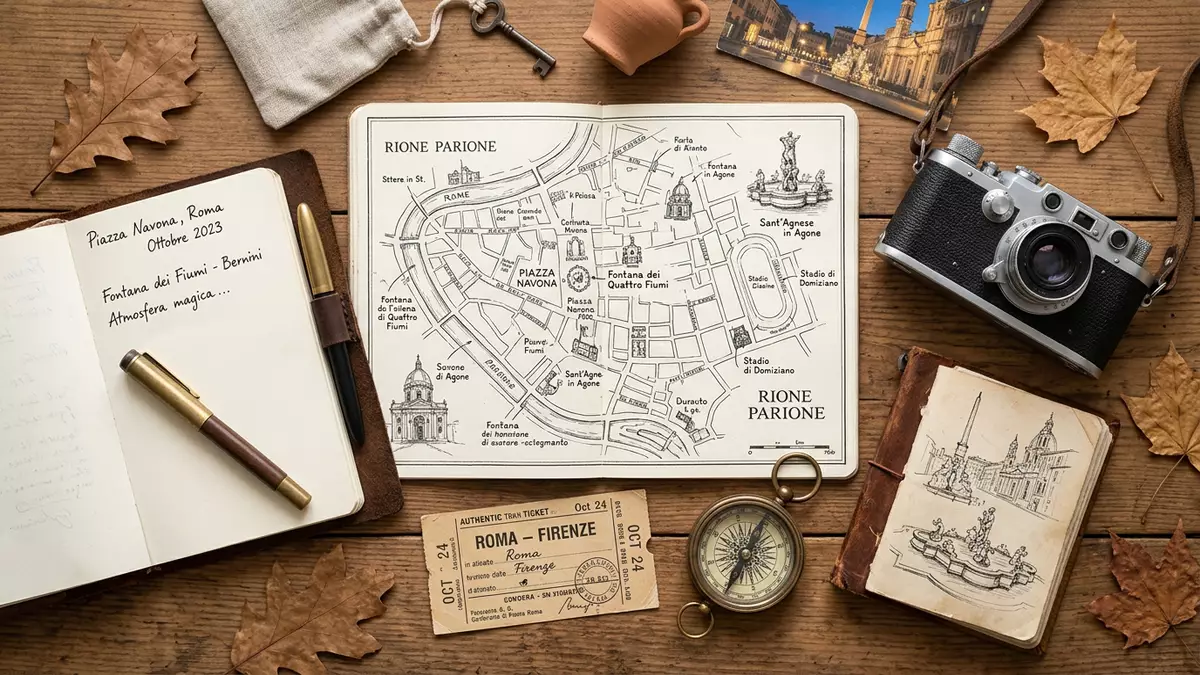
Piazza Navona is an elongated public square in Rom, shaped by the footprint of an ancient stadium. Its centre belongs to Gian Lorenzo Bernini’s Fountain of the Four Rivers, while Baroque façades, church architecture and fountains define the space around it.
Piazza Navona follows an ancient stadium
The square occupies the site of the Stadium of Domitian, a Roman arena built in 86 AD for athletic contests and public games. The open space retains the long outline of that stadium, with a broad central area and curved ends.
The stadium was associated with the Latin word agon, referring to contests and games. The name Navona developed from this association through medieval forms of the place name. The ancient foundations remain part of the square’s identity, even though the visible setting belongs to a later architectural period.
In the fifteenth century, Piazza Navona became a public urban space and a market site. Its stone paving, surrounding buildings and open plan created a civic setting that continued to change as Rome’s Baroque architecture developed.
Bernini’s river fountain at the centre
The Fountain of the Four Rivers occupies the middle of Piazza Navona. Gian Lorenzo Bernini created it in 1651 during the pontificate of Pope Innocent X, whose Pamphili family palace faces the square. The fountain combines sculpted river figures, rockwork and an ancient Egyptian-style obelisk.
The four rivers are the Danube, the Ganges, the Nile and the Río de la Plata. They represent major waterways associated with Europe, Asia, Africa and the Americas. The surrounding figures and animals form a sculptural group around the central monument.
The fountain is one of the clearest expressions of Bernini’s approach to Baroque sculpture. Marble figures project from a rough stone base, while water moves through the basin beneath the obelisk. The composition remains visible from several points across the piazza.
Fountain of the Four Rivers stands between two other fountains. The Fontana del Moro marks the southern end, and the Fountain of Neptune occupies the northern end.
Sant’Agnese and the Baroque façades
The Church of Sant’Agnese in Agone faces the piazza beside Palazzo Pamphili. Its façade is associated with Francesco Borromini, while the wider building history also includes Girolamo Rainaldi and Carlo Rainaldi.
The church’s concave façade, dome and towers create a strong architectural focus on the western side. Its pale stone surface contrasts with the sculptural movement of Bernini’s fountain across the open square.
Palazzo Pamphili extends along the western side of Piazza Navona. The complex includes the long gallery associated with Borromini and frescoes by Pietro da Cortona. Together, the palace and church give the piazza a formal Baroque character.
The square’s fountains belong to different phases of its history. Giacomo della Porta created the original basins of the Fontana del Moro and the northern fountain in the sixteenth century. Bernini contributed the Moor figure at the southern fountain, while later sculptural additions completed the northern fountain.
the three fountains occupy the central, northern and southern parts of the piazza. Their positions make the square readable as a sequence of sculptural landmarks rather than a single isolated monument.
Sant’Agnese in Agone provides the principal church façade facing Bernini’s central work. The relationship between church, palace and fountains brings several seventeenth-century artists into the same urban setting.
Visiting Piazza Navona: what travellers from Western Europe should know
- Piazza Navona lies in central Rom, within the historic centre and close to the Tiber. It is reached on foot from nearby streets, by Rome’s buses, and from the surrounding historic-centre routes.
- The square has a broad paved surface with fountains, steps and raised edges around parts of the monuments. The historic paving can be uneven beneath the feet.
- The official language is Italian and the currency is the euro.
Searching for Piazza Navona on social platforms
These links open searches for Piazza Navona on each platform.
Frequently asked questions about Piazza Navona
Where is Piazza Navona?
Piazza Navona is in the historic centre of Rom, close to the Tiber and surrounded by Baroque palaces, churches, restaurants and narrow streets.
What can visitors see there?
The square contains the Fountain of the Four Rivers, the Fontana del Moro and the Fountain of Neptune. Sant’Agnese in Agone and Palazzo Pamphili face the open space.
What makes Piazza Navona distinctive?
Its long form follows the Stadium of Domitian, while Bernini’s 1651 fountain, the other fountains and the Baroque architecture occupy the same public square.


