
Piazza Navona, from Roman stadium to Baroque stage
Published on 09/10/2026 at 08:46 | Editorial responsibility: Rafael Müller, Editor-in-Chief AD HOC NEWS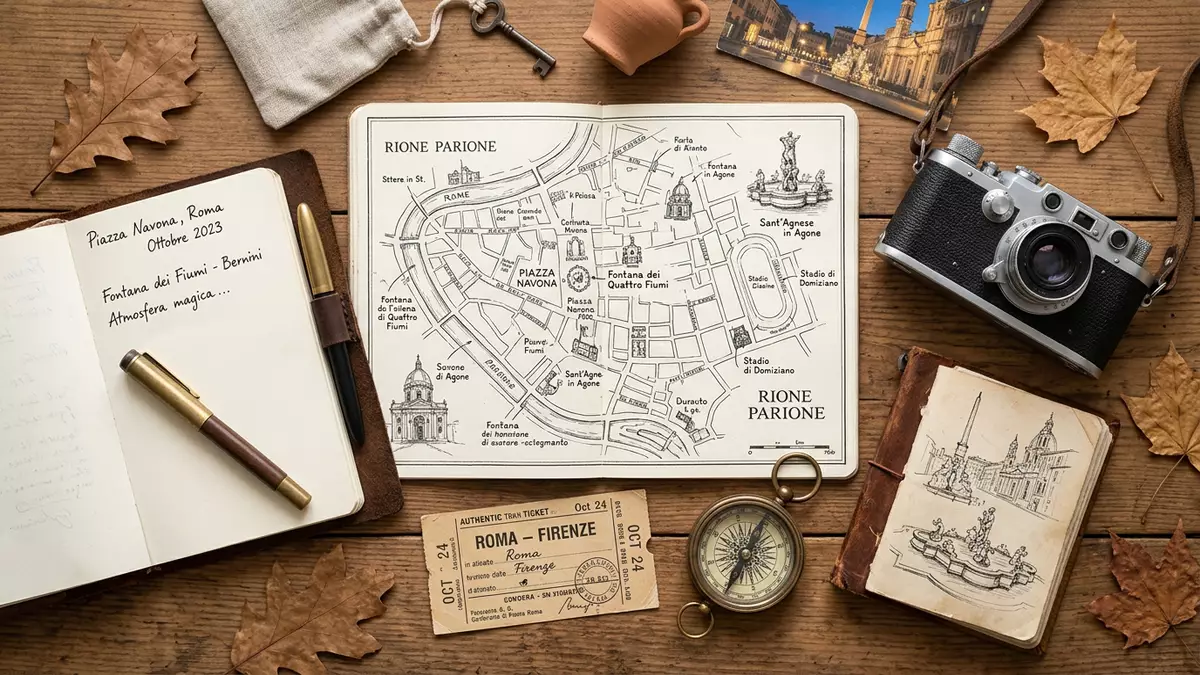
Piazza Navona in Rom is a long, curving city square laid out on the footprint of the Stadium of Domitian, where athletics competitions were held in the first century AD. The piazza took on its Baroque character in the seventeenth century, under Pope Innocent X of the Pamphilj family, when palaces and fountains reshaped the former racetrack into one of Rome’s most theatrical urban spaces.
A Roman stadium beneath a Baroque square
The site now known as Piazza Navona began as the Stadium of Domitian, built for athletic contests during the reign of Emperor Domitian in the first century AD.Stadium of Domitian The stadium’s plan followed the model of a Greek running track, with a straight side and a rounded end, and the current piazza preserves that outline as an elongated space framed by buildings.shape of a Greek running track Beneath the paving, substantial remains of the stadium’s masonry survive, and parts of the structure can be visited in an underground archaeological area where ancient walls and arches are visible.
After the decline of imperial Rome, the stadium ceased to function as a sports venue and its seating ranges were progressively absorbed into the growing city fabric. Houses and later palaces rose where the tiers of spectators had once stood, while the central arena remained open as a long urban space. By the late fifteenth century this open ground had become a recognised public square, used as one of Rom’s principal markets and gradually formalised into the piazza that travellers see today.defined as a public space
Baroque Rome on display around the oval
Piazza Navona’s present appearance is shaped above all by the Baroque projects of Pope Innocent X, who reigned from 1644 to 1655 and made the square a showcase for architecture and sculpture associated with his family.Baroque transformation under Innocent X On the western side stands Palazzo Pamphilj, the Pamphilj family palace facing the square and forming a long façade punctuated by windows and balconies.Palazzo Pamphilj on the piazza Opposite it, towards the centre of the eastern side, the church of Sant’Agnese in Agone rises with a Baroque façade, twin towers and a dome, aligning its entrance with the square.
At the heart of the piazza stands the Fontana dei Quattro Fiumi, the Fountain of the Four Rivers, designed by Gian Lorenzo Bernini and inaugurated in 1651.Fontana dei Quattro Fiumi The fountain centres on a travertine rock supporting an ancient obelisk, with four large river personifications arranged around its base. Each figure represents a major river linked to a continent then under papal influence: the Nile for Africa, the Danube for Europe, the Ganges for Asia and the Río de la Plata for the Americas.four river personifications Water flows into a broad basin edged by balustrades, with further carved animals and plants reinforcing the geographical themes.
Fountains, cobbles and a long urban stage
Beyond Bernini’s central composition, Piazza Navona is lined with further Baroque fountains and paving that turn the former stadium into a continuous urban stage. At one end stands the Fontana del Moro, remodelled with a central figure of an Ethiopian wrestler fighting with a dolphin and surrounded by smaller sculptures.Fontana del Moro At the other end, the Fountain of Neptune presents a group centred on the sea god in combat with a sea creature, framed by further marine figures and decorative elements. Together with the Fountain of the Four Rivers, these works articulate the length of the square and give rhythm to the central space.
The ground surface of Piazza Navona is paved with traditional Roman cobblestones known as sampietrini, forming a gently sloping floor between the lines of buildings.paved with sampietrini Cafes and restaurants occupy the ground floors of many surrounding buildings, placing tables along the edges of the piazza and reinforcing its role as a meeting place. Street artists and stalls commonly appear along the central walkways, set between the fountains and the façades. The overall impression is of a long, framed outdoor room where architecture, sculpture and everyday city life share the same elongated stage.
Visiting Piazza Navona: what travellers from Western Europe should know
- Piazza Navona lies in the historic centre of Rom, on the former Campus Martius, a short walk west from the Pantheon and close to the bend in the Tiber.
- The square’s surface is paved with cobblestones and includes gentle slopes; walking from end to end involves crossing an extended open space without shade along much of its length.
- Several streets lead into the piazza from the surrounding neighbourhood, with access on foot from neighbouring landmarks and bridges across the Tiber.
- The official language is Italian and the currency is the euro.
Searching for Piazza Navona on social platforms
These links open searches for Piazza Navona on each platform.
Frequently asked questions about Piazza Navona
Where is Piazza Navona in Rom?
Piazza Navona is in the central area of Rom historically known as the Campus Martius, west of the Pantheon and near a bend in the Tiber River.
What can visitors expect when walking through Piazza Navona?
Visitors encounter a long, curving square lined with Baroque palaces and churches, crossed by three major fountains and paved with traditional Roman cobblestones.
What makes Piazza Navona distinctive among Rom’s squares?
The piazza retains the elongated outline of Domitian’s athletics stadium while combining archaeological remains with Baroque works by Bernini and other seventeenth-century artists.


