Piazza Navona: Rome’s baroque stage on an ancient stadium
Published on 08/06/2026 at 20:23 | Editorial responsibility: Rafael Müller, Editor-in-Chief AD HOC NEWS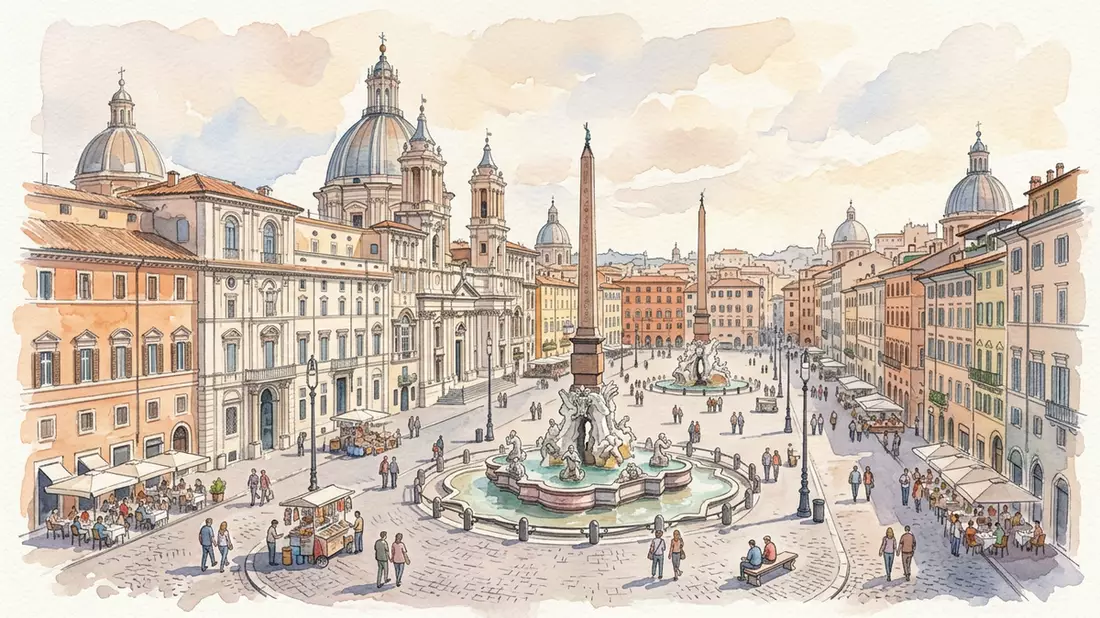
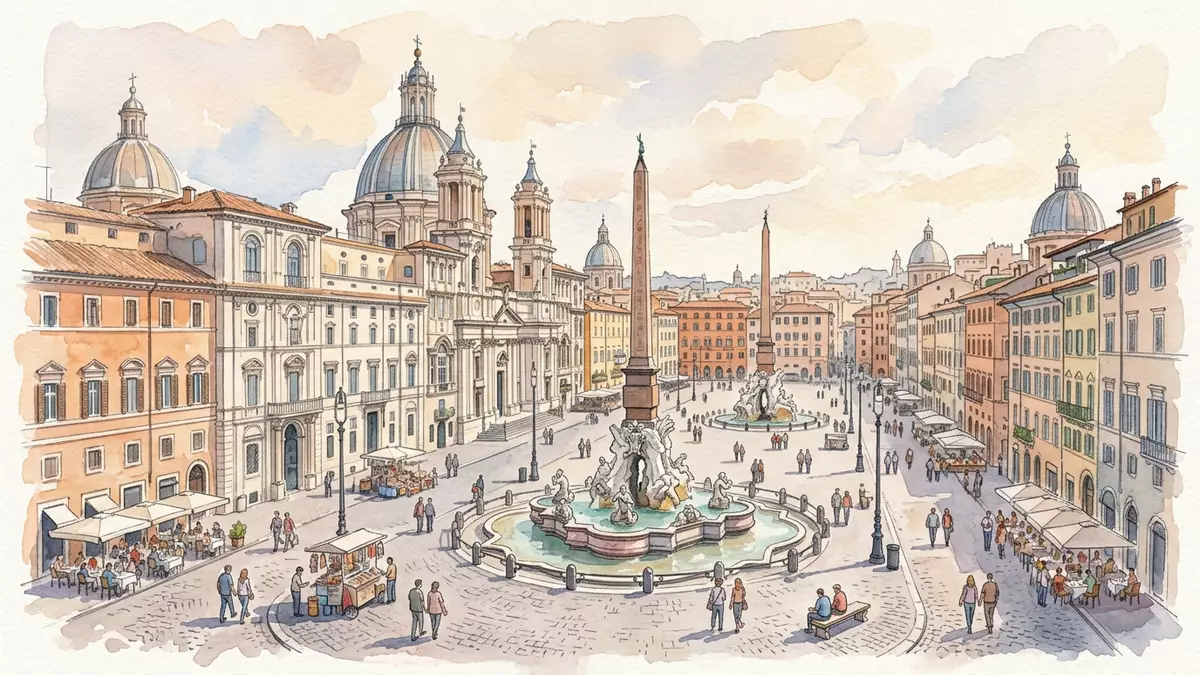
Piazza Navona in Rom is one of the clearest places where ancient Rome and baroque Rome share the same ground, visible in a single long sweep of space. Its outline follows the athletics stadium of emperor Domitian from the first century AD, wrapped later in churches, palaces and fountains that gave the square its present baroque form. The result is an open-air room with curved ends and a straight central axis, lined with historic façades and animated by street activity through the day.
From Domitian’s stadium to an elongated baroque square
The basic footprint of Piazza Navona is inherited directly from the Stadio di Domiziano, laid out in the first century AD for athletic competitions modelled on Greek games. That stadium had a long central arena framed by masonry terraces, with one short side closed in a curve, and this outline still shapes the square’s perimeter. Walking the length of Piazza Navona today recreates that axis: a straight stretch framed by buildings, gently bending into an arc at one end.
In the seventeenth century, the space was reshaped as a baroque city square under the patronage of the Pamphilj family, whose palace occupies one of its long sides. Pope Innocent X, born Giovanni Battista Pamphilj, is closely associated with this transformation, and his coat of arms appears in several places around the piazza. The new layout kept the ancient proportions while replacing the stadium’s seating with townhouses and palaces, turning a sports arena into a formal urban salon.
Fountains, church and palaces along the central axis
The long axis of Piazza Navona is articulated by three fountains set in a straight line: one near each curved end and one roughly at the centre. The middle fountain is the Fontana dei Quattro Fiumi, completed in the 1650s by Gian Lorenzo Bernini, whose sculptural groups represent four great rivers from different continents around a central obelisk. This fountain stands slightly off-centre in the square, creating a focus where routes cross and visitors naturally gather.
On one side of the Fontana dei Quattro Fiumi rises the church of Sant’Agnese in Agone, with a baroque façade attributed to architects including Francesco Borromini. Its towers and dome mark the square’s central stretch, forming a counterpoint to the lower palace fronts around it. Opposite Sant’Agnese, the Palazzo Pamphilj extends along the piazza with a sequence of windows overlooking the square, underlining how much of Piazza Navona’s life is watched from above as well as experienced on the ground.
Street life on an ancient footprint
Piazza Navona is paved as a pedestrian space, with cafés, restaurants and artists’ stalls opening directly onto the square. The absence of through-traffic allows the elongated form of the old stadium to read clearly in the paving and the alignment of the buildings. Musicians, painters and street performers often occupy patches near the fountains, using the existing nodes in the square’s layout as natural stages.
Seasonal events and local gatherings use the full length of Piazza Navona, making the proportions of Domitian’s stadium part of everyday life rather than distant history. Terraces under awnings line the edges, and the views along the piazza take in fountains, church fronts and the enclosing palaces in one extended glance. For many visitors, the most distinctive experience is moving slowly along that axis, aware that both the Roman arena and the baroque city are present in the same space.
Visiting Piazza Navona: what travellers from Western Europe should know
- Piazza Navona lies in the historic centre of Rom and is reached on foot from nearby streets or by public transport and taxis serving the surrounding area.
- Admission arrangements and opening hours are set by the site’s operator and change with the season; the official website is the only binding source.
- The square can feel different at various times of day, with quieter moments in the early morning and more animated activity in the evening and on weekends.
- The ground is largely level but paved; visiting involves walking on stone surfaces and standing for stretches, with some steps leading into surrounding buildings.
- Italian is the main language; card payments are widely accepted alongside cash, and social customs are relaxed, with many people lingering at cafés around the piazza.
- Entry requirements depend on your nationality. UK travellers should check the FCDO travel advice at gov.uk/foreign-travel-advice; Irish travellers the Department of Foreign Affairs at ireland.ie; EU and EEA citizens their own national foreign ministry.
Searching for Piazza Navona on social platforms
These links open searches for Piazza Navona on each platform.
Frequently asked questions about Piazza Navona
Where is Piazza Navona?
Piazza Navona is a historic square in the centre of Rom, in Italy, occupying the footprint of the Roman stadium of emperor Domitian.
What can visitors expect on a visit?
Visitors encounter an elongated stone-paved square framed by churches, palaces and cafés, with three fountains marking its axis and street activity around them.
What makes Piazza Navona distinctive among Rome’s squares?
Its proportions follow a first-century athletics stadium, while its fountains, church and palaces belong to the seventeenth-century baroque city, sharing one continuous space.