
Pico de Orizaba, the star mountain of eastern Mexico
Published on 09/10/2026 at 06:56 | Editorial responsibility: Rafael Müller, Editor-in-Chief AD HOC NEWS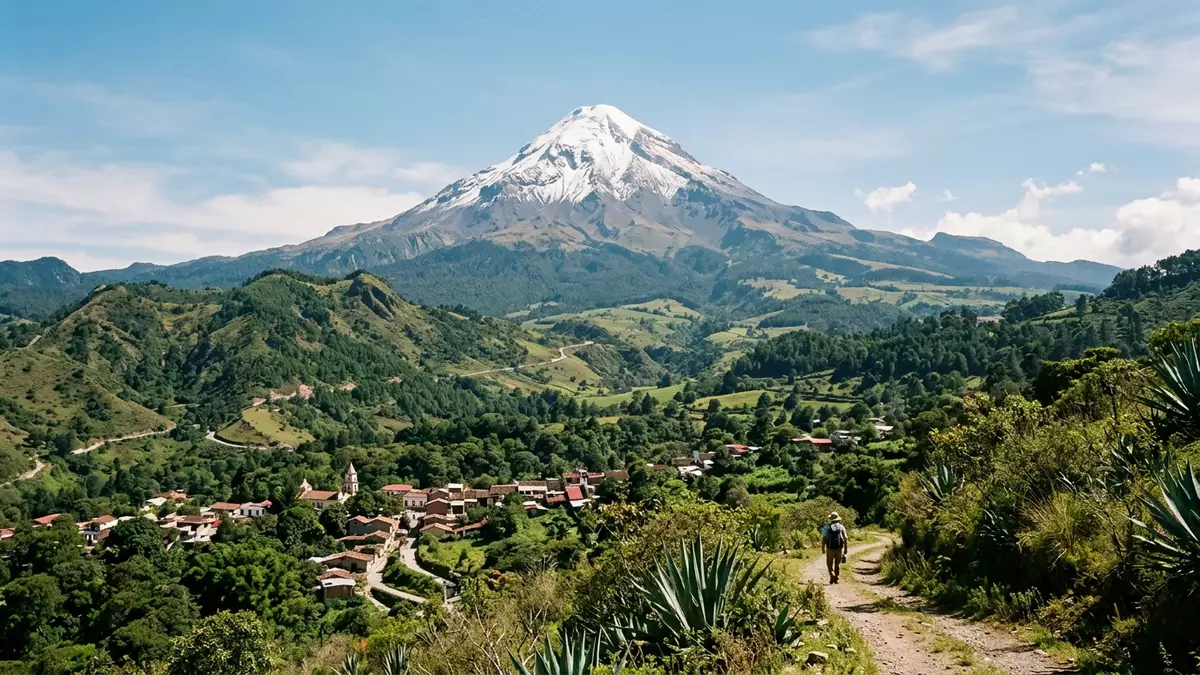
Pico de Orizaba, also known by the Náhuatl name Citlaltépetl, is a snow?capped stratovolcano that forms Mexico’s highest mountain on the border between Puebla and Veracruz. Rising to about 5,636 m (18,491 ft) above sea level in eastern central Mexico, it dominates the horizon north of the city of Orizaba and anchors the eastern end of the Trans?Mexican Volcanic Belt.
The high volcanic cone above Orizaba
Pico de Orizaba stands as a broad, symmetrical cone with its summit glaciers crowning a stratovolcano built from successive layers of lava and ash. It forms part of the Trans?Mexican Volcanic Belt, an east?west chain of volcanoes that crosses Mexico and includes neighbouring peaks such as Cofre de Perote and Popocatépetl.Trans?Mexican Volcanic Belt The volcano’s local Náhuatl name, Citlaltépetl, combines the words for “star” and “mountain”, a reference to its bright, ice?covered summit rising above the surrounding plateau.name derived from Náhuatl
The peak is commonly listed at around 5,636 m (18,491 ft), making it the highest mountain in Mexico and the third?highest summit in North America after Denali in Alaska and Mount Logan in Canada.third?highest mountain in North America It is also regarded as the highest volcano on the continent, standing far above the coastal plain to the east and the Mexican Plateau to the west.Mexico’s highest peak and North America’s highest volcano From lower slopes, the upper cone appears as a smooth, pale dome, while closer views reveal ridges, old lava flows and the jagged rim of the summit crater.
Glaciers, crater and volcanic history
Pico de Orizaba retains summit glaciers that drape its upper slopes and collect in hollows around the main cone. Together with Popocatépetl and Iztaccíhuatl, it is one of three volcanic peaks in Mexico that still carry permanent ice near their highest points, a feature that emphasises both its elevation and the relatively cool conditions at altitude in this tropical latitude.summit glaciers on three Mexican volcanoes Astronaut photographs show shadows accentuating channels and buttresses on the cone, with the glaciers forming bright caps against darker volcanic rock.
The volcano is classified as active in geological terms, though its present state is dormant. Documented eruptions have occurred over many centuries, with the most recent confirmed activity recorded in 1846.last eruption in 1846 Studies mention at least several historic eruptions with moderate explosive character and dacitic lava flows, reflecting the volcano’s role in the wider volcanic arc that extends across central Mexico.historic eruptions and stratovolcano description The crater near the summit forms a visible depression with steep inner walls, and its rim marks the highest point reached by mountaineers.
A mountain landscape between Puebla and Veracruz
Geographically, Pico de Orizaba rises on the boundary between the states of Puebla and Veracruz, in eastern central Mexico. It stands roughly west of the port city of Veracruz on the Gulf of Mexico and east of Mexico City, forming a landmark in views across the Mexican Plateau and the coastal lowlands.location between Puebla and Veracruz The surrounding terrain includes valleys with farmland, pine and fir forests on mid?slopes, and volcanic ridges connected to the broader Citlaltépetl–Cofre de Perote range.Citlaltépetl–Cofre de Perote volcanic chain
The upper mountain lies within Parque Nacional Pico de Orizaba, a national park that protects the high?altitude environment and the glacier?covered summit area. Approach routes from Puebla and Veracruz climb through forest zones before reaching open volcanic slopes, where the tree line gives way to rock, scree and occasional snowfields. On clear days the summit cone can be seen from considerable distances, with its profile changing as the view shifts from the Veracruz lowlands to the urban areas around Orizaba.
Visiting Pico de Orizaba: what travellers from Western Europe should know
- Pico de Orizaba rises north of the city of Orizaba in eastern Mexico, on the boundary between Puebla and Veracruz, and is reached from regional roads that lead towards mountain villages on its lower slopes.
- The terrain on the upper mountain is high?altitude volcanic ground with steep slopes, loose rock and glacier ice, and any ascent beyond the lower trails involves sustained climbing above 4,000 m (13,123 ft).
- In winter months the summit area carries extensive snow and ice, and weather on the mountain can change quickly between clear skies and cloud, affecting visibility on exposed ridges.
- The official language is Spanish and the currency is the Mexican peso.
- Entry requirements depend on your nationality; UK travellers can check the FCDO travel advice at gov.uk/foreign-travel-advice, Irish travellers the Department of Foreign Affairs at ireland.ie.
Searching for Pico de Orizaba on social platforms
These links open searches for Pico de Orizaba on each platform.Frequently asked questions about Pico de Orizaba
Where is Pico de Orizaba located?
Pico de Orizaba stands on the boundary between the Mexican states of Puebla and Veracruz in eastern central Mexico, north of the city of Orizaba.
What should visitors expect on a visit?
Visitors encounter a high?altitude volcanic landscape with steep slopes, forested lower approaches and glacier?covered upper slopes, where weather and visibility can change quickly.
What makes Pico de Orizaba distinctive among Mexican mountains?
Pico de Orizaba is distinctive as Mexico’s highest mountain, North America’s highest volcano and one of a small group of Mexican peaks that still carry summit glaciers.


