
Plaza de Espana in Sevilla and its sweeping brick crescent
Published on 08/18/2026 at 13:50 | Editorial responsibility: Rafael Müller, Editor-in-Chief AD HOC NEWS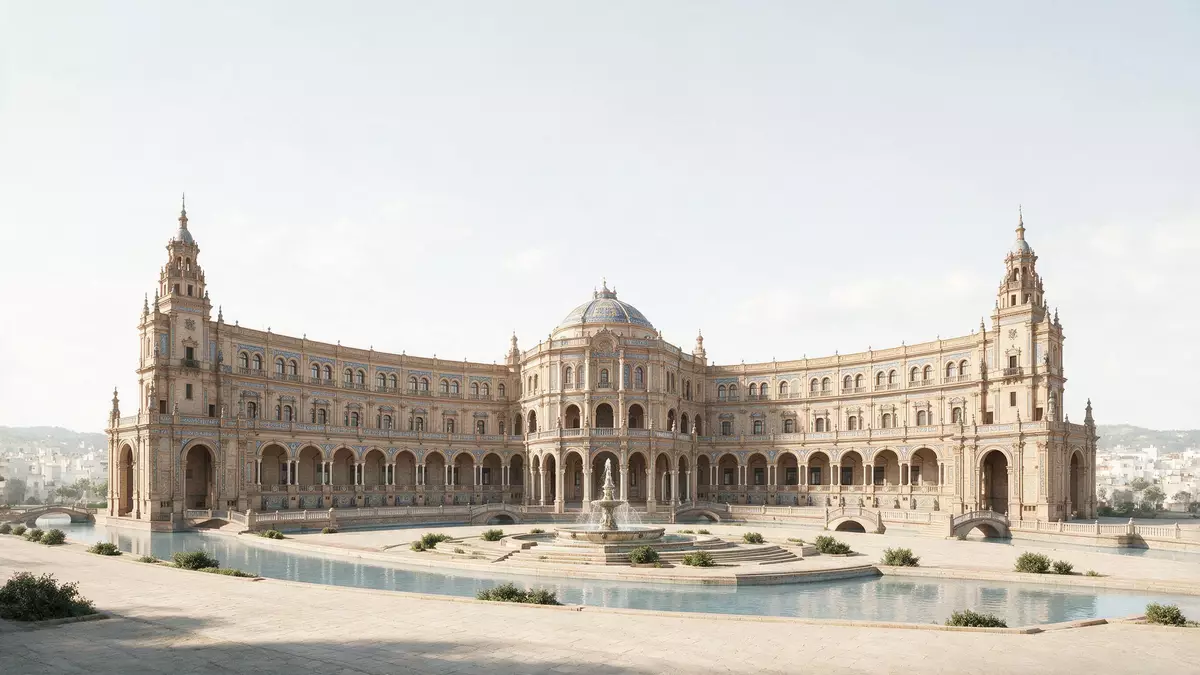
Plaza de Espana in Sevilla sweeps around a semi-circular space of brick, tile and water, a single architectural gesture that frames an urban stage. Conceived for the Ibero-American Exposition of 1929 and designed by the Sevillian architect Aníbal González in the early twentieth century, it brings together historical styles under one vast crescent of buildings and arcades.
A semi-circular palace embracing a city square
The defining feature of Plaza de Espana is its semi-circular plan, curving around a broad open plaza that faces towards the rest of Sevilla. The complex stands at the edge of Maria Luisa Park, on the south side of the historic centre, where formal gardens and avenues of trees give way to brick architecture and tiled balustrades.The plaza forms part of Maria Luisa Park and marks the transition between landscaped greenery and the planned exhibition grounds of the 1920s.Its floor plan is described as semicircular
Along the outer arc stands a continuous brick building articulated by towers, galleries and pavilions. Two tall towers rise at each end of the curve, framing the ensemble and giving it a skyline that is visible from parts of the surrounding district.These towers anchor the semi-circular brick building Between them, colonnaded galleries open towards the square, where a central fountain and patterned paving mark the centre of the space.
Regionalist architecture in brick, tile and carved stone
Plaza de Espana is one of the major works of Spanish Regionalist architecture, a movement that drew on historic styles and local materials in the early twentieth century.The plaza is widely cited as a landmark of this architectural current Aníbal González combined elements of Renaissance Revival, Baroque Revival and Neo-Mudéjar, using exposed brick, elaborate ceramic tilework and wrought iron to create a richly textured surface for the long facades.His design mixes Renaissance inspiration with Seville materials such as brick, ceramics and ironwork
Arcaded galleries run along the inner side of the building, each bay framed by pillars and openings that look out over the water and paving. Underfoot and along the parapets, glazed tiles form patterns in blues, greens and ochres, while balustrades and staircases are picked out with ceramic details. Within the curve, a broad canal follows the line of the building, crossed by several low bridges whose balustrades and steps continue the same tile and brick vocabulary.The building is surrounded on its inner side by a moat-like canal crossed by bridges
A twentieth-century exposition site that became a civic landmark
Plaza de Espana was created as one of the principal ensembles for the Ibero-American Exposition of 1929, a world’s fair that brought new pavilions and infrastructure to Sevilla.The plaza served as a centrepiece of the 1929 exhibition in and around Maria Luisa Park Construction began in 1914 under the direction of Aníbal González, whose work on the project continued into the 1920s.The ensemble was built between 1914 and 1929
The area covered by Plaza de Espana is substantial, with the curved building and its adjoining spaces extending over tens of thousands of square metres.Local tourism information gives a figure of about 50,000 square metres for the plaza complex After the exposition closed, the buildings housed various official bodies rather than exhibition functions, embedding the ensemble in the administrative and civic life of the city.Later occupants included the Government Delegation in Andalusia and other public institutions
Visiting Plaza de Espana: what travellers from Western Europe should know
- Plaza de Espana stands at the north-east end of Maria Luisa Park in Sevilla, south of the historic centre, and is reached on foot or by public transport from central districts.
- The square is expansive and largely paved, with broad staircases and stepped approaches to the canal and central level, so extended walking and stair climbing are involved.
- Rows of tiled benches and alcoves line parts of the inner facade, while the surrounding park provides shaded paths and lawns immediately beside the architectural ensemble.
- The official language is Spanish and the currency is the euro.
Searching for Plaza de Espana on social platforms
These links open searches for Plaza de Espana on each platform.Frequently asked questions about Plaza de Espana
Where is Plaza de Espana in Sevilla?
Plaza de Espana stands on the edge of Maria Luisa Park in Sevilla, at the southern side of the central city and near the Guadalquivir river.
What can visitors expect when they arrive?
Visitors encounter a vast semi-circular brick complex with towers, tiled galleries, a canal traced along the curve, open paving and the greenery of Maria Luisa Park beside it.
What makes Plaza de Espana distinctive among Spanish squares?
Its combination of a semi-circular palace-like building, extensive ceramic decoration, canal and bridges, and its origin as a 1929 exposition centrepiece gives Plaza de Espana a character strongly tied to early twentieth-century Regionalist architecture.


