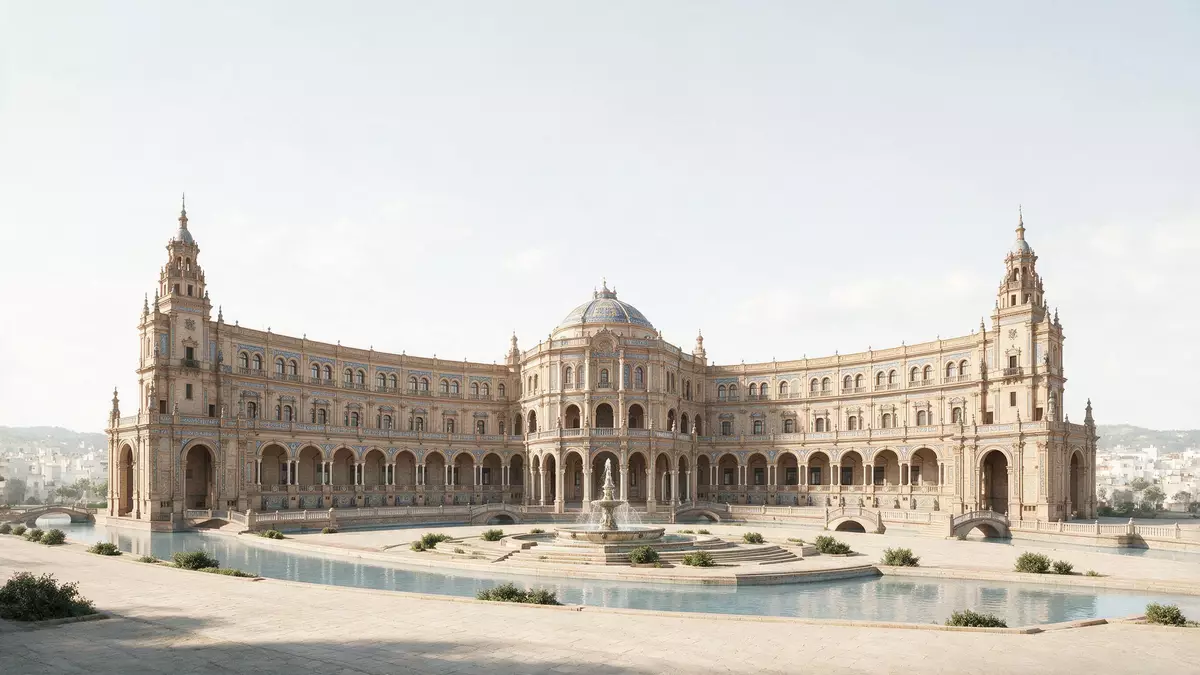
Plaza de Espana in Sevilla’s Maria Luisa Park
Published on 08/12/2026 at 14:06 | Editorial responsibility: Rafael Müller, Editor-in-Chief AD HOC NEWS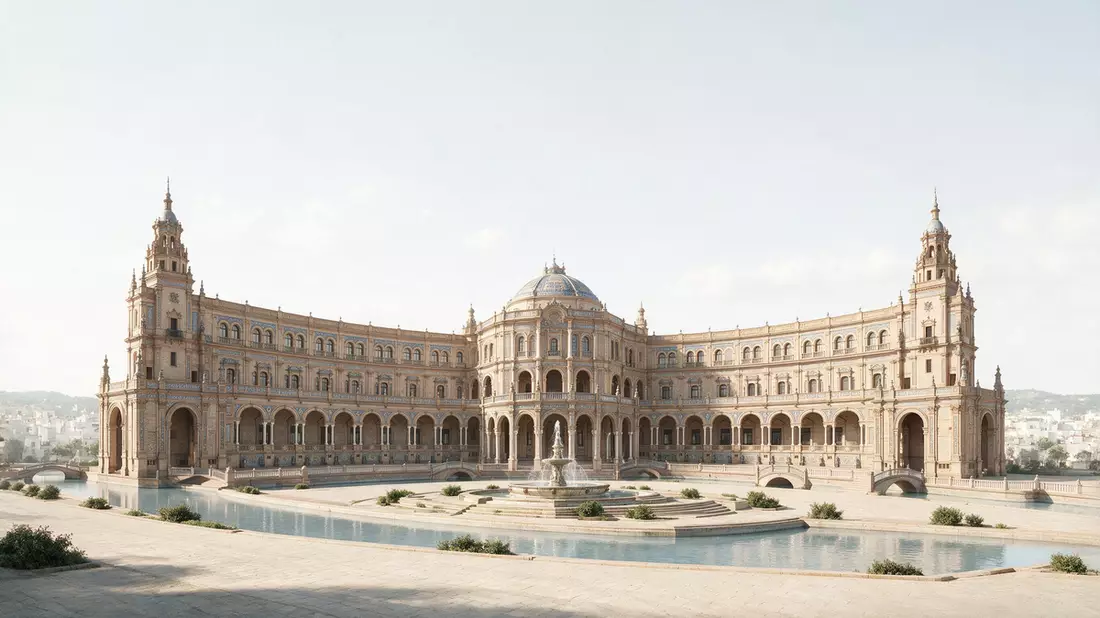
Plaza de Espana in Sevilla is a vast semi-circular ensemble of brick, tile and water set against the greenery of Maria Luisa Park. Designed by Sevillian architect Aníbal González and substantially completed by 1928 for the Ibero-American Exposition of 1929, it turns a commemorative fairground building into a permanent stage of Spanish regional styles.
A semi-circular palace around a tiled square
The defining gesture of Plaza de Espana is its semi-circular plan, where a curving palace-like façade encloses a broad paved square and a canal. The main building stretches in a long arc with a high central body and towers at each end, creating a continuous backdrop of brick, balustrades and arcades that reads almost like an open-air gallery of arches.Plaza de España is a semi-circular brick building
Across the front of the building runs a canal crossed by four tiled bridges, and inside the curve lies the main plaza with its patterned paving and central fountain. The elevation combines brick walls with ceramic balustrades, columns and cornices, so that structural elements double as decoration and the whole arc reads as a continuous piece of architectural ornament.Semicircular in shape, the square is bordered by a huge brick and ceramic palace
Regionalist architecture in brick, ceramic and carved detail
Plaza de Espana is one of the major works of early twentieth-century Spanish Regionalism, a style that blends historical references with local materials and craft traditions.It is a landmark example of Regionalism Architecture Aníbal González combined Renaissance Revival, Baroque Revival and Neo-Mudéjar elements, reworking arches, cornices and tile patterns into a single composition that feels both historic and of its period.The monumental structure was designed in the Regionalist style
Brick is the dominant structural material, but colour comes from extensive ceramic work, from balustrades and balcony fronts to coats of arms and floor inlays. Ironwork and stone are also present in railings, lamps and columns, creating a layered texture where different Andalusian crafts meet in a single monumental façade.Simple elements such as marble, carved bricks, ironwork and tiles were used
Tiles, provinces and the legacy of the 1929 exposition
Running along the inner side of the building is a sequence of tiled alcoves and benches, each dedicated to one of the Spanish provinces that existed at the end of the 1920s. These alcoves combine maps, coats of arms and historical scenes worked in glazed ceramic, so that geography and history appear as images on the walls of the square.Forty-eight tiled alcoves and benches represent the forty-eight provinces Spain had at the time
Construction of Plaza de Espana began in 1914 and continued into the 1920s as part of the preparations for the Ibero-American Exposition of 1929, a world’s fair in which Seville presented itself to Spanish-speaking countries and beyond.The plaza was built between 1914 and 1929 on the occasion of the 1929 Ibero-American Exhibition The complex stands on the north-eastern edge of Maria Luisa Park, forming part of a wider ensemble of pavilions and landscaped avenues that date from the same period.The Ibero-American Exposition of 1929 was a world’s fair held in Seville, with major buildings around Plaza de España
Visiting Plaza de Espana: what travellers from Western Europe should know
- Plaza de Espana stands at the north-eastern end of Maria Luisa Park in Sevilla, south of the historic centre, and is reached on foot, by bicycle or by city bus.
- The square itself is paved, with steps and ramps linking the central space, the bridges over the canal and the raised arcade along the main façade.
- The canal forms a loop inside the semi-circle of the buildings and is crossed by four tiled bridges with balustrades and short staircases.
- The official language is Spanish and the currency is the euro.
Searching for Plaza de Espana on social platforms
These links open searches for Plaza de Espana on each platform.Frequently asked questions about Plaza de Espana
Where is Plaza de Espana in Sevilla?
Plaza de Espana stands on the north-eastern edge of Maria Luisa Park in Sevilla, Spain, south of the historic core and near the park’s main avenues.
What can visitors expect to see at Plaza de Espana?
Visitors encounter a large semi-circular plaza framed by a monumental brick and ceramic building, a canal crossed by tiled bridges and a ring of provincial tile alcoves.
What makes Plaza de Espana distinctive among Spanish squares?
Its combination of Regionalist architecture, extensive ceramic decoration and the semi-circular layout with water and bridges gives Plaza de Espana a character unlike more traditional city squares.