
Praia das Catedrais and its stone arches on Galicia’s coast
Published on 09/23/2026 at 16:56 | Editorial responsibility: Rafael Müller, Editor-in-Chief AD HOC NEWS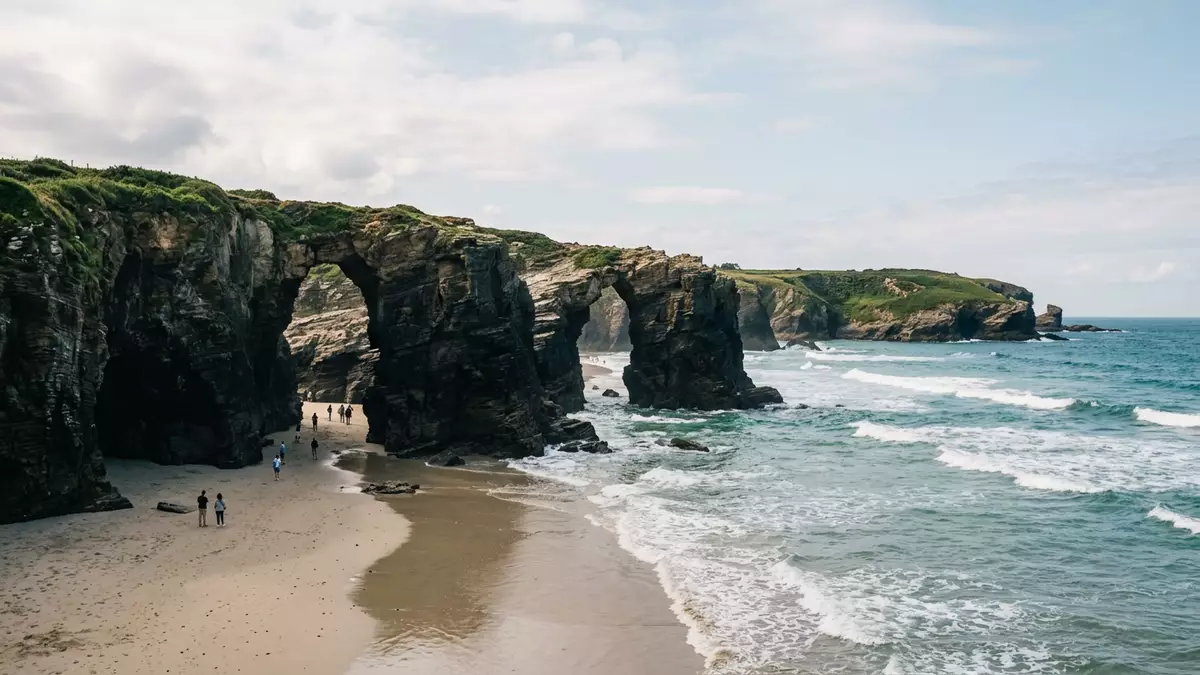
Praia das Catedrais lies on the Galician coast near Ribadeo, where slate and quartzite cliffs meet the Cantabrian Sea. At low tide, the shore reveals arches, columns, vaults and sandy passages cut into the rock, giving the beach its cathedral-like appearance.
Praia das Catedrais between Ribadeo and the open sea
The beach belongs to the municipality of Ribadeo in Lugo, within A Mariña oriental. Its protected coastal area extends between the beaches of Augasantas and Carricelas, with the N-634 providing the main road approach from the surrounding coast.
Praia das Catedrais is a natural monument covering 28.94 hectares, including 20 hectares of marine water. The designation dates from 20 January 2005, when Galicia formally recognised the site’s geological and landscape value. natural monument designation forms part of the place’s formal identity.
Slate, quartzite and the architecture of erosion
The cliffs are formed mainly from quartzite and slate, rocks with a geological history reaching back approximately 500 million years. Tectonic movement lifted and altered these materials before marine erosion shaped the coastal platform visible at Praia das Catedrais.
Fractures in the rock create lines of weakness. Waves enlarge those fractures into openings, caves and corridors, while harder sections remain as pillars and wall-like projections. The result includes arches rising to about 30 m (98 ft), along with vaults and passages between the cliff face and the sea. quartzite and slate cliffs provide the geological foundation.
What appears on the sand at low tide
The beach changes character with the tide. At high water, the sea reaches the foot of the cliffs and covers much of the sandy area. At low tide, the exposed shore becomes a route among rock walls, caves and archways.
The name refers to the forms created by these natural openings. Some arches resemble flying buttresses, while other sections form enclosed-looking chambers and narrow sandy corridors. The comparison comes from visible stone shapes rather than from a constructed monument. arches and coastal vaults show how the Cantabrian platform has been cut by the sea.
Praia das Catedrais is also part of a wider protected coastal setting connected with the Natura 2000 network. Nearby places include Os Castros beach and the fishing port of Rinlo, both within the coastal landscape associated with Ribadeo.
Visiting Praia das Catedrais: what travellers from Western Europe should know
- Praia das Catedrais lies west of Ribadeo on Galicia’s northern coast. The N-634 connects the area with coastal roads between San Miguel de Reinante and Rinlo.
- The closest railway access is the Esteiro-A Devesa stop on the narrow-gauge coastal line linking Ferrol and Gijón. The beach is reached from the station on foot.
- The shore is tidal, and the arches and sandy corridors belong to the intertidal zone. Walking beneath them requires attention to the sea’s changing position.
- The official language is Spanish and Galician, and the currency is the euro.
Searching for Praia das Catedrais on social platforms
These links open searches for Praia das Catedrais on each platform.
Frequently asked questions about Praia das Catedrais
Where is Praia das Catedrais?
Praia das Catedrais is on Galicia’s northern coast, in the municipality of Ribadeo in Lugo, Spain. It lies between Augasantas and Carricelas.
What can visitors see there?
At low tide, the shore exposes sandy passages, caves, slate walls, columns, vaults and large sea-carved arches. The visible formations belong to the intertidal coastal platform.
What makes Praia das Catedrais distinctive?
Its quartzite and slate cliffs contain a sequence of arches and openings shaped by marine erosion. The protected site combines a beach, a geological monument and a wider Natura 2000 coastal setting.


