
Praza do Obradoiro and Santiago’s four stone façades
Published on 09/23/2026 at 13:15 | Editorial responsibility: Rafael Müller, Editor-in-Chief AD HOC NEWS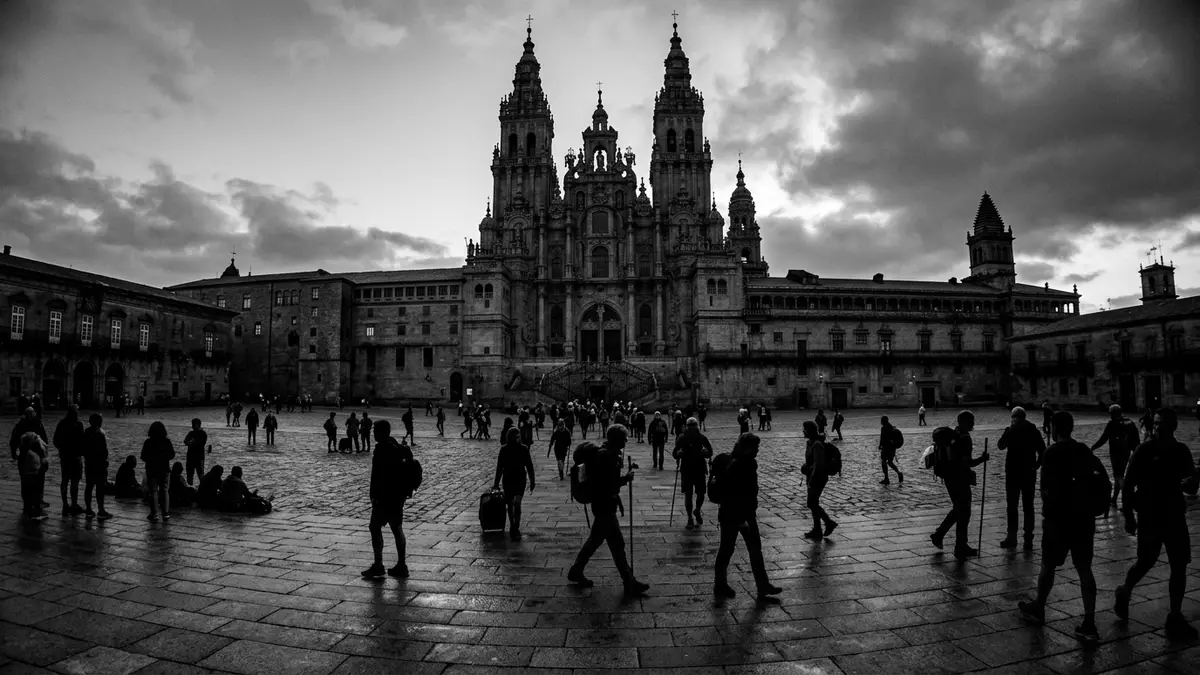
Praza do Obradoiro is a broad granite square in the historic centre of Santiago de Compostela. Four buildings face the open space: the Cathedral of Santiago, the Pazo de Raxoi, the Hostal dos Reis Católicos and the Colegio de San Xerome.
The square’s four sides bring together religious, civic, royal and academic architecture. Their materials and façades form a visible cross-section of Santiago’s history, from the medieval cathedral to eighteenth-century Baroque and Neoclassical buildings.
Four buildings around a single granite space
The cathedral occupies the eastern side, with its western façade rising above the paving. The façade belongs to the Baroque transformation of the medieval church and carries dense sculpted decoration between the towers known as Campanas and Carraca.
Opposite stands the Pazo de Raxoi, an eighteenth-century palace with a long classical front. It houses Santiago’s city council and the presidency of the Galician regional government. The four buildings around the square represent different chapters of the city’s public life.
The Hostal dos Reis Católicos closes the northern side. Founded in 1499 by Ferdinand and Isabella, the Catholic Monarchs, it began as a hospital for pilgrims and belongs to the Renaissance and Plateresque tradition.
The Colegio de San Xerome completes the opposite side. Its historic entrance leads to the university rectorate, connecting the square with the University of Santiago de Compostela and its long academic presence in the city.
From Romanesque cathedral to Baroque west front
The cathedral’s origins reach back to the Romanesque period and the medieval cult of Saint James. Its fundamental medieval structure remains, while later campaigns added Renaissance and Baroque elements to the complex.
The western façade facing Praza do Obradoiro took its present form during the eighteenth century. Fernando de Casas began the current façade in 1738, replacing an earlier elevation with a composition of towers, openings, sculpture and layered stone ornament. Fernando de Casas’ façade dominates the square.
A Renaissance staircase rises from the paving towards the cathedral entrance. Behind the façade lies the medieval church, including the Pórtico de la Gloria, whose Romanesque sculpture belongs to the cathedral’s older artistic history.
The name Obradoiro comes from the Galician word for workshop. It recalls the craftsmen who worked with stone during the cathedral’s building campaigns, including the period when the Baroque façade was being prepared and carved.
The Camino’s architectural arrival
Praza do Obradoiro is closely connected with the Camino de Santiago. Pilgrims arriving through the old town reach the open space before the cathedral, where narrow streets give way to granite paving and the western façade.
The square is not simply a forecourt for one church. The cathedral faces a palace, a former royal hospital and a university building across the same rectangle. Religious worship, government, hospitality and learning appear as separate functions within one architectural setting.
Santiago de Compostela’s old town entered the UNESCO World Heritage List in 1985. Its buildings include Romanesque, Gothic, Renaissance, Baroque and Neoclassical examples, with the Cathedral and Praza do Obradoiro forming a central part of the historic ensemble. World Heritage old town surrounds the square with streets and monuments shaped by pilgrimage.
The paving leaves the centre visually open. From one position, the cathedral’s sculpted front can be read alongside the palace’s regular windows, the Hostal’s Renaissance details and the smaller university entrance. The contrast is architectural rather than decorative: each building carries a different institutional history.
Praza do Obradoiro therefore works as a square of façades and relationships. Its identity lies in the way four major buildings face one another across granite, making the history of Santiago visible without leaving a single urban space.
Visiting Praza do Obradoiro: what travellers from Western Europe should know
- Praza do Obradoiro lies in Santiago de Compostela’s historic centre, in Galicia in north-west Spain. It is reached on foot through the old town and sits directly before the cathedral’s western façade.
- The square is paved with granite and enclosed by large historic buildings. Approaches through the old town use narrow streets, while the open square itself provides a broad level space.
- The Camino de Santiago reaches its traditional destination at the cathedral beside the square. The cathedral, Pazo de Raxoi, Hostal dos Reis Católicos and Colegio de San Xerome are visible from the same space.
- The official language is Spanish and Galician, and the currency is the euro.
Searching for Praza do Obradoiro on social platforms
These links open searches for Praza do Obradoiro on each platform.
Frequently asked questions about Praza do Obradoiro
Where is Praza do Obradoiro?
It is in the historic centre of Santiago de Compostela, directly before the western façade of the Cathedral of Santiago in Galicia, Spain.
What can travellers expect in the square?
They encounter a granite-paved urban space surrounded by the cathedral, a palace, a former pilgrim hospital and a university building.
What makes Praza do Obradoiro distinctive?
Its four sides bring religious, civic, royal and academic architecture together around one open square, linking the setting with the Camino de Santiago.


