
Predjamski grad and the castle that grows from the cliff
Published on 09/22/2026 at 00:33 | Editorial responsibility: Rafael Müller, Editor-in-Chief AD HOC NEWS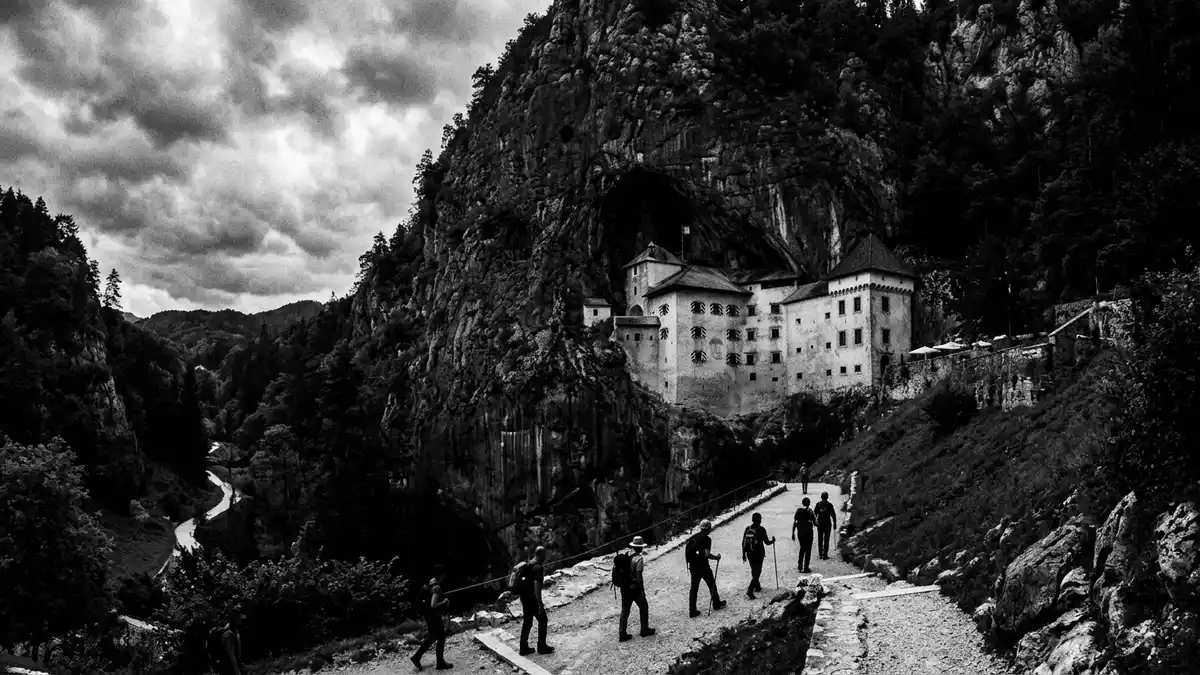
Predjamski grad near Postojna in Slovenia is a Renaissance-era castle that appears to grow straight out of a limestone cliff, its walls merging with the rock behind them. Built into the mouth of a karst cave in Inner Carniola, it turns the cliff itself into part of the fortification and makes the surrounding landscape as important as the stonework.
A castle anchored in rock and cave
Predjamski grad stands above the village of Predjama, north of Postojna, where a high limestone cliff is cut by a natural cave opening in the karst plateau of Inner Carniola. The castle’s masonry rises directly from this rock face, with its outer walls aligned against the cliff and its upper levels backed by the cave hall and cavities that extend deep into the hill.A Renaissance castle built within a cave mouth The position above the valley and the way the building fuses with the geology give Predjamski grad a silhouette in which cliff and castle form a single vertical surface from riverbed to parapet.
The site has medieval origins with a fortress recorded in the thirteenth century under German forms such as Luegg, when the Patriarchate of Aquileia held the property in Gothic form.Predjama Castle was first mentioned in 1274 Earlier structures recessed more deeply into the cave itself, using the overhanging rock as cover, and gave way over time to the more projecting castle front visitors see from the road today. The current building spans several levels of rooms, galleries and defensive elements, but much of its apparent mass still lies partly within the natural cavities of the cliff.
From medieval fortress to Renaissance residence
The architectural story of Predjamski grad begins with a medieval castle in Gothic style, documented in the late thirteenth century and later expanded by noble families connected with the Luegg and Jamski names. Over the fifteenth century it became associated with Erasmus of Predjama, a knight whose life and siege are woven into the lore of the house and the region.The castle became famous through the fifteenth-century lord Erasmus Whatever the precise details of his story, the link between a rebellious local lord and a cave castle high above a valley has helped fix Predjamski grad in the imagination of Slovenia and of visitors.
The present appearance of the castle dates from the sixteenth century, after earlier buildings suffered damage in an earthquake in 1511 and were replaced by a more representative residence.The present Renaissance appearance dates from 1570 In 1570 the Cobenzl family rebuilt Predjamski grad as a Renaissance castle beneath the remains of the medieval fortress, adjusting its layout to sit partly in front of the cave hall rather than entirely recessed within it.Rebuilt in 1570 in Renaissance style The result is a hybrid: an aristocratic residence with windows, halls and a more orderly façade that still uses rock overhangs, internal caverns and height above the valley as integral parts of its defence and character.
Architecture, secret routes and the karst landscape
Seen from the approach road, the façade of Predjamski grad stacks defensive and domestic elements on a narrow ledge, with outer walls, towers and rooflines pressed against the cliff, and the dark opening of the cave behind them. Inside, rooms follow the irregular line where masonry meets rock, with some chambers opening directly onto rough limestone surfaces, others extending further out into constructed galleries and halls.Castle hanging on a cliffside Levels rise above one another up the cliff face, and the upper parts connect to passages and shafts that lead deeper into the hill.
Behind the castle a network of tunnels and corridors runs through the karst, linking the fortress to hidden exits and store rooms in the rock, and tying it to the wider cave system that underlies the plateau around Postojna.An intricate system of secret tunnels connecting it to the outside This connection to subterranean spaces gives Predjamski grad a second dimension beyond its façade, where staircases, gangways and rock-cut routes continue into the hill. The castle also stands within sight of the wider karst attractions around Postojna, including the extensive cave system that has made the region a long-standing destination for travellers.
Visiting Predjamski grad: what travellers from Western Europe should know
- Predjamski grad stands above the village of Predjama in Inner Carniola, north of Postojna, and is reached by road from Postojna via local routes through the karst countryside.
- The castle occupies a high limestone cliff with approaches on foot that include sloping paths and interior stairways rising through several levels between rock and masonry.
- The surrounding landscape is part of the experience, with views over a narrow valley and nearby karst formations that link Predjamski grad visually to the wider plateau around Postojna.
- The official language is Slovene and the currency is the euro.
Searching for Predjamski grad on social platforms
These links open searches for Predjamski grad on each platform.
Frequently asked questions about Predjamski grad
Where is Predjamski grad located?
Predjamski grad stands above the village of Predjama in Inner Carniola, north of Postojna in south-central Slovenia, where a limestone cliff is cut by a cave opening.
What should visitors expect on a visit?
Visitors encounter a castle built into a karst cliff, with interior stairways and rooms that meet exposed limestone, and views over a narrow valley framed by the surrounding plateau.
What makes Predjamski grad distinctive among castles?
Its defining feature is the way Renaissance-era masonry fuses with a natural cave and cliff, combining a noble residence with subterranean tunnels and rock that form part of the fortress.


