
Puente Romano de Salamanca and the stone route into the old city
Published on 08/12/2026 at 14:21 | Editorial responsibility: Rafael Müller, Editor-in-Chief AD HOC NEWS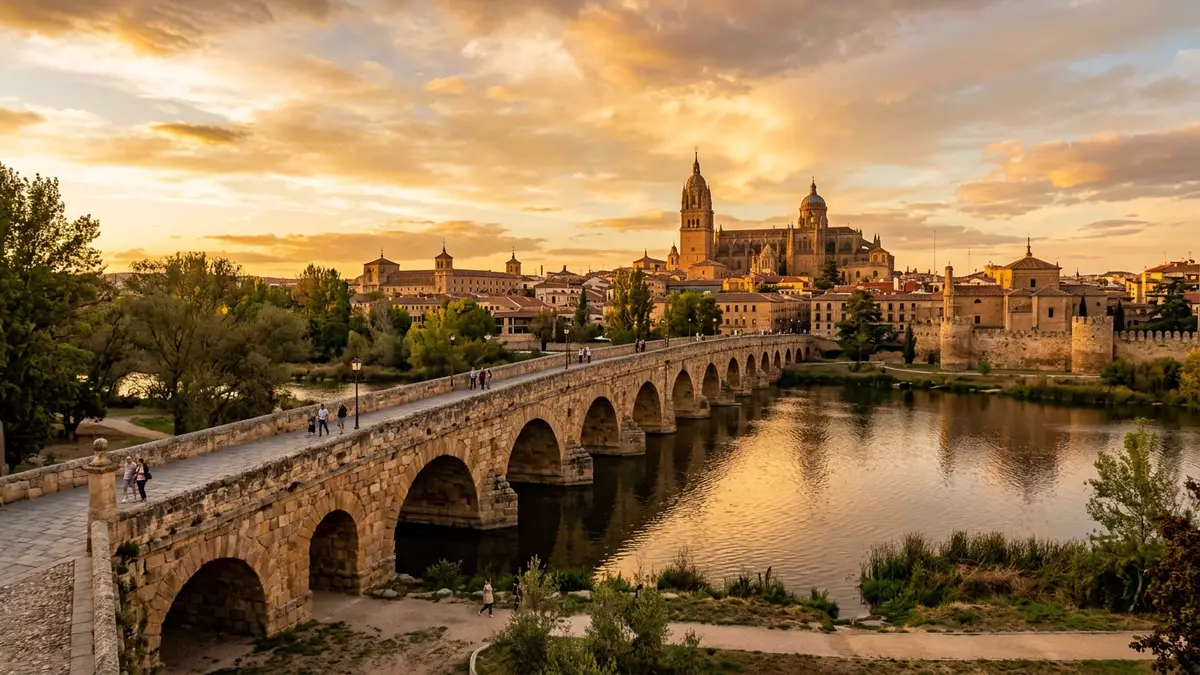
Puente Romano de Salamanca is the stone gateway across the River Tormes into Salamanca’s historic centre, a Roman bridge whose arches still frame the city’s skyline.
A Roman bridge at the edge of Salamanca’s old town
Puente Romano de Salamanca spans the River Tormes on the southern side of Salamanca in western Spain, connecting the city with the river’s broad floodplain and the Arrabal district beyond.Roman bridge of Salamanca The structure is also known locally as Puente Mayor del Tormes, a name that reflects its longstanding role as the principal crossing towards the city’s old core.Puente Mayor del Tormes From the bridge, the view rises towards Salamanca’s twin cathedrals, the older Catedral Vieja and the later Catedral Nueva, standing on the northern bank above the houses.
The bridge carries a line of stone arches across one of the widest stretches of the Tormes, resting on a rocky riverbed that has helped to anchor it through centuries of floods.widest stretches of the Tormes Its profile is low and elongated, a horizontal band of masonry that contrasts with the rising towers and domes of the city behind it. At the city end, the bridge meets the line of the former defensive walls and the approach roads that once funnelled travellers towards Salamanca’s core squares and university buildings.
Bimillennial Roman stone and later restorations
Puente Romano de Salamanca is traditionally dated to the first century AD, during the Roman imperial period, forming part of the Vía de la Plata route that linked Mérida with Astorga.Vía de la Plata The bridge is therefore a bimillennial monument in stone, belonging to the same broad era as the consolidation of Roman power in Hispania.bimillennial monument Its Roman fabric lies mainly in the sequence of arches closest to the city, which preserve the proportions and construction techniques of a classical roadway.
The bridge stretches to around 176 m (577 ft) in length and a little under 4 m (13 ft) in width, with a total of 26 arches carried on robust cutwater piers.176 m and 26 arches Fifteen arches nearer to the city belong to the Roman phase, while eleven more distant spans reflect later rebuilding after major floods of the Tormes.Roman and rebuilt arches Golden granite from quarries in the region gives the masonry its warm colour, and careful coursing produces a consistent texture along the parapets and spandrels.golden granite stone
The bridge within Salamanca’s urban and river landscape
Puente Romano de Salamanca stands slightly downstream from the tight cluster of Salamanca’s historic buildings, forming a foreground layer in many views of the city, especially those that include the cathedrals and the Casa Lis modernist museum on the northern bank.Casa Lis nearby At its southern end, the bridge meets paths and streets that run through the Arrabal neighbourhood and along the river, giving access to green spaces and riverside walks. The fluvial setting, with trees and low islands in the Tormes, underlines the contrast between the engineered stone crossing and the water beneath.
The bridge is reserved for pedestrians, turning what was once a roadway into a broad stone terrace over the river.entirely pedestrian Along its length, visitors pass a sculpted verraco, a pre-Roman stone figure that hints at an earlier cultural layer in the region’s history.sculpture of the verraco Beyond the bridge itself, the riverfront includes viewpoints and paths where the full curve of the arches can be seen, together with their reflection in the water when levels are calm.
Visiting Puente Romano de Salamanca: what travellers from Western Europe should know
- Puente Romano de Salamanca crosses the River Tormes south of Salamanca’s historic centre, reached on foot from central streets such as Calle Zamora and Paseo de San Gregorio.
- The bridge surface is paved in stone and largely level, with low parapets and no vehicular traffic, though the approaches on both sides involve gentle slopes.
- Puente Romano de Salamanca stands in Spain, where the official language is Spanish and the currency is the euro.
- Along the northern bank near the bridge are landmarks including the Casa Lis museum and the twin cathedrals, which are visible from the parapet.
Searching for Puente Romano de Salamanca on social platforms
These links open searches for Puente Romano de Salamanca on each platform.
Frequently asked questions about Puente Romano de Salamanca
Where is Puente Romano de Salamanca located?
Puente Romano de Salamanca is in Salamanca, in the Castile and León region of Spain, crossing the River Tormes just south of the historic centre.
What can visitors expect when walking across the bridge?
Visitors find a pedestrian stone bridge with a sequence of arches, river views and sightlines towards Salamanca’s cathedrals and riverside buildings on the northern bank.
What makes Puente Romano de Salamanca distinctive among Spanish bridges?
The bridge combines a first-century Roman origin, golden granite arches and a clear role within the Vía de la Plata route, all preserved beside a major historic city.


