
Raohe Yeshi turns one street into a temple-front market
Published on 09/24/2026 at 00:37 | Editorial responsibility: Rafael Müller, Editor-in-Chief AD HOC NEWS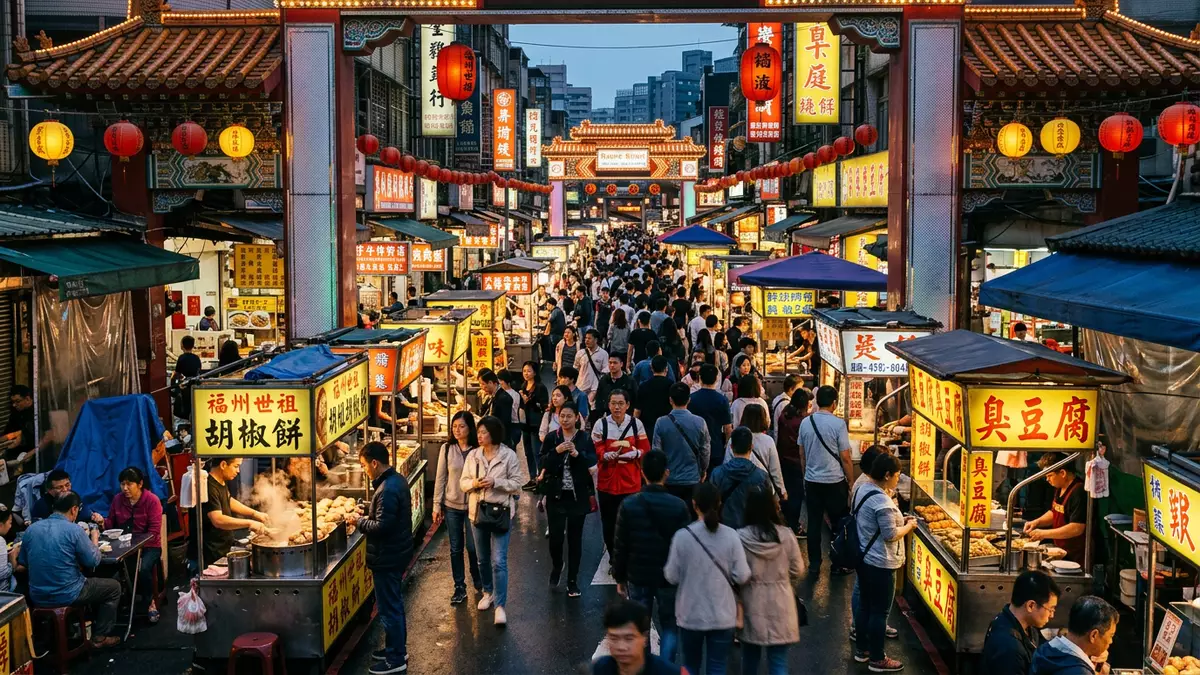
Raohe Yeshi occupies a single stretch of Raohe Street in Taipeh’s Songshan District. Its stalls form a food-and-shopping corridor beside Songshan Ciyou Temple, with the Keelung River close by and the city’s metro network at Songshan Station.
The market’s defining feature is its linear setting. Instead of a broad square or enclosed hall, Raohe Yeshi follows a street roughly 600 metres long, linking decorated gateways, shopfronts, food stands and a major temple facade.
Raohe Yeshi follows a 600-metre street
Raohe Yeshi runs through eastern Taipeh on Raohe Street, between the roads and riverside spaces of Songshan District. The market is commonly identified by its long, straight arrangement, with vendors occupying the street corridor and permanent businesses lining the edges.
The street’s length gives the market a clear sequence of spaces. Food stalls, small retail stands and established shops appear along the route, while overhead signs and illuminated entrances mark the market’s identity. The scene belongs to Raohe Street itself, not to a separate market building.
The market was formally organised as a tourist night market in 1987. The 600-metre market street occupies a former commercial area known as Xikou, whose position near transport routes and the Keelung River gave the district a long trading history.
Songshan Ciyou Temple marks the market entrance
Songshan Ciyou Temple stands beside one end of Raohe Yeshi. Its red, gold and richly ornamented facade forms a strong architectural counterpoint to the temporary stalls, signs and lanterns of the street market.
The temple is dedicated to Mazu, the sea goddess whose worship has deep roots in Taiwan and coastal Chinese communities. Its presence places food, commerce and religious practice within the same urban landscape, with visitors passing between temple architecture and market activity.
The temple’s origins reach back to the eighteenth century. Its location beside Raohe Street connects the market with the district’s older religious and commercial geography, while the market’s 1987 designation belongs to the late twentieth-century development of Taipei’s organised night markets.
The Songshan Ciyou Temple has a tall, multi-level facade filled with carved details, roof ornaments and bright colour. It remains a separate place of worship beside the market, rather than a decorative entrance structure.
Street food, old trade and Taipei evening culture
Raohe Yeshi presents Taiwanese street food in a concentrated public setting. The stalls sell prepared dishes, snacks, drinks and small goods, while neighbouring shops add a permanent layer to the street’s commercial character.
Several foods are strongly associated with the market in travel writing and local food culture. Pepper buns, herbal pork rib soup and grilled or fried snacks appear among the dishes linked with Raohe Street. The exact selection varies by stall, but the market’s food identity rests on quick preparation and direct service at the roadside.
The market’s history belongs to a district that carried the name Xikou during Qing rule. The Keelung River supported movement and trade around the settlement, and Raohe Street remained connected with the commercial life of Songshan after the area’s name changed.
The Taipei municipal setting is visible in the market’s formal street organisation, while the temple and riverside location preserve older layers of the neighbourhood. Raohe Yeshi therefore combines a late twentieth-century market designation with a much older urban landscape.
For travellers from Western Europe, the market offers a compact introduction to several features of Taiwanese city life. A short stretch of street contains religious architecture, local cooking, retail activity, transport connections and the traces of river commerce.
Visiting Raohe Yeshi: what travellers from Western Europe should know
- Raohe Yeshi lies on Raohe Street in Songshan District, eastern Taipeh, beside Songshan Ciyou Temple and close to the Keelung River.
- Songshan Station serves the market on the Taipei Metro Green Line and the conventional railway network. The market is reached from the station on foot.
- The route is a street corridor rather than a single building. Walking involves pavement, shopfronts, food stalls and changing space between fixed structures.
- Taiwan’s official language is Mandarin Chinese, and the currency is the New Taiwan dollar.
Searching for Raohe Yeshi on social platforms
These links open searches for Raohe Yeshi on each platform.
Frequently asked questions about Raohe Yeshi
Where is Raohe Yeshi?
Raohe Yeshi runs along Raohe Street in Songshan District, eastern Taipeh. Songshan Ciyou Temple and the Keelung River are nearby.
What can visitors expect at Raohe Yeshi?
The market contains food stalls, small retail stands, established shops and illuminated street entrances. Taiwanese snacks and prepared dishes form its central focus.
What makes Raohe Yeshi distinctive?
Its 600-metre linear layout places a street market beside the ornate Songshan Ciyou Temple. The setting joins a 1987 market designation with the older commercial history of Xikou.


