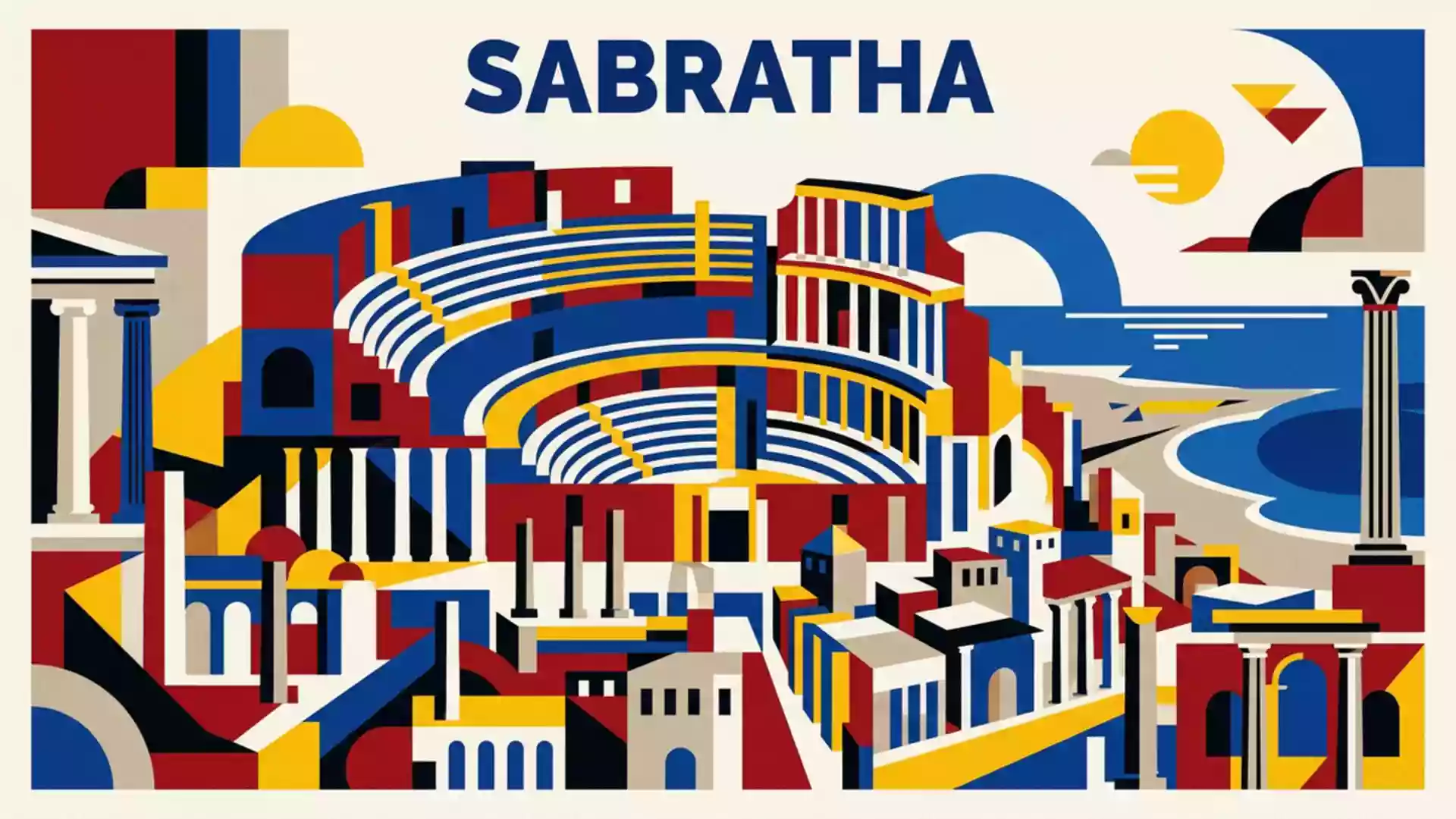
Sabratha’s Roman theatre rising above the Mediterranean ruins
Published on 09/03/2026 at 12:02 | Editorial responsibility: Rafael Müller, Editor-in-Chief AD HOC NEWS
Sabratha on Libya’s north-western Mediterranean coast is an ancient port city where a large Roman theatre dominates a spread of ruins beside the sea. The Archaeological Site of Sabratha is recognised as a World Heritage property and preserves layers of Phoenician trading life and later Roman monumental architecture within a compact coastal landscape.
The Roman theatre at the heart of Sabratha
The Roman theatre stands near the shoreline in the ancient city’s monumental quarter, its stone seating and high stage backdrop forming one of North Africa’s most substantial surviving theatre complexes. The building belongs to the period when Sabratha was a Roman colony in the province of Africa Proconsularis, and its theatre is a defining element of the Archaeological Site of Sabratha recognised on the UNESCO World Heritage List.Archaeological Site of Sabratha The theatre’s construction falls in the late second century AD, with work beginning under Marcus Aurelius and continuing under his son Commodus, before the Severan period added a richly decorated stage arrangement.constructed between 150 and 200 AD
The theatre is laid out with a broad, curving cavea of limestone seating facing an orchestra and a monumental scaenae frons, the architectural backdrop to the stage. Its restored scaenae frons rises in three tiers of columns and niches, giving a strong vertical emphasis that frames the performance area and the sky above.three-storey architectural backdrop The structure spans roughly 90 m (295 ft) across its greatest diameter and could accommodate around 5,000 spectators in antiquity, a scale that places it among the largest theatres in Libya.maximum diameter of 92.60 m Stone stairways and radial passages organise access to the cavea, while doors behind the scaenae frons connect the stage to ancillary rooms.
Mythological reliefs, colonnades and the wider forum
Along the front of the stage runs the pulpitum, whose base carries an elaborate series of marble reliefs. These sculpted panels depict mythological figures, historical scenes and decorative motifs, setting a narrative band along the edge of the performance space.sculptured pulpit decorated with scenes Above and behind the stage, more than one hundred Corinthian columns in limestone and marble stand in ordered ranks on three levels, forming the theatre’s distinctive colonnaded backdrop. This reconstructed colonnade accentuates the building’s vertical rhythm and marks the theatre out among Roman sites for the completeness of its architectural setting.colonnade of the scaenae frons
The theatre sits within Sabratha’s forum zone, where paved streets meet open squares framed by temples and civic buildings. The archaeological plan preserves the typical Roman pattern of main streets aligned as decumanus and cardo, with the theatre occupying a position close to the core of the monumental area east of the forum.forum with temples and theatre east of the monumental area Nearby stand the remains of the Temple of Jupiter and other sanctuaries, Roman baths and a Christian basilica with mosaic pavements, all forming part of the Archaeological Site of Sabratha inscribed as a UNESCO property in 1982.inscribed as a World Heritage Site in 1982
From Phoenician trading post to Roman Tripolis city
Sabratha began as a Phoenician trading post on the Tripolitanian coast, serving as an outlet for goods moving between the Mediterranean and the African interior. Later it fell within the short-lived Numidian kingdom of Massinissa before incorporation into the Roman province of Africa under Julius Caesar, a shift that brought extensive urban development and monumental building.Phoenician trading-post Romanised in the second and third centuries AD Under Roman rule, Sabratha formed the westernmost of the “three cities” that gave Tripolis its name, alongside Oea, the ancestor of modern Tripoli, and Leptis Magna further east.westernmost of the ancient three cities
The archaeological zone lies slightly seaward of the modern town of Sabratha, its ruins extending between the coastal road and the shoreline. From the theatre’s upper seating the visitor looks out over Roman walls, temple platforms and basilica ruins towards the Mediterranean, where the ancient harbour once linked this city to wider maritime networks. The combination of Phoenician foundations, Roman forum and theatre complex, and later Christian buildings makes Sabratha a compact illustration of Mediterranean city life across several centuries.
Visiting Sabratha: what travellers from Western Europe should know
- Sabratha lies on Libya’s Tripolitanian coast west of Tripoli, reached by road from the capital towards the coastal town and archaeological zone.
- The Roman theatre and surrounding ruins stand beside the Mediterranean shore, with uneven stone surfaces, flights of steps and exposed seating terraces that require steady footing.
- The archaeological site spreads between the modern town and the sea, so a visit involves walking across open ground with minimal shade among temples, forums and basilicas.
- The official language is Arabic and the currency is the Libyan dinar.
- Entry requirements depend on your nationality; UK travellers can check the FCDO travel advice at gov.uk/foreign-travel-advice, Irish travellers the Department of Foreign Affairs at ireland.ie.
Searching for Sabratha on social platforms
These links open searches for Sabratha on each platform.
Frequently asked questions about Sabratha
Where is Sabratha and what kind of place is it?
Sabratha is an ancient coastal city in north-western Libya, west of Tripoli, with an archaeological site that preserves Phoenician, Roman and later remains beside the Mediterranean Sea.
What can visitors expect on a visit to Sabratha’s archaeological site?
Visitors encounter a large Roman theatre with a restored colonnaded stage backdrop, surrounded by forums, temples, baths and basilicas laid out between the modern town and the shoreline.
What makes Sabratha distinctive among Mediterranean ancient cities?
Sabratha combines its origin as a Phoenician trading post with its role as a Roman Tripolis city, and its theatre’s three-tier colonnaded backdrop and sculpted reliefs give the site a particularly strong architectural focus.