
Sainte-Chapelle and its walls of coloured light
Published on 09/05/2026 at 22:26 | Editorial responsibility: Rafael Müller, Editor-in-Chief AD HOC NEWS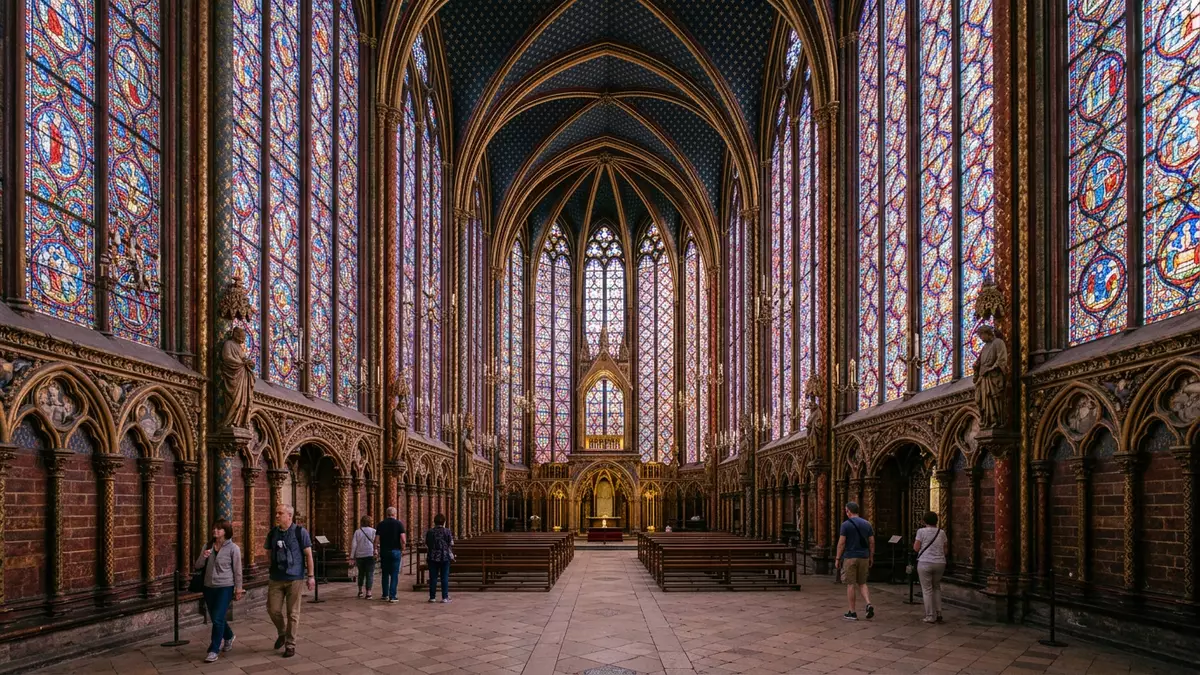
On the Île de la Cité in central Paris, Sainte-Chapelle rises inside the former royal palace as a tall Gothic chapel wrapped almost entirely in stained glass. Built for King Louis IX in the thirteenth century, it concentrates architecture, royal power and Christian devotion into a compact interior where walls give way to coloured light.
A royal chapel turned into a lantern of glass
Sainte-Chapelle stands within the medieval Palais de la Cité, the complex that served as the principal residence of the Capetian kings of France until the fourteenth century.Palais de la Cité The chapel was commissioned by Louis IX, later canonised as Saint Louis, to house relics associated with the Passion of Christ, notably the Crown of Thorns and a fragment of the True Cross.relics of the Passion Construction began in the 1240s and the building was consecrated in 1248, an unusually rapid programme for a chapel of this scale.
The plan follows the model of a palatine chapel with two superposed levels. The lower chapel, closer to street level, was reserved for palace staff and officers, while the upper chapel formed an elevated sanctuary for the king and his circle.two-level chapel Externally the building reads as a tall, narrow volume supported by buttresses and crowned by a slender spire, but the defining experience lies inside, where the upper chapel becomes a single high hall enclosed by stained-glass windows.
Rayonnant Gothic and a hall of vertical windows
Sainte-Chapelle is widely described as one of the clearest expressions of Rayonnant Gothic, a mid-thirteenth-century phase of French Gothic architecture that emphasised slender structure and large glazed surfaces.Rayonnant Gothic architecture In the upper chapel, stone walls retreat behind tall vertical windows separated only by filigree mullions and colonnettes, so that glass fills most of the perimeter. The interior volume is relatively compact in plan yet rises to a considerable height, with the vault resting on bundled shafts that fall between the window bays.
Figures given by architectural surveys state that the chapel measures about 36 m (118 ft) in length, 17 m (56 ft) in width and more than 40 m (131 ft) in overall height.chapel dimensions This narrow, tall proportion reinforces the sense of a single linear hall directed towards the eastern end, where the relics were kept above the altar. The stained glass, arranged in tall lancets and tracery panels, narrates biblical scenes and salvation history in dense detail, turning the walls into an illuminated cycle of images.
From royal reliquary to restored historic monument
The primary function of Sainte-Chapelle in the thirteenth century was to serve as a monumental reliquary for Louis IX’s collection of Passion relics, placing them at the ceremonial heart of the kingdom.monumental reliquary Over the following centuries the surrounding palace complex evolved into a centre of royal and judicial power, but the chapel retained its devotional role and its association with the Capetian monarchy. The building, however, did not escape the upheavals of the French Revolution in 1789; it was secularised, its liturgical furniture was dispersed and for a period it was used as a store, including for grain and later legal archives, with fittings that obscured the glazing.revolutionary use
In the nineteenth century a major restoration campaign transformed Sainte-Chapelle into the building visitors recognise again. From around 1840, architects including Félix Duban, Jean-Baptiste Lassus, Émile Boeswillwald and Eugène Viollet-le-Duc undertook extensive work to repair the structure and reconstruct decorative elements, bringing the colour and ornament of the interior back into focus.nineteenth-century restoration The chapel has been listed as a historic monument in France since the nineteenth century and forms part of the ensemble of the former royal palace, alongside the Conciergerie, that anchors the judicial quarter on the island.
Visiting Sainte-Chapelle: what travellers from Western Europe should know
- Sainte-Chapelle stands on the Île de la Cité in central Paris, within the Palais de la Cité complex at 8–10 boulevard du Palais in the 1st arrondissement; it is reached on foot from nearby bridges and from metro stations serving the island.
- Inside, the lower chapel is accessed from courtyard level and involves a short flight of steps, while the upper chapel is reached by a relatively narrow staircase climbing to a higher level within the same building.
- The chapel forms part of the wider complex of the Palais de la Cité and sits close to the Conciergerie; the River Seine runs beside the island, with views to Notre-Dame Cathedral from nearby quays.
- France’s official language is French and the currency is the euro.
Searching for Sainte-Chapelle on social platforms
These links open searches for Sainte-Chapelle on each platform.
Frequently asked questions about Sainte-Chapelle
Where is Sainte-Chapelle in Paris?
Sainte-Chapelle stands within the former royal Palais de la Cité on the Île de la Cité, at boulevard du Palais in the 1st arrondissement of Paris.
What should visitors expect inside Sainte-Chapelle?
Visitors encounter a two-level Gothic chapel with a stone-vaulted lower space and an upper hall where tall stained-glass windows occupy most of the wall surfaces.
What makes Sainte-Chapelle distinctive among Paris churches?
Its role as a thirteenth-century royal reliquary, its position inside the historic palace complex and its near-continuous ring of Rayonnant Gothic stained glass give Sainte-Chapelle a character distinct from other Parisian churches.


